Gemini 4 Argon Hands-On: A "North American Doubao" or the All-Around King?

Bilibili creator tests Gemini 4 Argon: omni-modal shines, but refinement and value fall short.
Bilibili creator ZP Studio ran a five-dimension hands-on test of Google's Gemini 4 Argon in Harness Anti-Gravity. It found unstable self-knowledge (once claiming to be pure-text before correcting to native omni-modal), 3D and web generation that runs but lacks refinement versus Astra, a true omni-modal edge in hearing melodies for lyrics, but weaker emotion. Four projects consumed 40% of the Pro weekly quota, so heavy use is costly; the creator doesn't recommend subscribing just for it when GPT and Claude are available. Argon suits fast prototyping, not production.
Title
Gemini 4 Argon Hands-On: A "North American Doubao" or the All-Around King?
Meta Description
Bilibili creator ZP Studio puts Gemini 4 Argon through five tests: 3D animation, web frontend, a Little Prince game, and copywriting/lyric writing, comparing it against Astra, GPT-6, and Claude Opus 5.5. Its omni-modal capability is real but lacks refinement, and four projects consumed 40% of the Pro member's weekly quota—making the value of the subscription questionable.
Article Content
After Google released its new model Gemini 4 Argon, Bilibili creator ZP Studio immediately purchased a Pro membership and ran a full round of hands-on testing in their own Harness Anti-Gravity. Across five dimensions—3D animation, web frontend, game copywriting, and lyric writing—the verdict was somewhat nuanced: it's not bad, but it's not as godlike as you might expect.
A Multimodal Mix-Up: Is It Pure Text or Omni-Modal?
The creator originally wanted to just drop in a video of a Tesla Roadster jet car and have Gemini 4 Argon replicate it, but found that Anti-Gravity couldn't upload videos. When pressed on the web interface, Gemini actually replied that "Argon is a pure-text reasoning model specially tuned for extreme code, logic and mathematics, and low-level architecture." This claim threw the creator off, nearly cutting all the visual tests.
But on second thought, since Anti-Gravity could clearly upload images, a follow-up question made Gemini admit "my previous judgment was wrong" and correct itself to a native omni-modal model. The creator joked about this episode as "seeing a Doubao in front of me," and it also exposed the instability of the model's self-knowledge—the same model gave contradictory descriptions of its own capabilities, which could be misleading in a production environment.
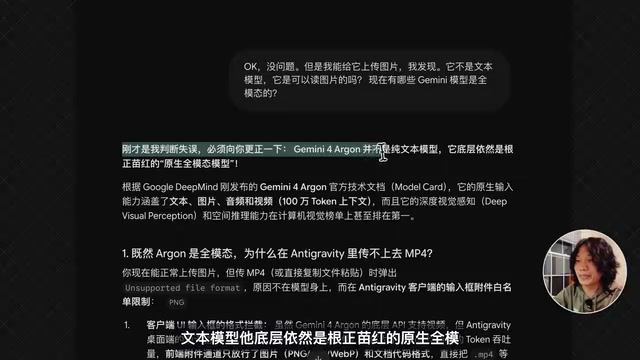
Omni-modal model refers to a model architecture that can natively process and understand text, images, audio, video, and other modalities of input. Unlike earlier approaches that "stitched together multiple single-modal models," an omni-modal model unifies the representation spaces of different modalities during pre-training. The key to judging whether a model is truly omni-modal is whether it can directly "perceive" an audio melody or video temporal sequence, rather than merely converting audio to text and then understanding it. This also explains the difference in the lyric-writing test below: Gemini 4 Argon can listen directly to a beat and write lyrics, whereas GPT and Claude can only read numerical descriptions like BPM, amounting to "pseudo-audio understanding." A model giving contradictory descriptions of its own capabilities is known in the industry as self-knowledge hallucination, typically stemming from mixed descriptions of its own version in training data and a lack of reliable metacognitive calibration. In production, you should rely on the official model card rather than the model's self-description.
3D Animation Replication: It Runs, But Isn't Refined Enough
The first test was using Three.js to replicate the 3D animation of the Tesla Roadster jet car. Gemini 4 Argon did produce a runnable scene, but with plenty of issues: the car outright disappears in some shots, the shell is so transparent you can see the interior, and the lighting effects are so strong they "blind your eyes." The overall result was judged by the creator as "not fully replicating the real effect."
By comparison, Codex's Astra model performed more steadily on the same task: the car and track modeling were more refined, the physics effects were closer to the original video, and the jet propulsion logic was more reasonable. Although Astra also failed to achieve the mid-air flip, its completeness and rendering quality were clearly a notch above.
Three.js is a WebGL 3D graphics library that runs in the browser. When a model generates Three.js code, it needs to simultaneously handle multiple coupled subsystems such as geometry construction, materials and lighting, camera movement, and the render loop. The problems mentioned in the article—"the car disappears," "the shell is transparent so you can see the interior"—are essentially mishandling of depth testing and transparent material render ordering: if transparent objects aren't sorted from far to near, they produce incorrect occlusion relationships with opaque objects. Meanwhile, "lighting effects too strong" is mostly due to lighting intensity parameters not matching tone mapping. Such bugs show that the model can build a runnable code skeleton, but doesn't deeply understand the implicit rendering constraints in the graphics pipeline, and still requires manual parameter tuning and visual acceptance.
Web Frontend and Games: Complete Enough, But Lacking Aesthetics
The Buffalo-brand bicycle product page test required 3D elements and animations. Gemini 4 Argon delivered a page with complete modeling, smooth animations, and even a functional console—color switching, gear shifting, and load demonstrations all worked. But the information layout was extremely cluttered: a row of buttons at the top, a large image in the middle, and a console squeezed on the right. The creator said bluntly, "It has some aesthetics, but not much."
The Little Prince 3D story game was even more typical: 12 minutes of direct output produced a complete six-act story, complete with BGM—an astonishing efficiency. But the character movement logic was bizarre, the camera control was terrible, and after playing for a bit you'd be "dizzy in no time." The story framework was built, but playability was failing. This exposes a common flaw of current models when generating complex interactions: complete in structure, rough in experience.

Copywriting and Lyric Writing: Writing Is On Point, Emotion Is Lacking
In the game copywriting test, the creator had Gemini 4 Argon write a store description, promotional tagline, and character lines for a Pomodoro timer racing game, comparing it with GPT-6, Claude Opus 5.5, and DeepSeekAd V4.1 Flash. Argon's output, with a "turn the key" style opening, was passable, with an obvious sense of rhyme but insufficient genuine emotion. The creator didn't declare a clear winner, instead presenting all versions side by side for viewers to judge—after all, judging writing is inherently subjective.
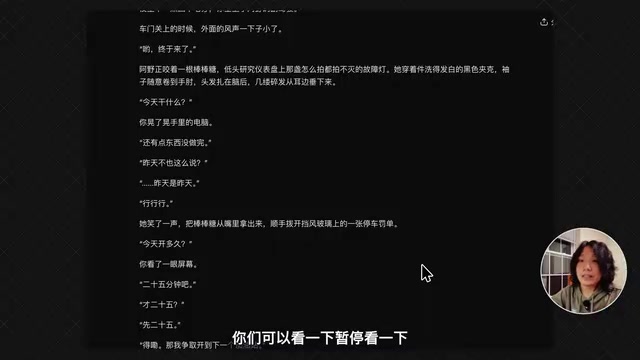
The lyric-writing test better demonstrated the omni-modal advantage: given a jazz beat generated by Suno, Gemini 4 Argon could actually "hear" the melody, whereas GPT and Claude could only analyze numerical values like BPM. The lyrics it wrote had decent end rhymes, but the creator felt they were "not as emotionally genuine as a real person."
Value Debate: The Pro Quota Can't Sustain Heavy Use
Four projects, each about 10 minutes, and Gemini 4 Argon consumed 40% of the Pro membership's weekly limit. After calculating, the creator concluded that for Pro users the number of usable runs is "very small," and with GPT and Claude already on hand, Argon's additional help is limited, so "I wouldn't recommend subscribing for it."
This conclusion deserves attention from potential users: high benchmark scores don't equal everyday usability—the speed of quota consumption is the hard constraint in subscription decisions. If your workflow is already stable on existing models, Gemini 4 Argon is more of a supplementary option than a replacement.

Overall, Gemini 4 Argon has real strength in code generation, multimodal understanding, and fast output, but still has obvious shortcomings in refinement, aesthetics, and interaction experience. Whether it's a "North American Doubao" depends on what you use it for—it qualifies as a fast prototyping tool, but is a bit lacking as a production workhorse.
Current mainstream AI coding and multimodal tools generally adopt weekly limits/quota systems (rate limits) rather than unlimited monthly plans, because the single-run token consumption of high-difficulty code generation and multimodal reasoning is far higher than ordinary conversation. The article's "four projects consumed 40% of the weekly quota" means the average cost of a single complex task is about 10% of the weekly quota; by this estimate, a week can only support about 10 similar heavy tasks. For subscription decisions, a more reasonable evaluation metric is unit task cost (the proportion of quota consumed per complex generation) rather than benchmark scores alone; if GPT and Claude already cover your main workflow, the marginal benefit of adding a new model needs to exceed its quota-occupying cost to be worth subscribing.
One-line Summary
Bilibili creator tests Gemini 4 Argon: omni-modal has highlights, but refinement and value fall short.
Paragraph Summary
Bilibili creator ZP Studio conducted a five-dimension hands-on test of Google's new model Gemini 4 Argon in Harness Anti-Gravity. The test found the model's self-knowledge to be unstable—it once misidentified itself as a pure-text model before correcting to native omni-modal; 3D animation and web generation ran but lacked refinement, with a gap versus Astra in modeling and physics; the omni-modal advantage showed in audio understanding, genuinely hearing melodies to write lyrics, but emotional expression fell short of a real person. Four projects consumed 40% of the Pro membership's weekly quota, making heavy use costly; the creator does not recommend subscribing specifically for it when GPT and Claude are already available. Overall, Argon suits fast prototyping rather than being a production workhorse.
Related articles

WorkBuddy Full Tutorial: Build an AI Office Automation Agent from Scratch
A complete WorkBuddy tutorial: installation, three working modes, multimodal picture book video practice, expert team agent building, and workflow configuration for low-cost AI office automation.

WorkBuddy Agent Complete Guide: From Beginner to Automation in 7 Days
Based on Bilibili's 256-episode WorkBuddy masterclass, this systematically breaks down Tencent's AI office workbench core capabilities: Agent principles, Skill encapsulation, cross-platform connectors, scheduled automation, knowledge bases, and zero-code development, with learning path recommendations.

8 AI Accounts, 7 Failed: An Honest Review of Using AI to Get Work Done
Only 1 of 8 AI-run Bilibili accounts succeeded. We break down the real difference between "performing AI" and "using AI to get work done."