Gemini 4 Argon Launch: Google Reclaims Top-Tier AI Status with Multi-Benchmark Wins

Gemini 4 Argon outscores GPT-6 Astra and Claude Opus 5.5 on three key benchmarks, but all three still lead in different areas.
Google's Gemini 4 Argon leads both major rivals across three key benchmarks: 51.3% on the Automation Bench office workflow test (nearly 10 points ahead), 91.7% on LVBench long-video understanding, and 77.9% on the Deep SWE long-horizon coding test — backed by a real case achieving 2.7× the speed of a Rust implementation. All three tests simulate real-world scenarios rather than isolated Q&A. That said, GPT-6 Astra still leads on Frontier SWE and Claude Opus 5.5 excels at terminal tasks, making this a task-level, multi-front competition rather than a clear sweep.
Google's newly released Gemini 4 Argon has outperformed both GPT-6 Astra and Claude Opus 5.5 across several key benchmarks. According to an analysis by Bilibili creator Zhu Jiale, this generation of model gives us good reason to put all three top AI systems back on the same table for comparison — not in vague terms, but grounded in specific tasks, concrete scores, and real engineering cases.
Office Workflows: Connecting the Dots Across Scattered Information
The capability most relevant to everyday work shows up in Google's Automation Bench office workflow test. Gemini 4 Argon scored 51.3%, compared to GPT-6 Astra's 41.4% and Claude Opus 5.5's 42.5%. Google outpaced both competitors on this metric by nearly 10 percentage points.
What does this test actually measure? Think of it as placing an AI inside a simulated company and checking whether it can retrieve information across different software tools, update records, and actually get things done. For example: a client sends a new purchase request, the old quote lives in a spreadsheet, and the updated discount terms are buried in another document — the AI needs to identify the right client, cross-check the terms, update the data, and notify the relevant person. Writing "here's what I suggest you do" doesn't count as completing the task; the information has to be correct, and the actions have to be carried out.

For everyday users, the relevance is clear: when we ask AI to handle a batch of client records, organize quotes, or move a project forward, what we actually need is exactly this — the ability to pull together information spread across different places and keep work moving.
Long-Video Understanding: Catching the Details Hidden in the Frame
Another area where Google performed strongly is long-video understanding. On the LVBench test, Gemini 4 Argon scored 91.7%, versus GPT-6 Astra's 87.5% and Claude Opus 5.5's 83.7%.
Imagine receiving a lengthy product training video and needing to find out how a specific feature is configured or where its limitations lie. The answer might be hidden in a few seconds of on-screen action, inside a chart, or in a line of small text. Relying only on subtitles won't always surface those details. If an AI can understand what's happening visually and connect information across different moments in the video, it can save significant time when reviewing courses, researching products, or sourcing footage — no more repeatedly scrubbing through the timeline. For content creators specifically, this capability matters because it can pinpoint genuinely useful clips and accurately describe what's actually happening on screen.
Long-Horizon Coding: From Prototypes to Real Software
GPT and Claude have consistently been formidable at coding, but this time Google also wins a round on the Deep SWE long-horizon software engineering test. Gemini 4 Argon scored 77.9%, ahead of GPT-6 Astra's 74.9% and Claude Opus 5.5's 74.2%.
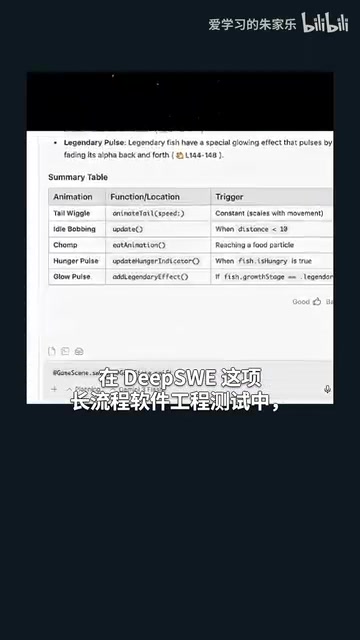
Even more compelling is the real engineering case Google presented: in a video decoding software optimization task, Argon ran tests repeatedly, analyzed results, and revised the code — ultimately achieving 2.7× the runtime speed of the previous Rust implementation while keeping video output consistent.
This example is worth pausing on. Building a demo webpage from scratch and inheriting an existing codebase are entirely different challenges. The latter requires reading and understanding existing code, identifying performance bottlenecks, and making changes without breaking the output. As this capability continues to improve, it means AI's role will shift from "help me build a quick prototype" to "maintain and improve software that's actually running in production."
Deep SWE (Deep Software Engineering) differs fundamentally from common coding benchmarks. Traditional coding tests typically ask AI to write a function based on a description or solve an algorithm problem. Deep SWE simulates a real software engineering environment: the AI must understand an existing codebase's architecture, locate issues, iterate on fixes, and verify correctness through automated tests. This more closely mirrors the day-to-day work of actual developers — inheriting someone else's code and making changes without breaking existing functionality. The mention of "2.7× the speed of the Rust version" in the video decoding case is particularly notable. Rust is known for memory safety and high performance, and is a mainstream choice for systems-level programming. Surpassing its performance while keeping output consistent means AI optimization capabilities have entered the competitive range of systems-level software — not just scripts or application-layer code.
No Runaway Winner: Each of the Three Has Its Strengths
This competition hasn't become Google's solo performance. In the same official benchmark table, GPT-6 Astra leads on the Frontier SWE software engineering test, and Claude Opus 5.5 is stronger on terminal operation tasks.
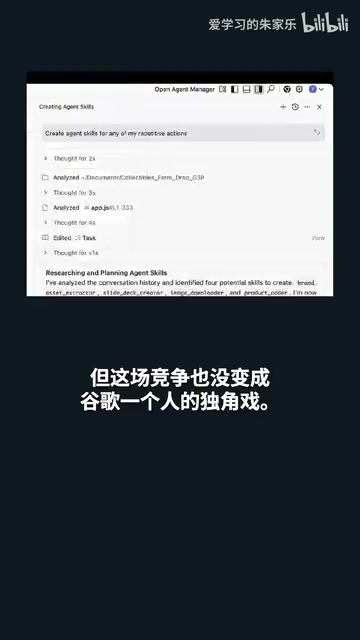
This dynamic actually makes the competition more interesting: Google takes the lead on office workflows, long-video understanding, and long-horizon coding; switch to other engineering tasks, and GPT and Claude reclaim their own advantages. In other words, the habit of "routing everything to the same AI" may need to change — for handling complex documents and analyzing long videos, Gemini has once again become a serious option worth considering.
Although both Frontier SWE and Deep SWE evaluate software engineering ability, they emphasize different things. Frontier SWE focuses more on a model's boundary capabilities with open-ended, frontier engineering problems — typically involving higher-complexity code reasoning and system design. Deep SWE, as described above, emphasizes long-horizon iteration within a real codebase. The divergence across these two subtests suggests that no single model currently dominates across the broad field of "software engineering." Choosing which AI to use for coding assistance still requires judging by the specific task type — not simply deferring to a single leaderboard ranking.
Rollout Pace and the Real Test Ahead
Currently, Argon is being opened first to invited cybersecurity partners, with access gradually expanding to developers, enterprises, and general users afterward.

The real test comes once users get hands-on time: who finds the key detail in the same product recording, who can make sense of the same batch of client data, who can improve the same software project without breaking what already works. What Google is trying to win back this time is the status of "first choice" for these concrete, real-world tasks. The last time the industry talked about Google, it was about a potential comeback. This time, Google has already put the scorecard on the table — and if GPT and Claude want to hold on to their users, they'll need to take this competitor seriously.
Related articles

Amphibious Transforming Drone: Beyond 100x Power Savings, What Are the Real Needs?
Is the amphibious transforming drone just a gimmick? Starting from the 100x power difference of the M4 Morphobot, explore real application scenarios and thesis topic ideas, analyzing boundary conditions where pure drones and pure ground robots both fail.

Warhound Raises $200 Million: Genetically Engineered "War Dogs" Paired with Anduril Gear
Warhound raises $200M, backed by Ben Lamm and Palmer Luckey, to genetically engineer dogs for military and law enforcement use and equip them with Anduril gear. This article analyzes its technology direction, funding logic, and ethical controversy.

Claude API Comes to Google Cloud: IAM Integration and SDK Access Guide
Anthropic hosts the full Claude API on Google Cloud with IAM-controlled permissions and unified billing. This guide covers the Vertex AI and Anthropic-hosted entry points, IAM role configuration, and SDK access.