Gemini 4 Argon Launches Globally: Key Highlights from the AI Daily Brief

Google opens Gemini 4 Argon globally and demonstrates robot control, with dense updates across open-source models and Agent infrastructure.
Over the past 24 hours, the AI industry has been busy: Google globally opened Gemini 4 Argon, available via Pro/Ultra subscriptions and the paid API, and demonstrated its ability to generate a simulation from a video of a human throwing and drive a robot to land 7 throws in a row, signaling that multimodal models are extending toward guiding physical actions. On the open-source side, Fish Audio, Liquid AI, and OpenCode released TTS, on-device multi-step task, and Agent coding models, while llama.cpp launched a Windows graphical app to lower the barrier to local deployment. On infrastructure, Arena launched an Agent model router, Anthropic moved its codebase away from Git due to heavy Coder code writing, and Exa's annualized revenue surpassed $100 million. Artificial Analysis disclosed that the task cost of the same GLM5.3 across vendors differs by about 9 times, with cache hit rate as a key variable. On safety, ByteDance SEED established a safety and alignment department, and the UK AISI open-sourced the Agent evaluation tool Transact. On hardware and commercialization, MiniMax, Tongyi, OPPO, and others all made deployment moves, while Nvidia's share of China's AI chip market fell to just over 30%.
Google has officially opened the Gemini 4 Argon model to the world, which is undoubtedly the biggest news in the AI world today. Meanwhile, from open-source models to Agent infrastructure, from hardware deployment to safety governance, the developments of the past 24 hours sketch out a rather dense industry picture.
Gemini 4 Argon: From Subscription Tiers to Robot Control
According to a report by the Bilibili AI Daily Brief program, Google has opened Gemini 4 Argon globally. Google AI Pro subscribers can use it in the Gemini App and AI Mode in Search, while Ultra subscribers get higher quotas and can also invoke it in Anti-Gravity and AI Studio. Developers can access it through the paid API.
More noteworthy is the robotics application Google demonstrated: covering robot control, simulation environment reconstruction, physical understanding, and self-improvement. In one test, Argon watched a video of a human throwing a sandbag, generated a training simulation, and after transferring to a physical humanoid robot, it landed 7 throws in a row. This case shows that multimodal models are moving from "understanding" to "being able to guide physical actions."
Google also opened free applications for the highest usage tier of Anti-Gravity: scientists and researchers can get 6 months of free access, and cybersecurity defenders can apply through the Fairwind Program.
Sim-to-Real transfer is a core challenge in robot learning: policies trained in simulation often fail when transferred to physical robots due to differences in friction, sensor noise, latency, and so on. In the Argon case, "watching a video to generate a training simulation" amounts to reconstructing the physical environment and motion priors from human demonstrations, then narrowing the sim-to-real gap through methods such as domain randomization. Landing 7 sandbag throws in a row shows that the model not only recognized the motion but also generated executable trajectories and grasping timing. The significance of this path lies in lowering the cost of collecting robot training data—no longer requiring large amounts of real-robot demonstrations, but instead using multimodal models to extract physical common sense from videos and generate simulation assets.
A Flurry of Open-Source Model Releases: TTS, On-Device, and Agent Coding
The open-source side is quite lively today. Fish Audio released the open-weight text-to-speech model Drama3, which supports guiding vocal performance with natural language, switching tone within a single sentence, and controlling the expression of individual words. It is already available on the web, mobile app, and API, and users can also download the weights to run it themselves. Liquid AI released the open-weight model LFM2.5 24BA2B, which supports invoking tools on laptops and PCs to complete multi-step tasks. OpenCode made its anonymous coding model CatJam freely available, promising zero data retention; the company says it is built specifically for Agent coding and runs very fast.
llama.cpp launched a Windows app that lets users download and run models locally without the command line. It targets Windows 11 and supports fetching models from Hugging Face.
Open Weights and Open Source are two concepts that are often conflated. Open weights means the model parameters can be downloaded and run locally, but the training data, training code, and license may not be public, and the scope of use is constrained by license terms. For enterprises and researchers, the practical value of open weights lies in keeping data local, being able to fine-tune, being able to deploy offline, and avoiding the marginal cost of per-token billing. Fish Audio's Drama3, Liquid AI's LFM2.5, and OpenCode's CatJam all fall into this category. It is worth noting that licenses for open-weight models vary widely—commercial restrictions, attribution requirements, and redistribution terms all differ—so they should be checked item by item before deployment.
Agent Infrastructure: From Model Routing to Version Control
Arena launched the Agent version of its Max model router, which dynamically selects models based on task type, complexity, and cost; it claims to reach frontier-model performance in tests while reducing costs. Command Code added a limited-time DeepSeekAd V4.1 Flash quota to its Goat subscription plan, offering $100 of usage credit during a three-day promotional period, after which it adjusts to $80.
Anthropic published an article introducing Scien, a version control system it built in-house over 5 months, and described fully migrating a monorepo away from Git. The article points out that as Coders write large amounts of code, infrastructure originally designed for human developers has become a bottleneck. This signal is worth noting: when the entity writing code becomes an Agent, the assumptions of the toolchain need to be rewritten.
Exa announced that its annualized revenue has surpassed $100 million. It provides search services for AI Agents, handling 2 billion requests per month, and predicts that by 2030 Agent search volume will reach 1000 times that of humans.
Model Routing refers to a scheduling layer that, before a request reaches a specific model, dynamically selects the most suitable model endpoint based on task type, complexity, latency requirements, and cost budget. Its core assumption is that different tasks have very different capability requirements: simple classification or summarization does not need the most expensive flagship model, while complex reasoning should be routed to frontier models. The routing layer usually also makes real-time decisions based on cache hits, context length, and vendor pricing. Arena's Agent version of the Max router is exactly the productization of this idea, and its claimed "frontier-model performance while reducing costs" depends on accurate prediction of task characteristics and price arbitrage between vendors. For enterprises, the routing layer also brings new observability requirements—each routing decision and its effect need to be logged; otherwise it is difficult to locate the source of quality regressions.
Cost Transparency and Safety Governance
Artificial Analysis published the cache hit rates of model endpoints as well as per-task cost data for open-weight models broken down by vendor. The data shows that the task cost of the same GLM5.3 model differs by about 9 times across vendors, with the gap related to cache hit rates and token pricing. This is a very valuable reference for enterprise model selection.
On the safety side, the UK AI Safety Institute (AISI) released an open-source tool called Transact that turns complex Agent evaluation records into interactive timelines.
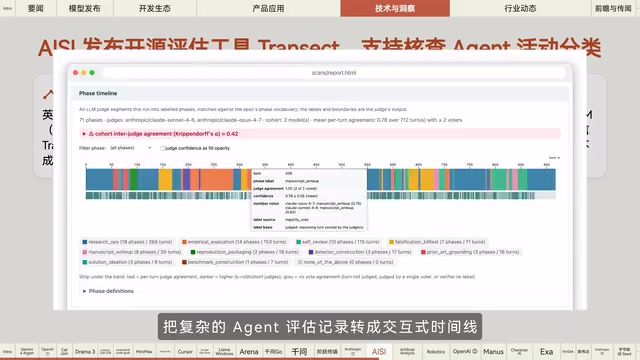
Reviewers can view the Agent's activities, resource usage, and collaboration process along the timeline, then go back to the original records to verify, rather than only looking at the final score. ByteDance's SEED team announced via internal email the establishment of a dedicated safety and alignment department to improve the safety capabilities of models and Agents and guard against frontier risks in chemical, biological, radiological, and nuclear domains. The U.S. Department of Justice reported that an OpenAI engineer was arrested on suspicion of hiding a recording device in an executive meeting room; OpenAI has fired the employee and said there is no indication that model weights, source code, or customer data were improperly accessed.
Cache Hit Rate measures the degree to which a model endpoint reuses repeated or similar prefixes. Mainstream inference services generally use prefix caching: if the beginning of two requests (such as system prompts, long documents, or tool definitions) is exactly the same, the second request can skip that part of the computation and be billed at the lower cache price. Therefore, vendors with high cache hit rates have a clear cost advantage in long-context, multi-turn Agent scenarios. The roughly 9x difference in task cost for the same GLM5.3 model across vendors disclosed by Artificial Analysis largely stems from differences in each vendor's caching strategy, token pricing, and batching efficiency. If enterprises only look at the listed price per million tokens when selecting a model, they can easily overlook the actual task cost; they should evaluate it in light of the prefix reuse characteristics of their own requests.
Hardware and Commercialization
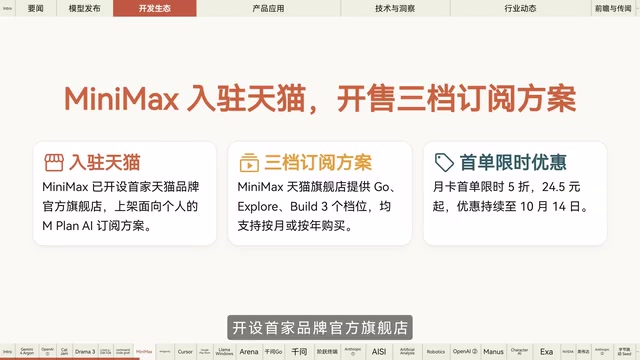
MiniMax opened its first official brand flagship store on Tmall, listing the Unplanned subscription plan for individuals. It offers three tiers, can be purchased monthly or annually, with an opening promotion running until October 14; the monthly card first order is limited to 5 weeks.
Alibaba's Tongyi launched "Tongyi Gou," a personal Agent embedded in the Tongyi app that helps users handle personal affairs. It is currently in limited-time internal testing, with priority for professional members. On the device-maker side, the smart-agent phone Steps Neo Pioneer Edition was launched, along with operating system development tools and model services; buyers can get 10 billion tokens per month for 12 consecutive months.
Minus and OPPO announced a partnership to integrate Agent capabilities into ColorOS 17, debuting with the overseas version of the FindX10 series. Users can use the new AI MindPilot mode to let AI organize information across apps.
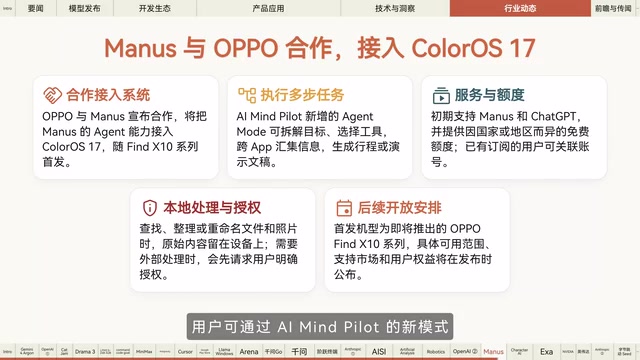
The official announcement has not yet clarified the market scope in which the related features are supported.
On the market landscape, according to an IDC report cited by Reuters, Nvidia's share of China's data center AI chip market fell to just over 30%, while Huawei's share rose to nearly 30%. Character.AI has filed for bankruptcy protection and will sell its assets under court supervision; court documents show that its compute spending in the first 8 months of this year reached $56.1 million, and as of August it was still losing about $8 million to $9 million per month.
Summary
Today's developments contain three intersecting signals: model capabilities extending into the physical world (the Argon robot), Agent coding forcing a reconstruction of infrastructure (Anthropic moving away from Git), and cost transparency becoming a must-have for model selection (the 9x price gap). Progress in open-weight models on TTS and on-device multi-step tasks is also further lowering the barrier to localized deployment.
One-line Summary
Google opens Gemini 4 Argon globally and demonstrates robot control, while open-source models and Agent infrastructure see a flurry of updates.
Paragraph Summary
AI industry developments over the past 24 hours have been dense: Google globally opened Gemini 4 Argon, available via Pro/Ultra subscriptions and the paid API, and demonstrated its ability to watch a video of a human throwing, generate a simulation, and drive a robot to land 7 throws in a row—a sign that multimodal models are extending toward guiding physical actions. On the open-source side, Fish Audio, Liquid AI, and OpenCode released TTS, on-device multi-step task, and Agent coding models respectively, while llama.cpp launched a Windows graphical app to lower the barrier to local deployment. On infrastructure, Arena launched an Agent model router, Anthropic moved its codebase away from Git because Coders write so much code, and Exa's annualized revenue surpassed $100 million. Artificial Analysis disclosed that the task cost of the same GLM5.3 across vendors differs by about 9 times, with cache hit rate as a key variable. On safety, ByteDance SEED established a safety and alignment department, and the UK AISI open-sourced the Agent evaluation tool Transact. On hardware and commercialization, MiniMax, Tongyi, OPPO, and others all made deployment moves, while Nvidia's share of China's AI chip market fell to just over 30%.
Related articles

When Did Paid Childcare Become the Norm? Working Mothers and the Evolution of Childcare
When did paid childcare become the norm? This article traces the evolution from the rise of childcare centers in the 1970s–80s and the 1990s linking of federal subsidies to work requirements, to declining stigma and rising costs, and explores advocates' 25-year effort to catch up with other countries on childcare and paid parental leave.

Red Flags for Product-Market Fit: A Practical Guide from Top VCs and the Superhuman Founder
Investors from Iconiq and Sapphire Ventures and Superhuman founder Rahul Vohra share PMF red flags and practical methods, including the 40% disappointment rule, retention curves, and acquisition costs.

What Task Should AI Agents Take Over Most? Heated Reddit Discussion
Reddit discussion: Which task do you most want AI agents to take over completely? Cross-app data migration, CRM updates, and report generation top the list, but insufficient reliability and the trust gap are the biggest obstacles to automation adoption.