Gemini 4 Argon Tops Text Arena, Anthropic Claims AI Solves Decades-Old Math Problem

Gemini 4 Argon tops leaderboards while Anthropic claims AI cracked a decades-old math conjecture.
This AI roundup covers four parallel threads: model releases, product updates, a mathematical breakthrough, and safety governance. Google's Gemini 4 Argon scored 77.9% on DeepStore, topping Text Arena at ~$0.62 per task. Anthropic claims its AI completed a full proof of a Fields Medal-caliber percolation theory conjecture open for decades. On the product side, Runway Ads, ComfyAPI, and Cloudflare AutoRouter landed in quick succession, while open-sourced WebGPU kernels lower the bar for browser-side AI. Meanwhile, the FTC launched investigations into OpenAI, Anthropic, and METR, and concerns grew over advanced cyberattack capabilities spreading into the open-source ecosystem.
Model Releases & Benchmarks: Gemini 4 Argon Makes a Splash
Google has released Gemini 4 Argon, a new model targeting complex tasks in specialized domains such as software engineering, law, finance, and cybersecurity. In DeepStore testing, the model scored 77.9%, surpassing GPT-6 Astra, and will be made available first to paid API customers and Google AI Ultra subscribers.
Third-party evaluations paint an equally impressive picture: Artificial Analysis data shows Gemini 4 Argon's intelligence index score of 53 ties with the top tier of GPT-6 Astra and edges out the top tier of GPT-6.1 Solo by one point. More notably, the High variant topped the Text Arena leaderboard and ranked eighth in Agent Arena, achieving a net Elo gain of 7.92% — all at roughly $0.62 per task. That balance of performance and cost is precisely where the large model competition is playing out right now.
Benchmark methodology itself is also evolving. Meta AI introduced Auto Benchmark, which lets research agents automatically generate evaluation benchmarks and then uses those benchmarks to test the models themselves. Testing found that agent-generated hard problems remain challenging for newer models, and that targeted human intervention can improve outcomes when automated research stalls. Meanwhile, Tencent, Fudan University, and Tsinghua University jointly released Exploration Bench, an evaluation tool for exploratory reasoning. It constructs an "alien world" with rules that contradict common sense but are internally verifiable, requiring AI to revise hypotheses across four rounds of experiments — testing its ability to learn from unknown rules.

One monitoring result worth flagging: a daily tracking project found that DeepSeekAd Reasoner's thinking token usage on identical problems rose to roughly 10–12 times its previous level starting September 10. This doesn't necessarily indicate degraded capability, but it could significantly increase response latency and usage costs. The other 33 models under monitoring have not shown similar silent capability shifts.
A Wave of AI Product Updates: From Ad Engines to Browser-Side Inference
Product announcements have been equally dense. Runway launched Runway Ads, an automated ad engine that generates video and image ads and deploys them directly across multiple platforms. Runway reported a 41% reduction in cost-per-subscription-acquisition in internal trials; the product is currently available to select enterprise customers only. X (formerly Twitter) announced it will soon allow users to add Grok to XChat group chats for answering questions, summarizing conversations, and more — though X and SpaceX AI will have access to all messages in groups where Grok is added, with message access permissions clearly labeled. This is worth noting from a privacy standpoint.
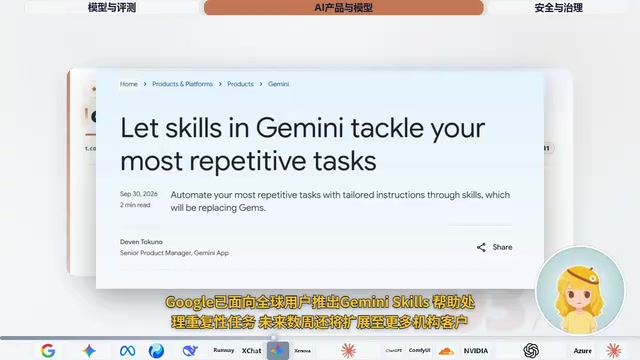
Google has rolled out Gemini Skills globally to help users handle repetitive tasks, with plans to expand to more enterprise customers in the coming weeks. Reports also indicate that Gemini Gems is scheduled to be discontinued on November 17 and replaced by Skills, signaling Google's move to consolidate its agentic feature entry points. On the open-source side, Zenova open-sourced over 200 WebGPU kernels covering common machine learning operators on Hugging Face, enabling AI models to run locally in the browser without a server — a development that could significantly lower deployment barriers.
The developer toolchain continues to mature. ComfyUI officially launched ComfyAPI: developers can submit a workflow file and deploy it as an auto-scaling inference endpoint with a single click, with the system automatically bundling custom nodes, models, and dependencies to take workflows from prototype to production. Cloudflare launched a public beta of AutoRouter in AI Gateway, which automatically selects the most appropriate model for each request without requiring users to choose manually — the company claims this can cut token costs by roughly 30%. NVIDIA released VSS Blueprint 3.3, a video search and summarization tool with accompanying tutorials; following the tutorial with a single prompt, developers can reportedly stand up a production-grade visual AI agent in about half an hour, reducing the need for complex coding.

ChatGPT's profile page now includes sections for popular plugins and websites, where users can choose which sites to display and set them to public visibility — and the feature is available to non-Pro users as well.
WebGPU is a next-generation web graphics and compute API standard developed by the W3C. It allows web pages to directly invoke the user device's GPU for general-purpose parallel computation, without relying on native applications or servers. Compared to the earlier WebGL, WebGPU provides lower-level compute shader capabilities, making it possible to run neural network inference inside a browser. The 200+ ML operator kernels open-sourced by Zenova cover core computational primitives for model inference — including convolution, matrix multiplication, and activation functions — meaning developers can fully deploy quantized, mid-to-small-sized models on the client side. Data never leaves the user's device, and server compute costs are eliminated entirely, making this particularly valuable for privacy-sensitive or low-latency use cases.
Anthropic: AI Completes Proof of Decades-Old Percolation Theory Conjecture
The most significant announcement this period comes from Anthropic, which claims its AI has produced a complete proof of a key conjecture in percolation theory that has remained open for decades. Percolation theory studies the conditions under which random networks form large-scale connected structures — a problem previously considered to be of Fields Medal caliber.

If verified by peer review, this would mark a meaningful shift in AI's role in frontier mathematics research — from "assistive tool" to "independent prover." That said, claims of this magnitude require rigorous scrutiny from the mathematics community, and readers should maintain cautious optimism.
Percolation Theory is a field at the intersection of probability theory and statistical physics. Its central question is: in a random grid or network where nodes or edges exist with some probability, does a connected component spanning the entire system (a "percolation" event) emerge? Classic examples include liquid seeping through porous media, wildfire spread, and disease transmission through networks. The theory features a "critical threshold": below it, the system consists of isolated fragments; above it, a large-scale connected structure suddenly appears. This phase transition behavior is extremely difficult to characterize mathematically with precision.
The Fields Medal is one of mathematics' highest honors, awarded every four years to mathematicians under 40 who have made breakthrough contributions. Several core conjectures in percolation theory have long been regarded as challenges equivalent to Fields Medal-level work, given their extreme proof difficulty. If Anthropic's claim is confirmed through peer review, it would be the first time an AI is recognized as the independent prover of a mathematical theorem — rather than a supporting tool — with implications far beyond a mere demonstration of problem-solving capability.
AI Safety & Governance: Tightening Regulation, Expanding Attack Capabilities
Signals on the governance front are growing tenser. The U.S. Federal Trade Commission reportedly plans to investigate OpenAI, Anthropic, and safety evaluation firm METR, focusing on whether out-of-control AI agents could harm consumers. The commission is expected to issue legally binding information requests within the coming weeks and require senior executives to testify under oath, with the review extending to risk assessment processes.
The security cat-and-mouse game is also intensifying. OpenAI says it intercepted a large-scale operation attempting to extract hidden reasoning content from its models, and identified individuals with ties to Moonshot AI (月之暗面) as participants. The operation began July 1 and involved more than 4,000 users and approximately 16,000 attempts over two days; OpenAI has banned the relevant accounts and strengthened defenses. Anthropic also reported observing similar behavior. Security researchers further revealed that while the official APIs of OpenAI and Anthropic have patched output-replay extraction vulnerabilities, an audit on September 13 found that the same OpenAI models accessed via Azure remained exploitable, and Anthropic Opus 4.8 carried similar risks.
A deeper concern involves the open-source ecosystem. Anthropic reported on September 30 that an open-source model, GLM5.3, exhibited exploit capabilities approaching those of Cloud Mythos Preview, with safety restrictions that can be easily bypassed. The report argues that advanced cyberattack capabilities are spreading into the open-source ecosystem. The research methodology and motivations behind the report have drawn some scrutiny, and this debate over the security boundaries of open-source models is unlikely to be resolved soon.
The so-called "hidden reasoning extraction" attack targets the intermediate reasoning steps that chain-of-thought (CoT) models generate before producing a final answer. Some models hide these internal thinking processes from users, but attackers can use large numbers of carefully crafted prompts to induce the model to leak or replay the masked reasoning in its output — effectively stealing the model's "thought process" and any sensitive information it may contain. OpenAI and Anthropic patched these vulnerabilities at the official API layer, but when the same models are accessed through third-party cloud services like Azure, those protections were not applied consistently — exposing a systemic security consistency problem inherent to "same model, multi-channel deployment" architectures.
Summary
From Gemini 4 Argon's performance-cost balance, to Anthropic's claimed mathematical breakthrough, to the parallel escalation of regulatory scrutiny and security attacks — this has been an exceptionally information-dense period. The model race is no longer just a benchmark competition; evaluation methodology, deployment accessibility, and security governance are together forming a more complete picture of the industry.
Related articles

Amphibious Transforming Drone: Beyond 100x Power Savings, What Are the Real Needs?
Is the amphibious transforming drone just a gimmick? Starting from the 100x power difference of the M4 Morphobot, explore real application scenarios and thesis topic ideas, analyzing boundary conditions where pure drones and pure ground robots both fail.

Warhound Raises $200 Million: Genetically Engineered "War Dogs" Paired with Anduril Gear
Warhound raises $200M, backed by Ben Lamm and Palmer Luckey, to genetically engineer dogs for military and law enforcement use and equip them with Anduril gear. This article analyzes its technology direction, funding logic, and ethical controversy.

Claude API Comes to Google Cloud: IAM Integration and SDK Access Guide
Anthropic hosts the full Claude API on Google Cloud with IAM-controlled permissions and unified billing. This guide covers the Vertex AI and Anthropic-hosted entry points, IAM role configuration, and SDK access.