Gemini 4 Carbon Fully Opened: Performance and Pricing Strategy Analysis

Gemini 4 Carbon is fully open, with standout coding and multi-agent capabilities; the low-price window lasts until December 1.
Google's Gemini 4 Carbon has expanded from being available only to select cybersecurity defenders to being open to all users, released with llm-gemini 0.36 and described as Google's best Gemini model to date. It is priced at $2 input and $10 output per million tokens, comparable to similar models, but will double to $4/$20 on December 1, creating a clear early cost window. Simon Willison demonstrated its capabilities through pelican image tests and a Three.js-based mecha animation coding test, and another case showed it using Antigravity's /swarm feature to coordinate sub-agents for 3D modeling, a browser game, and sound effects and music. The article recommends developers run comparative tests for core scenarios during the low-price period and watch for lock-in risk from ecosystem integration.
Google's Gemini 4 Carbon, which was available only to "select cybersecurity defenders" two weeks ago, is now open to all users. As part of the llm-gemini 0.36 version update released by Simon Willison, this model is described as Google's best Gemini to date.
Pricing Strategy: Low First, Then Doubled
Gemini 4 Carbon's pricing strategy is worth noting. At launch, input pricing is $2 per million tokens and output is $10 per million tokens, comparable to the price range of GPT-6.1 Sol and Claude Sonnet 5.5. But Google plans to double the price on December 1 to $4 input and $20 output, at which point it will be on par with Opus 5.5.
This "low first, then double" approach is not common in model launches. For developers, this means early adopters can enjoy a clear cost advantage, but long-term usage costs need to be factored into planning in advance. If your use case is cost-sensitive, conducting thorough testing and prototype development during the low-price period is a reasonable strategy.
Token and per-million-token pricing are fundamental to understanding large model API costs. A token is the smallest unit of text a model processes—typically one English word corresponds to about 0.75 tokens, while Chinese is often split by character or word. API billing is priced separately for input tokens (prompts, context, and attachments sent by the user) and output tokens (content generated by the model), generally expressed as "dollars per million tokens." The reason for using millions as the unit is that the token count consumed by a single call is relatively small compared to the pricing unit, so per-million pricing makes it easier to compare different models side by side. Input and output prices are usually different, with output often more expensive because autoregressive generation requires per-token computation. Only by understanding this pricing method can you accurately estimate the actual costs of batch calls, long contexts, and multi-turn agent loops.
Hands-On Performance: From Pelicans to Mecha
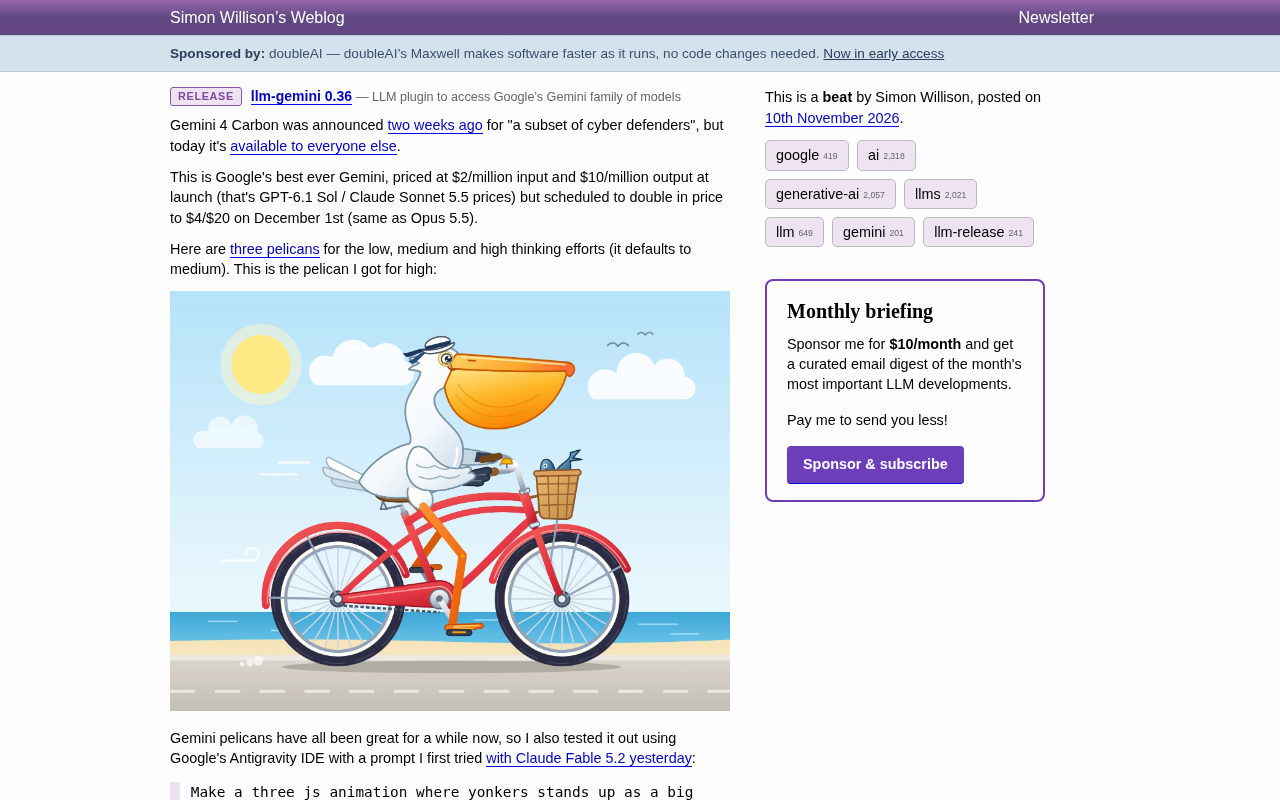
Willison continued his customary "pelican test," generating three pelicans with low, medium, and high thinking intensity respectively (default is medium). He described the pelican under high thinking intensity as "wearing a monocle, an elegant sailor hat with a blue bow, a basket and fish, an interesting but usable bicycle design, and a delightful use of gradients." The Gemini series' pelican generation capability has stabilized at a high level, which in itself shows the model's maturity in multimodal detail control.
More convincing is the coding capability test. In Google's Antigravity IDE, Willison used a prompt previously used for Claude Fable 5.2: create a Three.js animation in which Yonkers stands up and transforms into a giant mecha, stomping through Manhattan, Queens, and Brooklyn, using OpenStreetMap map data. He then asked to "build it as a standalone HTML file" to eliminate external dependencies, and recorded the result as a video.
Three.js is an open-source JavaScript 3D graphics library based on WebGL that lets developers create 3D scenes, models, lighting, and animations in the browser without directly writing low-level shaders and rendering pipelines. It encapsulates concepts such as cameras, materials, geometries, and the render loop, and supports loading external 3D models and textures. In the article, asking the model to generate an animation with Three.js and build city terrain using OpenStreetMap map data is actually testing the model's comprehensive ability to use graphics APIs, coordinate system transformations, and geographic data formats. The requirement to "build it as a standalone HTML file" further rules out the possibility of relying on external CDNs or build tools, forcing the model to inline all logic and resources—this exposes issues with code completeness and self-containment more effectively than generating a multi-file project.
/swarm Feature and Multi-Agent Collaboration
In the update, Willison mentioned another case he saw on YouTube: using Google Antigravity's /swarm feature, Carbon built an open-world 3D game in which the player plays a pelican riding a GBike exploring the Google Mountain View campus. In that case, Carbon coordinated multiple sub-agents, modeling 3D assets in Blender from Omni and Nano Banana references, building a browser game with Three.js and WebGL shaders, and pairing procedural Web Audio sound effects with Lyria music.
This case demonstrates the potential of multi-agent orchestration in real projects. The capability of a single model is important, but whether it can effectively coordinate sub-agents to complete complex multi-stage tasks is becoming a key dimension for measuring a model's practicality. The specific implementation details of the /swarm feature have not been fully disclosed, but based on the results, Carbon performs excellently in task decomposition and cross-tool collaboration.
Multi-agent orchestration refers to a master model breaking down a complex task into several subtasks, assigning them to multiple sub-agents for parallel or sequential execution, and then aggregating the results. Compared with one-shot generation by a single model, this paradigm can break through the limits of a single context and single-round reasoning, allowing different agents to be responsible for planning, coding, asset generation, validation, and other stages, and to interact with the external environment through tool calls (such as 3D modeling software and audio generation interfaces). Its challenges lie in the reasonableness of task decomposition, information transfer between sub-agents, failure retries, and result consistency. When evaluating such systems, in addition to looking at the quality of the final output, you should also pay attention to orchestration overhead, the risk of error propagation, and reproducibility—which is also why the article emphasizes the need for more real-world projects to verify stability.
Significance for Developers
The full opening of Gemini 4 Carbon means developers can now include it in their technology selection. Several points worth noting:
- Price window: The low price before December 1 is a good time for large-scale testing; afterward, costs will rise significantly.
- Coding capability: From Three.js animations to 3D game building, Carbon shows strong capability in code generation and toolchain integration, especially in the Antigravity IDE environment.
- Multi-agent collaboration: The /swarm feature provides a new workflow paradigm for complex projects, but more real-world projects are needed to verify its stability.
- Ecosystem integration: Coordination with Google's own toolchain (Antigravity, Blender integration, Lyria music) is a differentiating advantage, but it may also bring lock-in risk.
For teams currently evaluating model selection, it is recommended to conduct comparative tests for your core scenarios during the low-price period, focusing on code generation quality, multi-step task completion, and cost controllability.
One-line Summary
Gemini 4 Carbon is fully open, with outstanding coding and multi-agent capabilities; the low-price window lasts until December 1.
Paragraph Summary
Google's Gemini 4 Carbon has expanded from being available only to select cybersecurity defenders to being open to all users, and was released with llm-gemini 0.36, described as Google's best Gemini model to date. Its pricing is $2 input and $10 output per million tokens, comparable to similar models, but it will double to $4/$20 on December 1, creating a clear early cost window. Simon Willison demonstrated the model's capabilities through pelican image tests and a Three.js-based mecha animation coding test, and another case showed it using Antigravity's /swarm feature to coordinate sub-agents to complete 3D modeling, a browser game, and sound effects and music. The article recommends that developers conduct comparative tests for core scenarios during the low-price period and pay attention to the lock-in risk brought by ecosystem integration.
Related articles

OpenAI to Shut Down Agent Builder and Two Other Services on November 30, Developers Must Migrate Urgently
OpenAI will shut down Agent Builder, the evals dashboard, and reusable prompts on November 30; evals is already read-only. Here's the scope, OpenAI's migration paths (Agent SDK, PromptFu, your own code), and what developers should export and rebuild this week.
RankSpot: A Pay-Per-Use SEO & AI Search Execution Layer That Lets Agents Write, Publish, and Build Backlinks for You
RankSpot is an SEO & AI search execution layer for AI Agents. Connect via MCP to Claude or ChatGPT to write, publish & build backlinks. Pay-per-use, $3/article.

Appxiom: Giving AI Coding Assistants Production Context
Appxiom gives AI coding agents production context—crashes, jank, memory leaks, failed network calls—across Android, iOS, Flutter, KMP, and Web, ranking bugs by Goal Friction Impact.