Gemini 4 Carbon Released: Can Google Reclaim the Top Spot Through Cybersecurity?

Gemini 4 Carbon focuses on cybersecurity and ultra-long tasks, leading most tests but not winning everything.
Google released its next-generation model Gemini 4 Carbon, calling it its most powerful model and highlighting cybersecurity and ultra-long tasks. Its composite intelligence index rose from 50 to 59, and it took first place in 15 of 17 official tests, but it lost to GPT on large-scale software engineering and to Cloud Opus on computer operation, showing that its advantages are concentrated rather than all-encompassing. It ranked first in all three cybersecurity tests, with a breach rate of 0 in the Grace1 prompt injection attack test; its accuracy in finding clues in ultra-long texts of 250,000 to 1 million tokens reached 96.2%. Third-party Artificial Analysis ranked it first. It is currently available only to some cybersecurity experts and is gradually expanding cooperation through the FairOne program.
Google released its next-generation model, Gemini 4 Carbon, on October 28, calling it its "most powerful model to date" and highlighting two flagship capabilities: cybersecurity and ultra-long tasks. Overall, this is a substantial upgrade, but the claim of "reclaiming the top spot" needs to be examined more carefully—it leads in most tests, but it is not a clean sweep.
Two Flagship Capabilities: Cybersecurity and Ultra-Long Tasks
According to a Bilibili creator, Carbon's core selling points center on two areas. The first is cybersecurity: Google's internal team had it autonomously find and fix bugs in a large codebase over several consecutive days, demonstrating stability under long-horizon tasks. The second is ultra-long context: when searching for clues in extremely long texts ranging from 250,000 to 1 million tokens, it achieves 96.2% accuracy, and its ability to write exploits improved by nearly 13 percentage points.
The combination of these two capabilities points to the same use case—having the model work autonomously for extended periods across vast and complex code and documents. Cybersecurity is simply the extreme expression of this capability, because vulnerability discovery requires both long-context understanding and multi-step reasoning and verification.
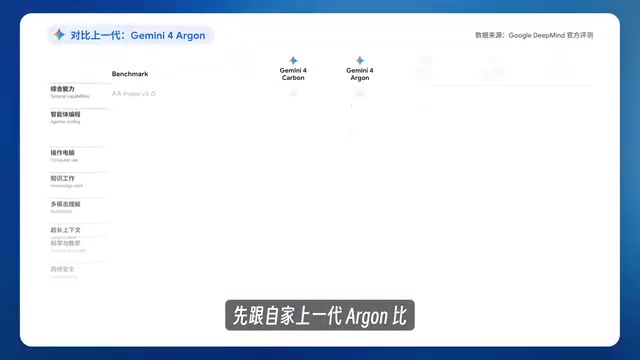
In terms of generational comparison, the previous generation Argon had a composite intelligence index of 50, while Carbon raises it to 59. The creator described this increase as "not a minor patch, but a major upgrade."
Tokens and context windows: A token is the basic unit of text processed by a model, roughly corresponding to a character or word fragment; the context window refers to the maximum amount of tokens a model can "remember" and process in a single pass. 250,000 to 1 million tokens is roughly equivalent to hundreds of thousands to over a million Chinese characters, enough to hold an entire mid-sized codebase or a lengthy technical document. The longer the context, the harder it is for the model to maintain stable retrieval and reasoning over key information, so accuracy under ultra-long context is an important indicator of a model's engineering capability—and a prerequisite for tasks such as autonomous vulnerability discovery.
First Place in 15 of 17 Tests, But Lost Two
Of the 17 official tests, Carbon took first place in 15, with competitors including GPT-6, Astra, Cloud Opus 5.5, and Fable 5.1. But it did not win everything—it lost to GPT on large-scale software engineering and to Cloud Opus on computer operation.
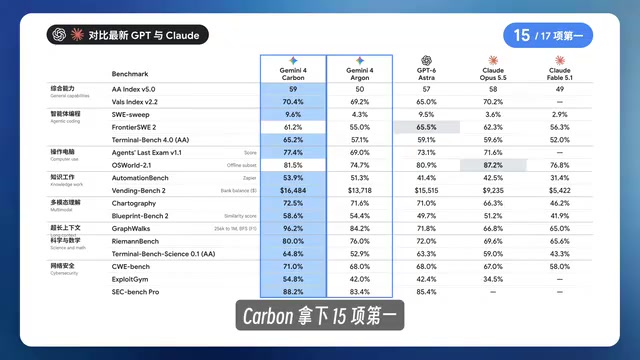
This result is worth noting: it shows that Carbon's advantages are highly concentrated in specific areas rather than being an across-the-board domination. Cybersecurity is the home turf this time—finding vulnerabilities 88.2%, patching vulnerabilities 71%, and writing exploits 4.8%, taking first place in all three. In the Grace1 prompt injection attack test, Carbon's breach rate was 0, a strong endorsement of its security positioning.
Prompt injection attacks: This refers to attackers embedding malicious instructions in the input the model reads, inducing the model to deviate from its original task, leak information, or perform unintended operations. For models with code execution and autonomous task capabilities, this type of attack carries higher risk. A breach rate of 0 in the Grace1 test means the model was not successfully manipulated under the attack samples defined by that test, but this is only a result under a specific benchmark and does not mean it is immune to all attack methods.
Real-World Experience: Surprising Performance in Image and Video Generation
Beyond capability tests, some real-world use cases better illustrate the model's overall quality. One blogger had three models render the same scene of a drop of water falling into a lake to compare realism; another gave Carbon only two images, and it recreated the effect of two black hole horizons using 3GS; yet another asked it to generate an ink-wash cat chasing a butterfly.

These cases lean more toward generation quality and creative execution and are not directly related to the main cybersecurity storyline, but they reflect a signal: Carbon's performance on visual tasks has not been weakened by its focus on security.
Third-Party Evaluation and Pricing
The third-party organization Artificial Analysis ranked Carbon first, providing an external reference for Google's "most powerful" claim. However, the weight of a single leaderboard is limited; what is more noteworthy is the distribution of wins and losses on specific subdivided tasks.

In terms of pricing, during the promotional period it costs $2 per million input tokens and $10 per million output tokens, after which the original price resumes. Carbon is currently available only to selected cybersecurity experts and is being gradually opened to more trusted partners through the FairOne program. This limited-access strategy is consistent with its security positioning—validate on a small scale first, then expand the trust boundary.
Artificial Analysis: This is an independent large-model evaluation organization that provides model rankings and intelligence indices by combining multiple benchmark tests and human evaluations, and is often used by the industry as a reference for horizontal comparison. Third-party leaderboards can reduce the bias of vendor self-evaluation, but rankings depend heavily on the composition and weighting of their test suites, so a single leaderboard should not be the sole basis for selection; it is more reliable to consider the distribution of wins and losses on subdivided tasks.
Token pricing: Large-model APIs typically bill separately for input tokens and output tokens, where input refers to the prompts and context submitted by the user, and output refers to the content generated by the model. During the promotional period, Carbon costs $2 per million input tokens and $10 per million output tokens; the output unit price is notably higher because the generation process is more computationally expensive. For ultra-long context scenarios, the number of input tokens can be very large, so cost estimation needs to take context length into account.
Conclusion: Leadership Is Local, Not Global
Carbon has indeed established a clear advantage in cybersecurity and ultra-long text tasks, and the improvement in its composite intelligence index and third-party ranking also supports the judgment of a "major upgrade." However, its losses in large-scale software engineering and computer operation show that it is closer to "leading on its home turf" rather than reclaiming first place across all dimensions. For teams focused on security scenarios, this may be the model most worth evaluating right now; for general tasks, model selection still needs to be based on specific requirements.
One-line Summary
Gemini 4 Carbon focuses on cybersecurity and ultra-long tasks, leading most tests but not winning everything.
Paragraph Summary
Google released its next-generation model Gemini 4 Carbon, officially calling it its most powerful model and highlighting two capabilities: cybersecurity and ultra-long tasks. Its composite intelligence index rose from 50 for the previous generation Argon to 59, and it took first place in 15 of 17 official tests, but it lost to GPT on large-scale software engineering and to Cloud Opus on computer operation, indicating that its advantages are concentrated in specific areas rather than being an across-the-board domination. It ranked first in all three cybersecurity tests, with a breach rate of 0 in the Grace1 prompt injection attack test; its accuracy in finding clues in ultra-long texts of 250,000 to 1 million tokens reached 96.2%. The third-party Artificial Analysis ranked it first. It is currently available only to selected cybersecurity experts and is gradually expanding its cooperation scope through the FairOne program.
Related articles

Deleted Reddit Post Sparks Debate Over AI Content Moderation
A Reddit post removed with only a 'Removed by Reddit' notice highlights AI content moderation's transparency gaps, misjudgment risks, and appeal challenges for platforms and creators.

DSH + Ollama Local LLM Deployment in Practice: Free Chat with Da Fei Yu
Bilibili creator tests DSH + Ollama local LLM deployment end to end: Ollama install, Xunlei-accelerated downloads, ModelScope GGUF model import, DSH custom API address setup, and a comparison of Qwen 3.5 4B, 8B, Gemma, and other models on 8GB VRAM, with advice on choosing local deployment vs. API calls.

Tested: A $899 Mac Mini vs. a $200/Month AI Subscription
Real-world test of whether an M4 Mac mini can replace a $200 AI subscription: 16GB can't fit large models, and both speed and quality fall short—but privacy, no caps, and near-zero running costs make it an ideal host for an always-on agent. Includes buying advice per configuration and money-saving strategies.