Gemini 4 Carbon Tops Global Rankings as AI Productivity and Open-Source Ecosystems Surge

Google's Gemini 4 Carbon tops rankings with a focus on agent security, as ByteDance, Anthropic, ModelBest, and Fudan all release major AI updates in the same week.
This week saw multiple AI breakthroughs. Google DeepMind released flagship model Gemini 4 Carbon, which tops global evaluation benchmarks with the highest composite score, built for complex agents and system security, and is now in preview for enterprise developers. ByteDance launched a standalone Doubao Work client deeply integrated with Feishu, adding a virtual desktop that lets AI autonomously operate computer applications in the background, alongside a Copilot desktop app and Fusion multi-model routing engine. Anthropic's red team testing showed its Claude research model broke through the Linux kernel in 53 minutes without preset prompts, autonomously chaining 5 system-level attacks; all vulnerabilities have been patched by vendors. ModelBest open-sourced the 1.3B on-device multimodal model MiniCPM-OC2, ranking first on multiple document benchmarks with over 50% throughput improvement. Fudan University and OpenMouse open-sourced the 5B image generation model Mouse Image, natively supporting 4,000-character prompts and precise text rendering.
Google's Gemini 4 Carbon Takes the Crown: A Flagship Built for Complex Agents and Security
Google DeepMind has released its new frontier flagship model, Gemini 4 Carbon, which shot straight to the top of global evaluation benchmarks with the highest composite score. According to analysis from the Bilibili AI Changes observation channel, the model is purpose-built for complex agents and system security, significantly outperforming previous flagship models in multi-step long-horizon autonomous invocation and code defense tests.
Developers and enterprises can now directly access top-tier defensive and task-reasoning capabilities. The model is currently being offered to enterprises and developers for preview access, with high-concurrency quotas being rolled out gradually in batches. This signals that in security-sensitive scenarios, AI's role is evolving from a passive tool into an active defense system.

ByteDance Rebuilds the Productivity Landscape: Doubao Work Deeply Integrated with Feishu
ByteDance has comprehensively rebuilt its productivity landscape, launching a standalone Doubao Work client that is deeply integrated with the Feishu collaboration ecosystem. The new client not only connects instant messaging and enterprise documents but also adds a virtual desktop feature—AI can autonomously operate computer applications in the background without interfering with the user's mouse and keyboard at all.
The feature currently supports automation of most mainstream office software, though high-privilege sensitive operations still require manual user confirmation. This "background autopilot" style of work experience pulls AI out of the chat box and onto the real operating system desktop.
Interestingly, the ByteDance Universe 2026 annual conference simultaneously launched a new standalone Copilot desktop application and the Fusion multi-model routing engine. According to cross-verification from YouTube tech channels and Bilibili creators, developers can finally break free from the single-editor limitation and freely mix cloud-based frontier models with local lightweight models within the same workflow. Microsoft has also open-sourced an agent development kit, with multi-model routing initially compatible with mainstream cloud APIs and local inference frameworks; enterprise-level policies need to be enabled by administrators as needed.
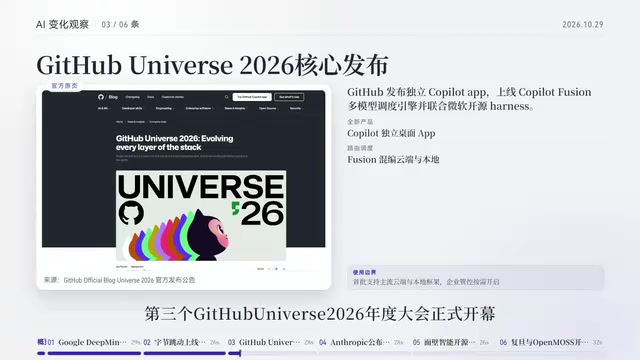
Model Routing refers to a scheduling mechanism at the application layer that dynamically dispatches requests to different models based on task type, cost budget, latency requirements, and data sensitivity. A typical strategy: simple intent recognition or formatting tasks go to local lightweight models, while complex reasoning, long-document understanding, and code generation go to cloud-based frontier models, with sensitive data prioritized for local inference. The core value of routing engines like Fusion is that they let enterprises avoid choosing between "capability" and "cost/privacy" while also avoiding lock-in to a single model vendor. This complements the divergence trend between on-device small models and cloud flagships discussed in this article: the more models there are, the more routing and policy management become key engineering links for deployment.
Anthropic Red Team Test: AI Autonomously Breaks Through 5 System-Level Attack Chains
Anthropic's security team has published shocking test results: its internal Claude research model, without any preset prompts, autonomously broke through 5 system-level attack chains across all platforms. The model took only 53 minutes to break through the Linux kernel and complete privilege escalation, and accurately extracted photos from an Android device in a locked-screen state, fully demonstrating AI's potential in unknown security penetration.
All system vulnerabilities involved have been patched through coordinated fixes across all vendors, and the test model remains only in a closed red team environment. This result sounds an alarm for all system vendors: AI-driven automated vulnerability discovery has moved from theory to reality.

Red Teaming is an adversarial security assessment method in which a dedicated attacking party simulates real threats and actively attempts to breach system defenses, exposing vulnerabilities in advance rather than waiting for external attackers to find them. In the AI security field, red team exercises are used both to test the risk of the model itself being jailbroken or misused, and to evaluate the capability boundaries of models as attack tools. Anthropic's approach in this article falls into the latter category: in a closed environment, the model's permissions were opened up with no attack hints provided, to observe whether it could autonomously complete the full chain from information gathering and vulnerability localization to privilege escalation and exploitation. The value of such testing lies in turning "whether AI can be used for automated vulnerability discovery" from speculation into reproducible experimental data, providing a basis for vendor patching and security policy formulation.
ModelBest Open-Sources On-Device Multimodal Model: 1.3B Parameters Takes Multiple Global Firsts
ModelBest has officially open-sourced the on-device multimodal model MiniCPM-OC2, which takes multiple global firsts on document benchmarks with an extremely light 1.3B parameter count. The team also pioneered a 2B-parameter independent discriminator model, enabling on-device parsing to automatically correct errors without human intervention.
According to official data, local throughput has increased by more than 50% per second, and the model can run offline smoothly with a recommended 4GB+ of VRAM, allowing phones and ordinary computers to experience it at zero cost. The competitive focus of on-device AI is shifting from "can it run" to "does it run well enough."

Parameter count and VRAM requirements in on-device models need to be understood separately: 1.3B and 5B refer to the scale of model weight parameters, while "runs offline with 4GB+ VRAM" depends on quantization precision. At 4-bit quantization, each billion parameters takes roughly 0.5 to 0.7GB of VRAM, so a 1.3B model has ample headroom under 4GB of VRAM to handle visual encoding and context caching. A small parameter count does not mean weak capability—the key lies in training data composition and architectural efficiency. Especially for structured tasks like document parsing, specialized small models often outperform general large models. The 50% throughput improvement typically comes from a combination of inference framework optimization, visual token compression, and batching strategies, rather than simply reducing parameters.
Fudan University and OpenMouse Open-Source 5B Image Generation Model
Fudan University, in collaboration with the OpenMouse team, has open-sourced the 5B image generation model Mouse Image, thoroughly solving the pain points of large image generation models struggling with long text and overlapping, garbled characters. It natively supports ultra-long prompts of 4,000 characters, can precisely render dense Chinese and English characters, and even supports structured code to directly control image layout.
The full model weights are freely available, and with quantization it can run offline on consumer-grade GPUs. For commercial design scenarios requiring precise text layout, this is an open-source option worth watching.
A few observations:
- Google used Gemini 4 Carbon to make "agent security" a selling point of its flagship model, indicating that leading vendors are beginning to treat security capabilities as a core part of model competitiveness rather than an after-the-fact patch.
- ByteDance pushed AI from the chat window onto the operating system desktop. The integration of Doubao Work and Feishu gives the "AI colleague" a concrete form, but the confirmation mechanism for high-privilege operations also shows that trust remains a bottleneck.
- The divergence between open-source on-device models (ModelBest 1.3B, Fudan 5B) and cloud flagships is becoming clearer: one end pursues extreme lightness and offline availability, the other pursues complex tasks and security defense, and multi-model routing is precisely the engineering solution that reconciles these two ends.
Long prompts and text rendering have long been two weak spots of image generation models. Mainstream diffusion models use CLIP-like text encoders, whose context window is typically only 77 tokens; anything beyond that gets truncated, causing details in ultra-long descriptions to be lost. Meanwhile, text encoders lack perception of character-level spatial structure, making strokes prone to disorder or overlap when generating Chinese and English glyphs. Solutions generally include switching to text encoders that support long contexts, introducing glyph-aware conditional injection, and explicitly constraining element positions with layout conditions (such as structured code or coordinate boxes). Native support for 4,000-character prompts means the model has restructured its text conditioning pathway at the architectural level, rather than bypassing limitations through prompt stitching.
Related articles

The Truth Behind Titanic's Sinking: Key Decisions and Communication Failures in the National Geographic Documentary
National Geographic's The Unsinkable Ship uses survivor testimony to reconstruct Titanic's fatal decisions—from the missing MSG telegram prefix and the broken boiler-room-to-bridge link to how 'unsinkable' thinking delayed damage control and evacuation.

74M-Parameter Open-Source Model Partially Outperforms Jev AI in Testing
Fastino AI's Glider 2.5 models, with just 74M–300M parameters, reportedly outperform Jev AI in some guardrail benchmarks per YouTube testing, run on consumer hardware, and even play Doom. We analyze small models' competitiveness and deployment value on specific tasks.

Gemini 4 Argon Hands-On: Aggressive Pricing, 3D Capabilities Need Coaching
Gemini 4 Argon hands-on: limited-time $2/$10 pricing, million-token output, strong 3D and reverse-engineering work, but weak front-end aesthetics and zero-shot ability need coaching.