Gemini 4 Carbon Tops Intelligence Index, Tencent Releases Buddy One | AI Daily

Gemini 4 Carbon tops Intelligence Index as tool-layer orchestration and routing move toward automation.
This issue covers two shifts in frontier models and tools. Google's Gemini 4 Carbon high-reasoning version ranks first on Intelligence Index V5 with 59 points, focusing on cybersecurity and long-horizon tasks with a phased rollout. At the tool layer, automation is accelerating: GitHub Copilot Fusion is generally available with effort-based model selection, and OpenRouter's default routing now scores providers on price, wait time, throughput, and failure rate. Also: Tencent Buddy One integrates Docs, Meeting, and Drive via WorkBuddy Agent; Diffbot open-sources Clover with 1.52-second median latency; NVIDIA open-sources Nemotron 3.5 Transcribe for 40 languages and ~1-hour audio.
Frontier Model Landscape Shifts: Gemini 4 Carbon Tops Intelligence Index
Google has released Gemini 4 Carbon, which the company calls its strongest frontier model to date. On the Intelligence Index V5, the high-reasoning version scored 59 points, ranking first. The model focuses on cybersecurity and long-horizon tasks, and will first be made available to a subset of cyber defenders this week before gradually being provided to other trusted partners through the Frontier program.
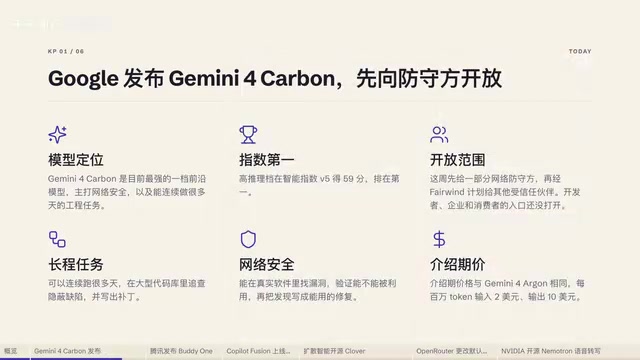
In terms of positioning, Gemini 4 Carbon does not follow the general-purpose chat model route; instead, it centers its capabilities on security scenarios and complex tasks requiring multi-step execution. The score of 59 on Intelligence Index V5 is the highest among currently public data, indicating a clear advantage in reasoning depth. The phased rollout approach is also noteworthy—defenders first, trusted partners later—a cadence that is uncommon in past model releases and reflects Google's cautious attitude toward deploying highly capable models on the security side.
Intelligence Index V5 is a benchmark evaluation system used to compare frontier model capabilities horizontally, typically aggregating multiple categories of high-difficulty tasks (reasoning, coding, long-horizon planning, etc.) into a single weighted score. A higher score represents stronger comprehensive performance on complex, multi-step tasks. "High-reasoning version" refers to a model that invests more computation at inference time (e.g., longer chains of thought or more sampling) in exchange for higher-quality output, at the cost of slower responses and higher expense. Therefore, the 59 points should be understood as a result under a "heavy-reasoning" configuration and is not fully comparable to the regular chat version.
Long-horizon tasks refer to tasks that require dozens or even hundreds of consecutive operations, spanning multiple tools or pages to complete. The difficulty lies in maintaining goal consistency, handling intermediate failures, and self-correcting, rather than in the quality of a single-step answer.
Tencent Buddy One: Stringing Office Suite Into a Personal Agent
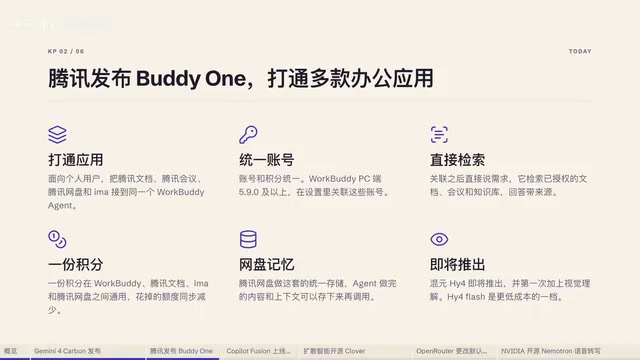
Tencent has released Buddy One for individual users. It connects Tencent Docs, Tencent Meeting, and Tencent Drive, and shares the WorkBuddyAd Agent with ima, with a unified account and credits system.
This means that document, meeting, storage, and other operations within the Tencent ecosystem can be orchestrated by the same Agent, rather than each application having its own assistant. The significance of unified accounts and credits lies in reducing friction across applications—users no longer need to maintain separate quotas or identities for different products. For individual users, the value of this integration is in converging scattered office actions into a single entry point, reducing the cost of switching back and forth between multiple applications.
GitHub Copilot Fusion Generally Available: From Choosing Models to Choosing Effort
GitHub has made Copilot Fusion generally available. Users no longer need to manually select a model for each step; instead, they choose an effort level, and Copilot decides which models to use and in what workflow to combine them.
The essence of this change is transferring the decision-making power of model orchestration from users to the system. In the past, users had to choose between different models and understand each model's strengths and weaknesses; now they only need to express how much processing effort the task requires, and Copilot handles the rest of the routing. For developers, this lowers the barrier to use, but it also means less control over underlying model selection. GitHub's decision to make it generally available at this point suggests sufficient internal confidence in the stability of automatic orchestration.
Model orchestration refers to the system automatically deciding which model or models to invoke and in what order and workflow they collaborate to complete a request, based on task characteristics. Common approaches include using lightweight models for intent recognition and triage, delegating complex steps to stronger reasoning models, and then validating or retrying results. Its core trade-off is that automatic orchestration reduces the user's cognitive burden, but the user loses direct control over specific models, costs, and output style. The abstraction layer of "effort" essentially translates "which model to choose" into "how much processing this task requires."
Diffbot Open-Sources Clover: 1.52 Seconds Median for Web Operations
Diffbot has open-sourced Clover for writing code, performing web operations, and calling tools. In web operation scenarios, Clover's median latency is 1.52 seconds, compared with 8.86 seconds for Gemini 3.6 Flash.
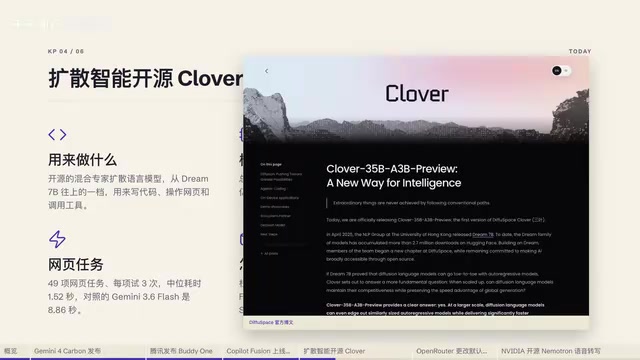
In terms of task execution steps, creating a project and inviting members took Clover 13 steps, compared with 21 steps for the comparison solution. Both data points point to the same conclusion: Clover has advantages in both speed and step efficiency on web operation tasks. The median latency differs by several times, and the step count is about one-third lower; for Agent scenarios that require frequent web operations, this gap will directly affect usability. Open-sourcing means this capability can be integrated into more toolchains, rather than being limited to a single platform.
OpenRouter Overhauls Routing Rules: From Lowest Price to Composite Scoring
OpenRouter has made the largest change to its default provider routing since its inception. Previously, the default almost exclusively rewarded lower input prices; now it scores providers based on actual price, wait time, throughput, and failure rate.
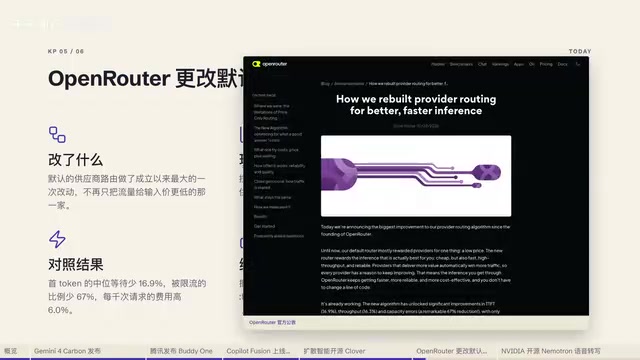
The problem with the old rules was single-dimension optimization—the cheapest provider is not necessarily the best experience. The new rules incorporate wait time, throughput, and failure rate into scoring, effectively putting the quality users actually experience into routing decisions. For providers, this means strategies that rely solely on low prices to attract traffic will become less effective, and stability and speed become equally important. This is a signal that the routing layer is shifting from price competition to quality competition.
Provider routing is the mechanism by which aggregation platforms distribute requests among multiple backend providers. The same model is often hosted by multiple providers, which differ in price, latency, throughput, and stability. The old rules sorted almost exclusively by input price, causing requests to concentrate on the cheapest provider and thereby driving up its queue time and failure rate. The new rules incorporate these runtime metrics into scoring, effectively balancing cost and experience with weights; for users, routing quality becomes as important as the model itself.
NVIDIA Open-Sources Nemotron 3.5 Transcribe: 40 Languages, ~1-Hour Recordings
NVIDIA has open-sourced the Nemotron 3.5 Transcribe transcription model, covering 40 languages and recordings up to about 1 hour long. It can use natural language instructions to determine transcription style, such as verbatim transcription, written language, or speaker labels.
Controlling transcription style with natural language is a particularly distinctive aspect of this release. Traditional transcription models have relatively fixed output formats, and users often need post-processing to get verbatim or written-language versions. Delegating style control to instructions effectively moves the post-processing step into the model itself. The coverage of 40 languages and about 1 hour of duration, combined with open-sourcing, makes it suitable for integration into workflows that require long-audio processing, such as meeting notes and content organization.
Speaker diarization refers to labeling "who said what and when" in transcription results. It requires first performing speech segmentation and speaker clustering, then aligning the text to specific speakers. It is more difficult than pure speech recognition because it must handle overlapping speech, speaker changes, and similar timbres. Unifying style differences such as verbatim transcription, written-language rewriting, and speaker labels under natural language instruction control means the model itself must simultaneously possess recognition, formatting, and rewriting capabilities, rather than relying on external post-processing pipelines.
Today's Observations
Today's releases concentrated on two directions: first, the boundaries of model capabilities continue to expand, with Gemini 4 Carbon setting a new high on the reasoning index and choosing security scenarios as its landing point; second, orchestration and routing at the tool layer are becoming automated, with Copilot Fusion handing model selection to the system and OpenRouter shifting routing criteria from price to composite quality. For users, opportunities to directly choose models are diminishing, and expressing needs and setting effort levels are becoming the new way to interact.
One-line Summary
Gemini 4 Carbon tops the Intelligence Index as tool-layer orchestration and routing move toward automation.
Paragraph Summary
This issue focuses on two changes at the frontier model and tool layers. Google released Gemini 4 Carbon, whose high-reasoning version ranks first on Intelligence Index V5 with 59 points, focusing on cybersecurity and long-horizon tasks and adopting a phased rollout strategy—first to defenders, then to trusted partners. At the tool layer, there is a clear trend toward automation: GitHub Copilot Fusion is generally available, with users only needing to choose an effort level while the system decides model combinations and workflows; OpenRouter's default routing has shifted from almost exclusively rewarding low prices to composite scoring based on actual price, wait time, throughput, and failure rate. In addition, Tencent Buddy One connects Docs, Meeting, and Drive and shares the WorkBuddy Agent; Diffbot's open-source Clover outperforms the comparison solution on web operations with a 1.52-second median latency and 13 steps; and NVIDIA has open-sourced the Nemotron 3.5 Transcribe model supporting 40 languages and recordings of about 1 hour.
Related articles

Qwen 3.8 Beats Opus at Coding—But Can Your Mac Run It?
Open-source Qwen 3.8 beats Opus 4.6 at coding at just 18GB, but how much Mac memory do you need? 24GB crashes; 32GB is the sweet spot. Full config guide inside.

Claude Code + Agent: Building a Fully Automated AI Testing Loop
Bilibili course breakdown: how test developers can use Claude Code terminal-based Agents to build a fully automated AI testing loop. Compares permission boundaries of terminal vs. device Agents, explains why enterprise projects choose Claude Code over Open Claude-type tools, and outlines the Node.js environment setup and DeepSeek model integration path.

Working with AI Agents Requires Nerves of Steel
The more autonomous AI agents become, the heavier the user's psychological burden. Drawing from a Hacker News discussion, this article analyzes black-box anxiety, behavior drift, and monitoring fatigue in agent collaboration, and offers practical approaches like sandbox isolation, permission control, and task granularity management to reduce cognitive load.