Gemini 4 Carbon Tops the Leaderboard but Is Hard to Use? Three Weeks of Real-World Testing
Gemini 4 Carbon claims to be the strongest, but testing protocols, access limits, and independent verification are all in question.
Google DeepMind's Gemini 4 Carbon was ranked first by Artificial Analysis, but three weeks after release the public version differs from the advertised one. Its security scores were measured with guardrails off and correspond to Fairwind whitelist access, not public API capabilities. The #1 spot leads by only 1 point and consumed about 200M output tokens versus a 71M median. On CWE Bench it reports only a single-attempt 71%, trailing rivals under 4 attempts, and its hallucination rate rose from 4% to 11%. Fairwind cases are all Google-relayed, and reproducible independent verification is still missing. Carbon is a strong signal, but not yet a reproducible evaluation.
Google DeepMind released what it calls "the strongest model yet," Gemini 4 Carbon, on October 28, and independent evaluator Artificial Analysis ranked it at the top. But three weeks after release, very few people can actually use it—behind this "number one" lie multiple question marks around testing methodology, access restrictions, and independent verification.
The Three-Week Predicament of a "Strongest Model"
Carbon is built on Argon, which launched two weeks earlier, and focuses on two things: long-horizon engineering tasks and cybersecurity. "Long-horizon" means letting it run continuously for days in a large codebase, finding bugs on its own, fixing them, and then verifying the fixes. It sounds like an ideal software engineering assistant, but three weeks after release, there is a considerable gap between the publicly available version and the version Google advertises.
On November 10, Carbon finally opened to paid developers and enterprises under the model ID Gemini 4 Carbon, and Google AI Ultra users can also use it. But the cybersecurity-related version is a separate SKU and remains behind a whitelist. In other words, the API you pay to call is not the same model Google uses to climb the leaderboard.
The Scores Look Great, but the Testing Has Preconditions
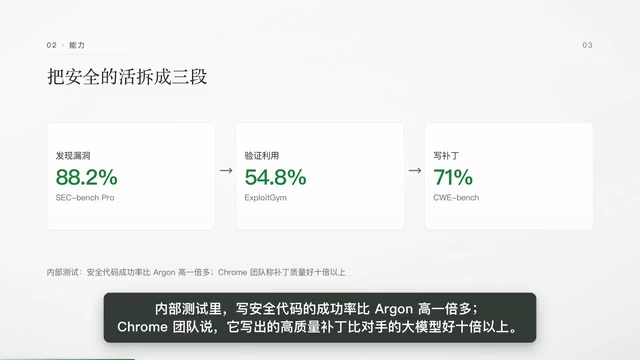
Google's three-part cybersecurity scores are: 88.2% for finding vulnerabilities, 54.8% for building exploits, and 71% for writing patches. In internal testing, the success rate for writing secure code is more than double that of Argon. The Chrome team even says the high-quality patches it writes are more than 10x better than those from rival large models.
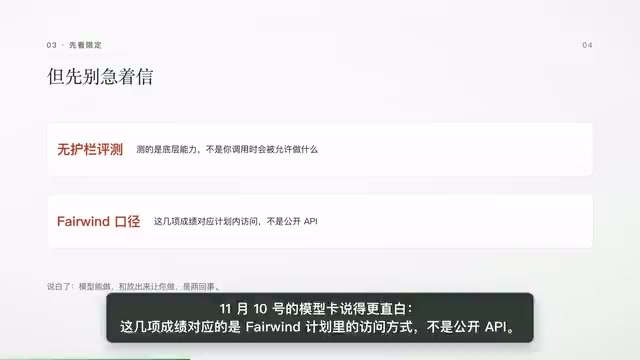
But these numbers come with a key precondition—Google itself states that testing was conducted with safety guardrails disabled. What was measured is what the model is "capable of at the底层" rather than what you "will be allowed to do" when calling it. The November 10 model card is even more direct: these results correspond to access methods under the Fairwind program, not the public API.
This is like a race car setting an astonishing lap time on a closed track, while the consumer version is speed-limited. The scores themselves are not false, but they do not represent the capability of the product you buy.
Independent Evaluation: The Gap at Number One Is Only 1 Point
Artificial Analysis ranks Carbon first with a score of 59. But this first place is very thin—the second-place Cloud Opus 5.5 scores 58, only one point behind.
There is also a detail about cost. Carbon burned about 200 million output tokens in this test, while the median is only 71 million. The score was built by piling on compute, so the cost-effectiveness of this first place deserves a discount.
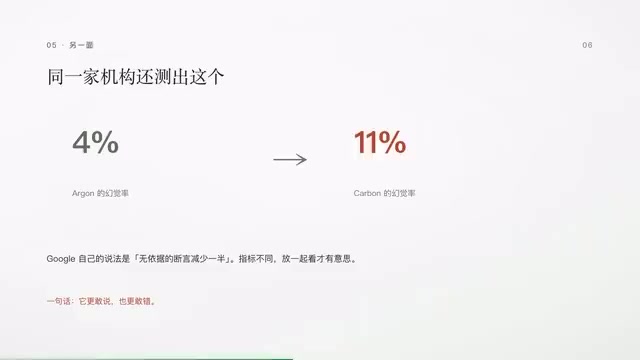
The same organization also gave another less flattering number: Carbon's "hallucination rate" (the original calls it "换绝率") rose from 4% for Argon to 11%. Google's own claim is that "unsupported assertions were halved." The two metrics do not measure the same thing, and they are more interesting when viewed together: it is more willing to speak, and also more willing to be wrong.
CWE Bench (Common Weakness Enumeration Benchmark) is a benchmark for large-model security capabilities maintained by the security research community. Tasks require the model to identify, exploit, or fix specific types of software weaknesses (such as buffer overflows or injection vulnerabilities) in given code snippets. Evaluations usually use one of two protocols: single-attempt or multi-attempt. Single-attempt means the model generates one answer and is judged right or wrong; multi-attempt allows the model to repeatedly revise under feedback, closer to the real development process of "trial and error—iteration." Multi-attempt scores are usually significantly higher than single-attempt scores because the model has a chance to adjust from mistakes, but it is also easier to "game" scores through brute-force search or pattern matching. Therefore, when comparing across models, the number of attempts must be aligned; otherwise, directly comparing single-attempt and multi-attempt scores will be severely distorted.
CWE Bench: Change the Protocol and the Lead Disappears
Google's CWE Bench score used for its lead is 71%, single-attempt. But on independent leaderboards, under a 4-attempt protocol, Cloud 4.7 scores 81% and Opus 5.5 scores 79%, while Carbon has no 4-attempt result yet.
Single-attempt and multi-attempt are two completely different evaluation logics. Multi-attempt allows the model to repeatedly try and fail, closer to real engineering scenarios, but it is also easier to inflate scores. Carbon currently reports only single-attempt results, and on a comparable basis, it has not yet proven itself ahead.
So before talking about a lead, you have to ask: measured under what protocol?
The Fairwind Program: Who Can Use the Real Carbon
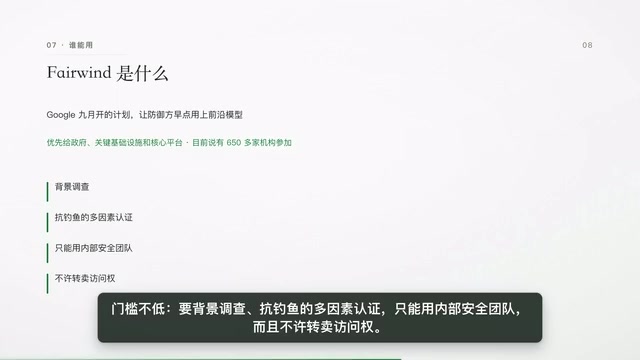
Fairwind is a program Google launched in September to let defenders use frontier models earlier. Priority goes to governments, critical infrastructure, and core platforms; reportedly more than 650 organizations are participating. The bar is not low: background checks are required, phishing-resistant multi-factor authentication is required, only internal security teams may use it, and reselling access is prohibited.
Some results have already been described. Google says Waze used it to find zero-day vulnerabilities at two large SaaS vendors within two hours (the original says "零日落"). Its cloud vulnerability research team confirmed that two open-source bugs were indeed exploitable, helped maintainers raise their severity, and then released patches. There is also a Carbon-based agent that helped verify the core security guarantees of the Signal protocol.
These results are all relayed by Google, not independently tested by third parties. They show that Carbon is indeed useful in certain controlled scenarios, but no more than that.
Prompt injection is a class of attack in LLM applications: attackers disguise malicious instructions as normal input (such as user messages, web content, or documents) to trick the model into ignoring its original system instructions and executing the attacker's intended behavior, such as leaking the system prompt, invoking tools without authorization, or outputting harmful content. Unlike traditional injection attacks, the attack surface is natural language rather than code, and defense is harder because models struggle to reliably distinguish "data" from "instructions." Google's reported "0% prompt injection attack success rate" usually means that on a specific attack set the model did not produce the expected jailbreak behavior, but this does not mean the model is immune to all injection techniques; attack-set coverage, system prompts at deployment, and filtering mechanisms all affect the result, so this metric must be interpreted together with the test conditions.
A zero-day vulnerability is a software security flaw not yet discovered or patched by the vendor, which attackers can exploit without an official fix. Finding zero-days usually requires deep understanding of code logic, memory models, or protocol implementations, and traditionally relies on manual auditing by security researchers or fuzzing. When large models are used to assist vulnerability discovery, their advantage is quickly reading large-scale codebases, identifying suspicious patterns, and proposing hypotheses, but final confirmation of exploitability still requires manual verification and dynamic testing. The Waze case in the article, "finding zero-day vulnerabilities within two hours," is highly controlled assisted discovery, not the model independently completing end-to-end exploitation; the value of such results is shortening initial screening time, and it cannot be equated with the model having a general ability to autonomously discover and exploit zero-days.
Security Metrics: 0% Does Not Mean Zero Risk
Google's reported security metrics also look good: 0% prompt injection attack success rate, cheating attempts down to 0.4%, and internal high-severity misalignment alerts down by nearly 80%.
But 0% only means the attacks tested this time did not succeed. Change the attack set or the integration method, and the risk will resurface. Most of these numbers are also measured by Google itself—what outsiders cannot access is, in essence, not independent verification either.
How to View Carbon: A Strong Signal, but Not Yet a Reproducible Evaluation
Carbon is a strong signal: AI for long-horizon engineering and security defense is indeed moving forward. The Chrome team's feedback on patch quality and the real cases in the Fairwind program both point in this direction.
But it is not yet an evaluation you can verify with your own money. There is a gap between the capabilities of the public API and those of the whitelist version, the lead shrinks substantially under independent protocols, and the testing conditions for security scores are not a public environment.
Wait until access opens up, and wait until others have independently tested it, before drawing conclusions. For developers, what can be done now is to watch pricing changes after the discount ends on November 30 (input rises from $2 to $4 per million tokens, output from $10 to $20), and when the security version will come out of the whitelist.
Ranking first is a good story, but whether a product is good to use has to be run by yourself to count.
One-line Summary
Gemini 4 Carbon claims to be the strongest, but testing protocols, access restrictions, and independent verification are all questionable.
Paragraph Summary
Google DeepMind's Gemini 4 Carbon was ranked first by independent evaluator Artificial Analysis, but three weeks after release there is a gap between the publicly available version and the advertised version. Its security scores were measured with safety guardrails disabled and correspond to Fairwind whitelist access methods, not public API capabilities. The independent number-one spot leads the runner-up by only 1 point, and it consumed about 200 million output tokens, far above the median of 71 million, showing the score was built on compute. On CWE Bench, Carbon has only a single-attempt 71% result and trails competitors under the 4-attempt protocol. Its hallucination rate rose from 4% for Argon to 11%, meaning the model is more willing to speak and more willing to be wrong. The Fairwind program has a high bar and its cases are all relayed by Google, while publicly reproducible independent verification is still missing. Carbon is a strong signal, but not yet a reproducible evaluation.
Related articles
GLM-5.4 vs. Opus and Neon: How Far From the Top?
No official benchmarks for GLM-5.4. Based on a YouTube deep test and developer trials, we analyze its gap vs. Claude Opus 5.5 and Gemini Neon, the speed bottleneck from marathon-style thinking, and its real position in enterprise agent scenarios.

From Gobbler to Sloppy Joe: The Hit-Making Playbook of a New Jersey Deli Institution
NYT Cooking visits Milburn Deli in New Jersey to break down the hit logic behind the Gobbler turkey sandwich and the local Sloppy Joe: bread sliced to order, house-made sauces, a group shout culture, and customer co-creation behind six locations.
In the Age of AI Programming, When Do You Still Need to Write Code by Hand?
Is handwritten code still valuable once AI programming agents are widespread? This article outlines three scenarios where handwriting is essential—learning, style development, and prototype validation—and provides a division-of-labor framework between AI and humans to help developers balance efficiency and skill growth.