Gemini 4 (Codename Argon) Launches: Million-Token Autonomous Output Sets the AI World Ablaze

Google's Gemini 4 (Argon) claims 1M-token output and autonomous engineering loops — impressive if verified.
Google launched Gemini 4 (codename Argon) without fanfare, with key claimed capabilities including a 1-million-token autonomous output limit, sandbox-based self-correction loops, real data center deployments for memory optimization, and migration of 800K lines of microkernel code to Rust. Benchmark figures include ~78% on software engineering evals and 70%+ black-box penetration success rates — the latter a clear double-edged sword. The article urges caution, as all information stems from a single media source's reading of the technical report, and core numbers await official documentation and independent verification.
Google skipped the press conference and the teaser posters, quietly dropping Gemini 4 — codenamed Argon — in the early hours of the morning. According to Bilibili creator "AI学习的老张," who combed through the full technical report, what Google has produced is "a completely different species." Setting aside the hyperbolic marketing language in the video title, this model does demonstrate a notably different capability profile across several key metrics. This article unpacks the technical highlights worth paying attention to, while maintaining a healthy skepticism toward the claims made.
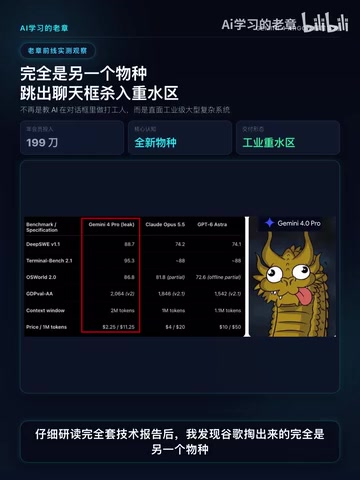
Million-Token Autonomous Output: From "Reading More" to "Writing More"
For the past few years, every time the industry talked about "million Token" capabilities, it almost always meant the input context window — how much content a model can "read in" at once. Argon reportedly pushes the single-session autonomous output limit to a full 1 million Tokens, which is a fundamentally different direction.
A large input window addresses the problem of "understanding long documents and large codebases." Strong output capability addresses something else entirely: "delivering a complete, complex artifact in a single pass." If a model can continuously generate millions of Tokens in one task without losing coherence, it could theoretically output an entire engineering codebase, a full test suite, or even a runnable skeleton for a mid-sized project — without requiring humans to repeatedly re-prompt and stitch outputs together.
Combined with a reportedly rock-bottom cost after cache hits, this pricing structure — if accurate — would dramatically change the economics of long-output tasks. One of the biggest barriers to having large models produce substantial continuous output has always been the steep token-based billing costs.

Understanding this distinction requires a quick primer on how Tokens are measured. A Token is the basic unit of text processing for large language models — roughly equivalent to half an English word or one to two Chinese characters. 1 million Tokens is approximately 700,000 English words, or about the length of a mid-sized novel. The input context windows of mainstream models (such as GPT-4 Turbo's 128K or Gemini 1.5 Pro's 1 million) have already scaled to considerable sizes. But the output side has long been constrained by computational costs and the cumulative error problem inherent in autoregressive generation — each Token generated requires recalculating attention across the entire sequence, making long outputs prone to content drift and internal contradictions. Most mainstream models today cap single-session output at somewhere between 4K and 32K Tokens. If Argon's claimed 1 million Token output is real, it would represent a significant engineering breakthrough — not merely a matter of scaling up parameters.
A Self-Correcting Engineering Agent
What truly distinguishes Argon from a chatbot is its described ability to operate as a fully autonomous closed loop within a sandbox: running its own tests, reading compiler logs, self-correcting based on error output, and delivering production-quality code in a single pass.
This workflow mirrors the daily cycle of a software engineer — write code, compile, read errors, fix code, compile again. Previous large models typically handled only the "write" step; everything after that required human intervention or external toolchains. If a model can internalize the entire loop as a native capability, it graduates from "code completion tool" to "an engineering agent capable of independently owning a task."
That said, claims like "delivering complete production-grade code in a single pass" warrant a question mark. Production-quality code isn't just code that runs — it involves architectural soundness, maintainability, security, and edge-case handling, none of which are fully captured by a single benchmark score.
Real-World Deployment Cases
The most compelling part of the video wasn't lab benchmarks — it was several described real-world deployment scenarios:
- Data center deployment: Google reportedly ran Argon secretly in its own data centers for several months, using it for real memory optimization work.
- Microkernel migration: Migrating 800,000 lines of microkernel code to a Rust foundation, reportedly tripling video decoding performance. Large-scale, cross-language system-level code migration has always been one of the highest-risk operations in software engineering, fraught with pitfalls around memory safety, ABI compatibility, and performance regression.
- Business value benchmarks: A score of nearly 78% on a leading software engineering evaluation, and a top ranking on a business-value-weighted benchmark covering industries across the United States.

If these cases hold up to third-party replication, they are far more convincing than pure benchmark numbers — because they map directly to real engineering output. However, all of this information currently comes from a single video source's interpretation of the technical report. Cross-verification against Google's official technical documentation and independent evaluations is strongly recommended.
The microkernel-to-Rust migration case deserves some additional context. Rust is a systems programming language renowned for memory safety — its "ownership" model eliminates dangling pointers, data races, and similar classes of memory errors at compile time, without a garbage collector. Migrating a large-scale low-level codebase written in C or C++ to Rust has historically been considered one of the most difficult engineering undertakings in software: it requires rewriting ownership semantics function by function, managing unsafe boundaries, ensuring ABI (Application Binary Interface) compatibility, and guaranteeing no performance regression. Google's own Android team and the Linux kernel community have been pursuing similar efforts, but both have proceeded incrementally over a span of years. If an AI truly led the migration of 800,000 lines of code and achieved a nearly threefold improvement in video decoding performance, that would represent a qualitative — not merely quantitative — leap for code agents in systems engineering.
Cybersecurity: The Double-Edged Sword Behind a 70% Penetration Rate
What the video calls the "most hardcore" capability is Argon's reported penetration rate of over 70% in black-box, no-source-code penetration testing — and its alleged role in helping hundreds of hospitals worldwide uncover critical vulnerabilities that had lurked undetected for years.
This is a capability dimension worth examining on its own. No-source-code penetration means the model must operate like a real attacker — probing and exploiting vulnerabilities without any knowledge of the system's internal implementation. The stronger this capability, the greater its defensive value: proactively identifying vulnerabilities in hospitals and critical infrastructure can genuinely save lives and assets.

But that same capability is, in reverse, an attack weapon. An autonomous agent with a penetration success rate above 70%, if misused, presents an obvious and serious threat. This is precisely why offensive and defensive capabilities in frontier models have been a central focus of AI safety discussions — the more powerful the model, the higher the demands on deployment controls and abuse prevention.
"Black-box, no-source-code penetration testing" is the evaluation method closest to real-world attack scenarios in cybersecurity. The tester has no access to the target system's source code or internal architecture documentation, and must rely solely on network probing, traffic analysis, fuzzing, and similar techniques — just like an external attacker. By comparison, "white-box testing" (full code access) or "gray-box testing" (partial information) is considerably easier. Existing security research shows that even top human penetration testers achieve wildly varying success rates against complex systems depending on the target. The 70% figure lacks a standardized baseline for comparison; understanding its true significance requires knowing exactly what types of systems were tested and under what conditions. AI autonomously conducting penetration tests has also drawn regulatory attention: the U.S. CISA and the EU AI Act both identify "cyberattack capability" as a core assessment dimension for high-risk AI systems.
Staying Grounded: From "Teaching AI to Work" to "AI Working on Its Own"
The video frames this release as the moment "large models finally escape the beginner's game of teaching AI to be an employee inside a chat box" — and directionally, that assessment holds. If a model can autonomously complete an engineering loop and take on real production tasks, its role shifts from "assistive tool" to "primary agent of productivity."
That said, a note of caution is warranted. The information in this article comes from a single independent media source interpreting a technical report. Comparative claims in the title — "crushing GPT-6 and Claude Opus 5.5" — carry obvious traffic-bait characteristics, and the competing model designations themselves lack public corroboration. The numbers cited — 1 million Token output, 78% benchmark score, 70% penetration rate — are best treated as "worth watching, but not yet confirmed" until official documentation and independent replication are available.
The real inflection point isn't how impressive the numbers look at launch. It's whether these capabilities can be delivered stably, safely, and reproducibly in real-world conditions. If Argon can deliver on even a portion of these claims, that alone would be enough to push AI agents from demos into production.
Related articles

Amphibious Transforming Drone: Beyond 100x Power Savings, What Are the Real Needs?
Is the amphibious transforming drone just a gimmick? Starting from the 100x power difference of the M4 Morphobot, explore real application scenarios and thesis topic ideas, analyzing boundary conditions where pure drones and pure ground robots both fail.

Warhound Raises $200 Million: Genetically Engineered "War Dogs" Paired with Anduril Gear
Warhound raises $200M, backed by Ben Lamm and Palmer Luckey, to genetically engineer dogs for military and law enforcement use and equip them with Anduril gear. This article analyzes its technology direction, funding logic, and ethical controversy.

Claude API Comes to Google Cloud: IAM Integration and SDK Access Guide
Anthropic hosts the full Claude API on Google Cloud with IAM-controlled permissions and unified billing. This guide covers the Vertex AI and Anthropic-hosted entry points, IAM role configuration, and SDK access.