Gemini 4 Full Lineup Tested: 13 Models Across 8 Real-World Challenges

A $300 test of 13 models: all three Gemini 4 siblings beat OPUS 5.5 overall, but still trail GPT 6.2 Astra in pure-code art and the hardest logic.
The author spent $300 on a local workbench and ran 13 domestic and international models through 8 real-world challenges (Three.js shooter, 15-second creative video, 3D modeling, St. Peter's Basilica, pure-code Mona Lisa, large 3D scenes, GoDot project, pure-logic lights-out puzzle). Gemini 4 impressed: Neo, Carbon, and Hydrogen took third, fourth, and fifth overall with 83.91, 75.05, and 73.83, all beating OPUS 5.5's 58.23, with strong cost control (Carbon's video cost only $2.02, about a third of OPUS 5.5). But the pure-code Mona Lisa exposed the Gemini line's brushstroke weakness, with GPT 6.2 Astra far ahead at 112,153 strokes; Astra also topped the lights-out leaderboard at 94.31. The author also tested Orchestrator mode: Neon coordinating plus Hydrogen executing was faster, cheaper, and nearly flagship-quality, leading to layered selection advice.
A $300 Model Stress Test
Google has recently released a dense wave of Gemini 4 series models, named after elements of the periodic table, with a lineup spanning lightweight to flagship. To find out what these new models are really made of, I spent $300 of my own money to set up a local testing workbench and ran 13 domestic and international models through 8 real-world challenges across different dimensions. The results were surprising: all three Gemini 4 siblings beat the industry benchmark OPUS 5.5 on the overall leaderboard.
This round of testing covered hardcore scenarios including a first-person shooter game, a 15-second creative video, 3D precision modeling, maximalist architecture, a Mona Lisa painted purely in code, and a native GoDot engine project, plus a pure-logic-reasoning lights-out puzzle challenge. All tests were run with identical prompts and environments to keep things fair.
The Gemini 4 Family: The Product Logic Behind the Periodic Table Names
Google released four new models in just over a month, all named after chemical elements. Argon (氩), the base reasoning model, launched October 13; Carbon (碳), the flagship long-horizon model, was announced October 28; Hydrogen (氢), a lightweight high-speed model, arrived November 13; and Neo (氖) debuted November 19. Neo is a formidable contender that can beat its own flagship in both benchmarks and real-world tasks.
Two hard facts need to be stated before we begin. On thinking levels, only Hydrogen and Neo currently support the maximum thinking mode; the other two can only be set to high. On the platform side, Google Antigravity is about to retire the early base model Argon and the previous generation Gemini 3.8 Flash, so Argon was excluded from this test. The good news is that the flagship Carbon, which previously required the $99 Ultra subscription, is now directly available to Pro subscribers, and users who claimed a year of campus Pro benefits can also use it in Antigravity.
Eight Real-World Challenges: From Game Development to Pure Logic Reasoning
Challenge 1: Single-File Three.js First-Person Shooter
The requirement: using a single file with zero external textures, zero external models, and zero external audio, write from scratch a modern first-person shooter set in an abandoned industrial park. The prompt locked in 9 hard requirements: factory buildings, roads, and containers; freely enterable indoor spaces; no clipping through walls when walking against them; an M4A1 with a detailed gun model and shooting animation; enemies with humanoid structure that can patrol, pursue, and find cover; line of sight blocked by walls; exploding oil barrels; a complete tactical HUD; and a one-click auto-demo that takes over.
Gemini 4 Neo took 26 minutes, wrote 7,660 lines of code, and cost about $3.56. It was the first of the six to deliver clear hit feedback, with muzzle flash and hit reactions all working and smooth handling—a fast and stable all-around workhorse. GPT 6.2 Astra had top-tier visual quality, but after raising the red-dot sight with the right mouse button it couldn't fire and had to switch back to hip fire. OPUS 5.5 had a strong oppressive art style and high playability, but relatively ordinary gun modeling, and its tracers never disappeared—white and yellow beams hung in midair—at a cost of $17.95, five times that of Neo. The domestic representative DeepSeekAd V4.1 Flash was functionally complete and playable through to the end, already reaching the threshold of overseas top models, but its gun models were mediocre and its aim point shifted noticeably when aiming down sights.
Challenge 2: 15-Second Creative Video
The requirement: a tightly timed 15-second video with three rhythm sections, where the protagonist must be the official logo or mascot itself performing live, with jelly, squeeze, stretch, and elastic collision motion effects, and an original soundtrack built from scratch with Web Audio that lands on the downbeats.
Gemini 4 Carbon completed it in 21.1 minutes using only 1.38 million resources (about $2.02). Its jelly beat sync and camera transition smoothness stand at the top of the Gemini family, and it was even more economical than its smaller sibling Hydrogen. Opus 5.5 showed off its design-director chops, with typography, whitespace, and rhythm that are textbook, but it took 34.5 minutes and 9.18 million resources—about $7.3—roughly three and a half times Carbon's cost.
Challenge 3: 3D Mechanical Butterfly Specimen Viewer
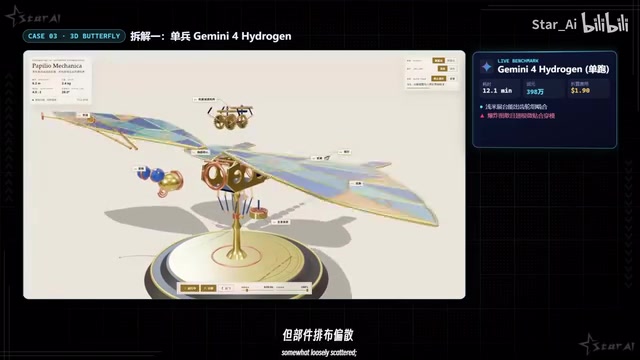
The requirement: a single file depicting polished brass, a blue-steel clockwork frame, and translucent colored glass wings, with real meshing gears in the thorax, wings flapping in phase, support for a one-click auto demo, and an eight-part exploded view.
Gemini 4 Carbon moved it into a dark museum exhibition hall, with green faceted compound eyes paired with polished brass and red stained glass, maximizing the premium feel at only 940,000 total resources, about $1.08. The shortcoming: when the exploded view expands, the gap between the outer wing panels and the core frame is narrow, and under rotation and perspective the part edges occasionally clip slightly.
The Orchestrator arrangement I tested live in Antigravity was even more impressive: using Neon at maximum thinking intensity as the controller, paired with Hydrogen at maximum thinking intensity executing in parallel, it took the same 12.1 minutes as running Hydrogen alone, while total resources dropped to 1.59 million and cost to just $1.41. Completion quality was solidly above 90%, even more refined than running Carbon alone at high thinking intensity.
Challenge 4: St. Peter's Square and Basilica Interior/Exterior
A single-file Three.js reconstruction of St. Peter's Square and the basilica interior and exterior, with an automatic camera path visiting ten viewpoints. Gemini 4 Neo took 25.6 minutes and cost $4.44; the full sequence from the square panorama, portico, colonnade, and dome drum to the basilica's interior main axis was complete, but indoor default exposure was too bright. GPT 6.2 completed it in 21.4 minutes using 1.5 million resources, with warm Roman sunlight that matched the mood, and it flew smoothly straight into the nave. OPUS 5.5 consumed 50.38 million resources—about $27.82—with the highest detail density, but the cost makes you gasp.
Challenge 5: Mona Lisa Painted Purely in Code
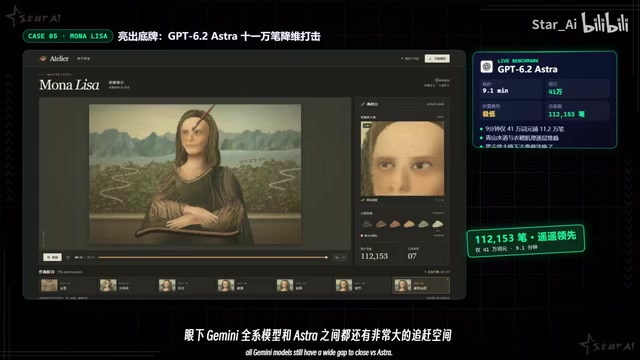
Zero images, zero textures—paint the Mona Lisa purely with Canvas code in 15 seconds using 7 passes of classical glazing, plus a brush-tip magnifier. The gap here was brutal: Gemini 4 Neo's 4,396 strokes smeared into a dirty gray mess, and Hydrogen managed only 2,169 strokes, painting the face as a conical blob—expensive, slow, and broken. OPUS 5.5 layered 1,078 strokes, but the resulting portrait stretched into a stiff, pale, long horse face. GPT 6.2 Astra took only 9.1 minutes and 410,000 resources and actually laid down 112,153 strokes, with the light-and-shadow transitions of classical sfumato and the subject's expression firmly in place. In pure code brushstroke scheduling and artistic visual precision, the entire Gemini line still has a very large gap to close with Astra.
Challenge 6: Two Large 3D Scene Exams Combined
The floating voxel island required ten connected ecosystems with water systems, lava, and day/night and seasonal switching. Gemini 4 Neo turned it in fast in just 17.4 minutes, with the ten biomes arranged compactly; the obsidian intersection zone's purple crystal columns and blazing orange-red lava created strong tension, and the self-illuminating lava river atmosphere on a snowy winter night was top-notch. The shortcoming was that the nearby voxel terrain steps were rather too regular.
The 3D earth-tiger riding a bike challenge required a 48-second auto demo plus native ocean-wave sound effects, testing Google's strength in linking four-season weather transitions, wing-spread takeoff, and coastal scenery. Gemini 4 Neo ran it through completely with excellent dynamic detail—the hooved tiger leaned into turns, the herd smoothly moved from cherry-blossom spring to winter snow, and after coming to a stop they all left their seats and circled into flight. Hydrogen took only 11.5 minutes and $1.42, but at low-angle riding the wing surfaces pressed against and even slightly clipped through the handlebars, and at the 34-second mark when the wing-spread phase began, the camera triggered corner distortion.
Challenge 7: Native GoDot Engine Project
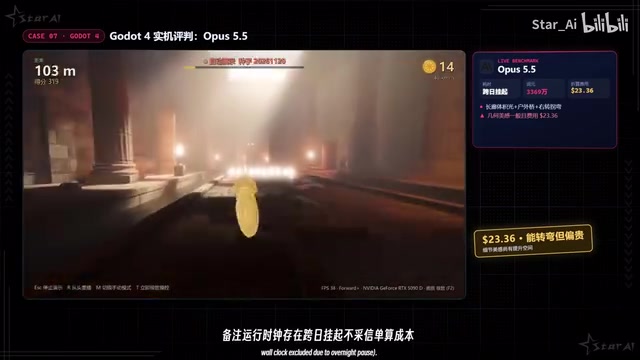
This tested each model's control over complex engineering scripts and real-time rendering. Among the three domestic contenders, Hunyuan's visuals were unbearable, failing consistently throughout the 420-meter map and only spawning distant trap railings and coins right up close. DeepSeek V4.1 Flash stably generated a complete ten-lane path, but modeling detail remained poor. QwenMax was a notch above DeepSeek, with depth and magnet pickups, but pickup detection couldn't keep up with the pace. GPT 6.2 Astra's exterior art was a big step lighter, but the map had only a finite 201-meter length—it never wrote an infinite-loop generation mechanism—and the final stretch ran straight through a stone wall. OPUS 5.5 ranked high in scene richness and actually implemented the track mechanism where the passage turns right, but its geometry lacked fine polish, and the $23 bill stings in terms of value.
Gemini 4 Neo's single-shot scene featured dual-wielded torches and bronze bracers, with gorgeous cave grotto greenery, water flows, mist, and light spots. Its motion smoothness, environmental aesthetics, and stability solidly beat the domestic tier, and it stood its ground even next to OPUS and Astra. Hydrogen was the real ace: 26.2 minutes for only $2.81, and it not only smoothly delivered multi-theme switching and big-turn levels but also packed in ever-accelerating dynamic staircases, auto-attracting coin magnets, and shield defense. The entire auto-run had zero stutter—so smooth it didn't feel like a lightweight model.
Challenge 8: Pure Logic Hard Exam—Lights-Out Puzzle Season 2
All 13 models received identical plain-text prompts, with no code writing and no external tools allowed, and a 30-minute limit per problem. The first problem, a 12x12 low-difficulty grid with forbidden cells and chain locks, crushed the vast majority of domestic models right away: DeepSeek V4.1 Flash scored 1.78, Hai 4 scored 1.59, and Kimi K3.1 Pro scored 1.17—all failed. Among domestic models, only K1 Max at 14.20 and Mini Max M3.1 Flash at 15.11 crashed in the first round and crawled over the threshold via a second-round retake. The second problem, a 16x16 medium-difficulty grid, locked out GPT 6.1 Terra at 17.96, Grok 4.7 at 16.88, and the four Mix models that had passed the retake—all stuck.
Only the top-tier players could really reach the threshold. Gemini 4 Hydrogen cleared four consecutive levels, scoring a six-step line solution on the hard K26 to shoot up to fifth on the overall leaderboard with 73.83 points. Carbon cleared the first four levels for 75.05 points, fourth place. Opus 5.5 got stuck several times on the hard Z1; its chain of thought ran so long that it repeatedly triggered platform safety interception, was automatically downgraded to Opus 5 at one point, and ultimately stopped at three levels cleared with 58.23 total points, falling to sixth behind Carbon and Hydrogen. The top three were the five-level-clear top tier: GPT 6.2 Astra at 94.31, solving the extremely hard K1 in just 64 steps, close to the theoretical lower bound; GPT 6.2 Soul at 93.53, K1 in 110 steps; and Gemini Neo solidly in third at 83.91, solving K1 in 80 steps on its second attempt.
"Lights-out puzzle" problems belong to the class of combinatorial optimization/state-space search problems: on a grid, clicking switches changes the state of adjacent light cells, and the goal is to light the entire board in the fewest steps. Difficulty grows combinatorially with grid size (12x12, 16x16) and additional rules (forbidden cells, chain locks). A model's score on such tasks essentially reflects its long-horizon planning, constraint satisfaction, and search pruning abilities rather than its language ability. Phrases in the text like "six-step line solution" and "64 steps close to the theoretical lower bound" refer to how close the model's solution step count is to the optimal solution or the search lower bound—the fewer steps and the closer to the lower bound, the more effectively the model performs lookahead reasoning rather than trial-and-error guessing.
Orchestrator Mode: A Combo That Gets Both Speed and Quality
How do you use these in daily development to get both speed and reliable quality? Running the lightweight Hydrogen alone is fast and low-threshold, but with complex engineering details and extreme aesthetics it tends to come out flat or even stumble. Running the flagship Carbon or Opus 5.5 alone gives stable quality and on-point aesthetics, but time and bills routinely multiply several times over.
The smooth and efficient approach I found in live Antigravity testing is to enable Orchestrator mode: let Gemini Neo be the controller brain, responsible for requirement decomposition, architecture decisions, visual acceptance, and fixing polish, then hand the bulk code writing, module splitting, and routine verification to Gemini Hydrogen for high-speed parallel execution. Back to the actual bill from Challenge 3's mechanical butterfly: running Hydrogen alone took 12.1 minutes and burned 3.98 million resources, about $1.90, with a flat-looking result; using Orchestrator to have Neon lead Hydrogen in collaboration kept total time at 12.1 minutes while total resources dropped to 1.59 million, costing only $1.41, and the delivered dark-hall red-glass butterfly's quality rivaled the flagship—saving nearly 90% versus Opus 5.5.
Orchestrator mode is an architectural paradigm in current multi-model workflows: a "controller model" with strong planning ability handles requirement decomposition, task dispatch, and result acceptance, then sends concrete coding, verification, and other subtasks to lower-cost, faster "executor models" to complete in parallel. Its value lies in decoupling the relative strengths of different models—using flagship-level judgment to anchor direction and lightweight-model throughput to carry repetitive labor, thereby lowering token consumption and bills while keeping total time essentially unchanged. The combination of Neon coordinating and Hydrogen executing described here is exactly this idea in practice.
Selection Advice and Conclusion
If you have campus Pro benefits, use Hydrogen directly for quick everyday scripting and module edits; for hardcore engineering, complex interactions, and pure logic reasoning, switch straight to Neo; for refined visual typography and long-horizon architecture, you can enable Carbon right now with a Pro subscription; and for big projects, go straight to the Orchestrator combo of Neon coordinating plus Hydrogen executing.
This round of testing reveals a clear signal: the Gemini 4 series has formed an all-around suppression of OPUS 5.5 in engineering completeness, aesthetics, and cost control, but at the very top of pure-code artistic brushstroke scheduling and extremely hard logic reasoning, GPT 6.2 Astra still holds a clear generational lead. Model selection is no longer about a single flagship ruling everything, but about layered scheduling and combined use according to task difficulty.
One-line Summary
A $300 self-funded test of 13 models: all three Gemini 4 siblings beat OPUS 5.5 overall, but still trail GPT 6.2 Astra in pure-code art and the hardest logic.
Paragraph Summary
The author spent $300 to build a local workbench and ran 13 domestic and international models through 8 real-world challenges (Three.js shooter, 15-second creative video, 3D modeling, St. Peter's Basilica, pure-code Mona Lisa, large 3D scenes, GoDot project, and pure-logic lights-out puzzles). The Gemini 4 family performed impressively: Neo, Carbon, and Hydrogen took third, fourth, and fifth overall with 83.91, 75.05, and 73.83 points, all beating OPUS 5.5's 58.23, with clear cost-control advantages—Carbon's creative video cost only $2.02, about a third of OPUS 5.5's. But the pure-code Mona Lisa exposed the Gemini line's brushstroke scheduling weakness, with GPT 6.2 Astra far ahead at 112,153 strokes; Astra also topped the lights-out puzzle leaderboard with 94.31. The author also tested Orchestrator mode: Neon coordinating plus Hydrogen executing was faster, cheaper, and nearly flagship-quality compared with running solo, leading to layered model-selection advice.
Related articles
The New AI Testing Frontier: Deploying Tencent's Open-Source Knowledge Base and Hands-On RAG Evaluation
Starting from AI testing's evaluation challenge, this article covers deploying Tencent's open-source WeKnora, comparing production vs. learning setups, and explaining RAG evaluation principles and hands-on paths.

Why Learn Python in the AI Era? A Deep Dive with the Author of 'Python Crash Course'
Eric Matthes, author of 'Python Crash Course', discusses why Python remains essential in the AI era, the democratization and risks of AI coding tools, and the value of human creators.

Convex Skill Allegedly Uploads User App Ideas to Remote Servers Without Consent
Convex backend skill allegedly sends user app ideas to remote servers without disclosure, sparking Hacker News debate. We analyze the privacy risks and transparency issues.