The New AI Testing Frontier: Deploying Tencent's Open-Source Knowledge Base and Hands-On RAG Evaluation
Deploying Tencent's open-source WeKnora to explain knowledge base/RAG evaluation methods and value in AI testing.
The article notes that AI testing has shifted from judging right/wrong to "evaluation," spanning large models, knowledge bases, and agents, with knowledge base evaluation offering the best value — akin to API testing in traditional testing. It recommends Tencent's open-source WeKnora as an entry product for its big-tech pedigree, rich Chinese resources, full open-source status, and comprehensive features — capable of standalone Q&A and invocation via MCP and Skills by tools like Claude Code. Deployment should match the scenario: containerization plus K8s for production, single-file binary for learning to save resources. The article details hands-on steps from extraction, .env configuration, and script execution to registration and login, plus common error handling, and concludes by introducing RAG principles, noting that follow-up evaluation should focus on retrieval and generation quality.
Title
AI Testing's New Frontier: Deploying Tencent's Open-Source Knowledge Base and Hands-On RAG Evaluation
Meta Description
Starting from the evaluation challenge in AI testing, this article explains how to deploy Tencent's open-source knowledge base WeKnora, compares production vs. learning environment approaches, and breaks down the principles and hands-on path of RAG evaluation.
Article Content
As teams increasingly rely on AI to drive testing, an unavoidable question emerges: who ensures the correctness of the AI itself? Traditional testing judges right from wrong, but in the world of large models, we need a new methodology — evaluation. Among the three directions of AI evaluation (large models, knowledge bases, agents), knowledge base evaluation offers the best value for effort. It can serve both as a standalone product and as an agent component, much like the role of API testing in traditional software testing.
Based on a tech-sharing session from Bilibili, this article walks you through deploying Tencent's open-source WeKnora knowledge base from scratch and understanding the underlying logic of RAG evaluation.
Why Knowledge Base Evaluation Is the "API Testing" of AI Testing
In traditional software testing, API testing delivers the highest return: APIs are both a product and a service for frontends and apps. The same applies to AI agent evaluation — a knowledge base can independently provide Q&A capabilities externally while also being invoked as a component by AI tools like Claude Code.
According to a breakdown by Bilibili creator "Teacher Beifang" in his video, AI evaluation falls into three tiers:
- Large model evaluation: assessing the general capabilities of the base model
- Knowledge base evaluation: assessing the accuracy of retrieval-augmented generation (RAG)
- Agent evaluation: assessing an agent's task planning and execution capabilities
The knowledge base is a good entry point because it's flexible to deploy, highly observable, and rich in Chinese-language resources — ideal for learning and practice.
Retrieval-Augmented Generation (RAG) is the key prerequisite for understanding knowledge base evaluation. The core idea of RAG: when a user asks a question, the system first retrieves the most relevant document chunks from an external knowledge base, then feeds those chunks as context into the large language model, which generates an answer based on that material. Compared to letting the model answer directly from parametric memory, RAG significantly reduces "hallucinations" and makes answers traceable to specific documents. The RAG pipeline is typically split into two stages — retrieval and generation — so evaluation must examine each separately: the retrieval stage looks at recall, hit rate, and ranking quality; the generation stage looks at whether the answer is faithful to the retrieved source text (faithfulness) and whether it actually addresses the question (relevance). This is precisely what fundamentally distinguishes knowledge base evaluation from traditional keyword search testing.
Tencent's Open-Source WeKnora: A Knowledge Management Framework with Big-Tech Pedigree
The knowledge base product recommended in the video is Tencent's open-source WeKnora (official site domain weixin.qq.com), positioned as an enterprise-grade knowledge management framework. The reasons for choosing it are straightforward:
- From a major domestic tech company: Under Tencent WeChat, with abundant Chinese-language resources and highly readable documentation
- Fully open source: GitHub source code available, customizable and privately deployable — when deployed inside a company or project, it's inaccessible from the outside
- Feature-rich: Beyond traditional knowledge base functions like chunking, embedding, storage, and retrieval, it also supports task execution, MCP, Skills, clients, and more
WeKnora also supports generating Wiki pages, where documents and knowledge can be linked to form a knowledge-graph-like structure. In newer versions, it can create MCPs or provide skills that external AI tools like Claude Code and CodeX can invoke. This means it works both as a standalone product and as a "building block" for agent components.
According to the video, the product also offers conversation management, web search, and other features. Interested readers can consult the official documentation.
The MCP (Model Context Protocol) mentioned in the article is an open protocol for letting AI applications connect to external tools and data sources in a standardized way. Think of MCP as the "USB interface" of the AI world: as long as capabilities like knowledge bases, databases, and file systems are exposed as "servers" following the MCP spec, clients that support the protocol — Claude Code, CodeX, and others — can call them directly, without writing separate adapter code for each tool. WeKnora's ability to "create MCPs or provide skills" means it can encapsulate its own retrieval and Q&A capabilities as standard tools for external agents to call on demand. This also explains why a knowledge base can be both a standalone product and an agent component — MCP is precisely the bridge between the two.
Deployment Strategy: Production vs. Learning Environment
The official installation docs provide a containerized approach — one command to launch — but at a high cost. The video author measured that standard deployment alone requires 4 to 8 GB of RAM; on a typical 16 GB dev machine, little memory is left after deployment.
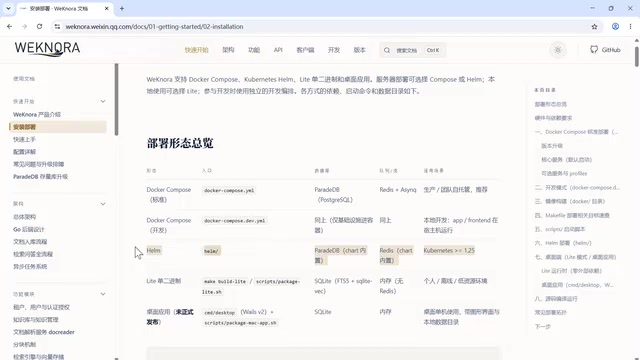
So deployment needs to be split into two scenarios:
Production environment: containerization + K8s
Production environments should use containerized deployment with K8s for one-click launch, provided the hardware is powerful enough. This suits formal internal company use.
Learning environment: single-file binary
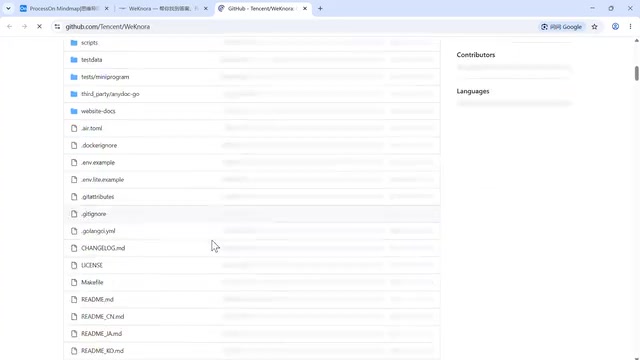
Learning environments don't need production-grade databases, logging, and monitoring — just file-based databases and in-memory storage so any computer can run it. The official docs mention a binary approach, but no precompiled binary is actually provided — only source code is released, and you need to compile it yourself.
For Windows users, the video author (Teacher Beifang) has kindly compiled a Windows version; you can contact the teaching assistant via the comments section to get the archive. Mac and Linux users familiar with compilation can handle it themselves.
Single-file binary deployment means compiling and packaging the program and its dependencies into a directly runnable executable, so that no separate installation of databases, message queues, or other middleware is needed at runtime, with data stored as local files or in memory. Its difference from containerized deployment: containerization emphasizes environment isolation, orchestration, and easy horizontal scaling, suitable for multi-user shared use and production operations; the single-file approach pursues "download and run," sacrificing high availability and observability in exchange for extremely low resource usage and zero configuration overhead. So for learning, demos, or single-machine validation, the single-file approach is the most economical; once you need to provide external services with backup and monitoring, you should return to the containerized approach. The article emphasizes that the official release only provides source code without a precompiled binary, also because the single file must be compiled separately for different operating systems and architectures.
Step-by-Step Launch: From Extraction to Access
Once you have the archive, the deployment process is:
- Extract: you get a directory containing the main program (about 200+ MB)
- Create a
.envfile: copy the example file and rename it for environment variable configuration - Run the script: execute
start.ps1(a PowerShell script) — don't double-click; run it from the command line
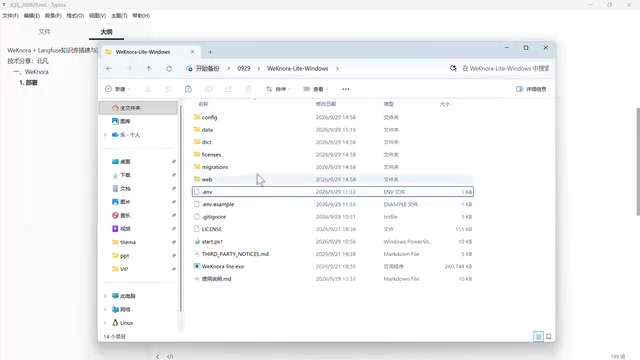
Key configurations in the .env file include:
- Whether to enable certain features: default
false, ignore for now - Server listen address: keep the default port
8215for local use; for external access, change to0.0.0.0and80 - Keys and data directory: auto-generated, keep defaults
If startup reports "can't find .env file," check whether the file path is correct; if it reports a decryption failure, it's usually because the data directory already contains old data whose keys don't match those in .env — delete the data directory and restart. On first install the data is empty, so a new key is generated automatically.
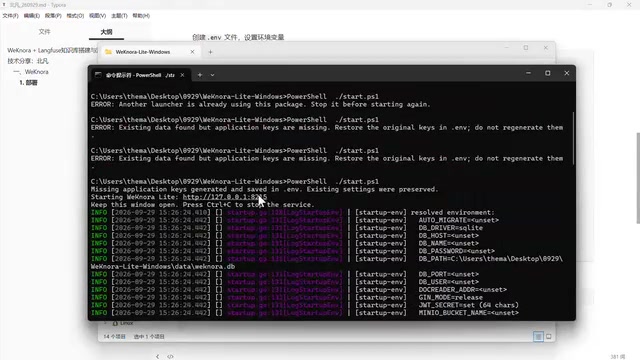
After successful startup, visit the local address to see the login screen. Since it's a fresh deployment with no accounts, you need to register first. WeKnora manages data by space and user, so even for personal use you need to create an account.
The video author also mentions a minor issue with the current binary version: there's no logout button after logging in. As a test engineer, you can force logout by clearing cookies and storage via developer tools, or wait for a future version update. Since the project is open source, you could also wrap an outer service to customize registration and logout logic.
From Deployment to Evaluation: Knowledge Base Principles and Next Steps
Deployment is only the beginning. The video ends by raising the key question: what is the principle behind a knowledge base? What's discussed here isn't traditional keyword search but RAG (Retrieval-Augmented Generation).
Traditional knowledge base search returns a passage directly, whereas RAG retrieves relevant document chunks and hands them to a large model to generate an answer. Evaluating RAG requires attention to dimensions like retrieval quality and generation faithfulness. This is also the core of the follow-up hands-on work — after setting up the knowledge base, conduct evaluation and testing around its principles and features.
When evaluating a RAG system, several common metrics are worth establishing concepts for first: Recall measures how much of the relevant knowledge was retrieved; Hit Rate checks whether the correct chunk appears in the returned results; Faithfulness judges whether every part of the generated answer can be found in the retrieved source text, identifying content the model fabricated; Answer Relevancy examines whether the answer is on topic. In practice, a common approach is "LLM-as-a-judge" — using a more capable model as the judge to score Q&A results along these dimensions, turning the subjective "is the answer good?" into quantifiable, regressable scores. This is also the core method that distinguishes AI evaluation from traditional assertion-based testing.
Key Takeaways
- The new proposition of AI testing is evaluation: traditional right/wrong judgments no longer suffice; you need a three-tier evaluation system covering large models, knowledge bases, and agents.
- Knowledge base evaluation offers the best value: it has the dual nature of product and component, akin to API testing's place in traditional testing.
- WeKnora is great for getting started: open-sourced by Tencent, rich in Chinese resources, feature-complete, with private deployment and external tool invocation.
- Deployment should match the scenario: containerization for production, single-file binary for learning, to avoid wasting resources.
- RAG is the core principle of knowledge bases: evaluation should focus on the retrieval-augmented generation pipeline, not simple keyword matching.
This article is compiled from a Bilibili tech-sharing video. For product deployment details, refer to the official documentation.
One-line Summary
Starting with deploying Tencent's open-source WeKnora, this article explains the methods and value of knowledge base/RAG evaluation within AI evaluation.
Paragraph Summary
The article notes that the core of AI testing has shifted from judging right/wrong to "evaluation," split into three tiers: large models, knowledge bases, and agents, with knowledge base evaluation offering the best value — akin to API testing in traditional testing. The author recommends Tencent's open-source WeKnora as an entry product for its big-tech pedigree, rich Chinese resources, full open-source status, and comprehensive features — it can independently provide Q&A and also be invoked via MCP and Skills by tools like Claude Code. Deployment should match the scenario: containerization plus K8s for production, single-file binary for learning to save resources. The article details hands-on steps from extraction, .env configuration, and script execution to registration and login, along with common error handling, then introduces RAG principles and points out that follow-up evaluation should focus on retrieval and generation quality.
Related articles

MIT PhD Takes You from Scratch to Build DeepSeek: A 25-Hour Hardcore Course
MIT PhD Raj Dandekar launches a 25+ hour Bilibili course building DeepSeek from scratch—MoE, MLA, GRPO, hand-written code plus math derivations, aiming to reproduce mini R1.
DeepSeek Harness in Practice: From Installation to Plugin Ecosystem, Building a Fully Automated AI Workflow
Based on a hardcore Bilibili tutorial, this guide systematically covers DeepSeek Harness installation, three plugin installation methods, and real-world use cases to help developers quickly build customizable AI Agent workflows.
DeepSeek Harness in Practice: From Installation to Automated Workflows
Hands-on DeepSeek Harness tutorial covering Mac/Windows installation, login, workspace binding, model & permission setup, and minimal closed-loop verification for AI automation workflows.