Gemini 4 Neon Review: Benchmark Scores Rival Carbon, API Pricing and Quota Breakdown

Gemini 4 Neon review: benchmark scores rival Carbon, quota more durable, but AntiGravity remains the weak point.
Google suddenly launched Neon, the fourth model in the Gemini 4 series, positioned between Carbon and Hydrogen, but actual benchmarks closely track Carbon—even one point higher—and it can replace 90% of Carbon scenarios. API pricing is input 3/output 15, twice that of Hydrogen, offering better value than Carbon (whose price doubles after November 30). Key finding: in AntiGravity, Carbon quota consumption is 3 times the API price, while Neon and HG are charged at list price—so within five hours on Pro subscription, Neon's available quota is 35 vs. Carbon's 5. Available channels: gifted Pro subscriptions cannot use Neon in AntiGravity; paid Pro or Ultra required. Community tests show impressive video generation and game demos. The creator warns that 2API relay leads to account bans with only one unban chance. Overall, Neon is a sweet-spot mainstay model, but AntiGravity's stability and speed issues remain weak points.
Gemini 4 Neon Review: Benchmark Scores Rival Carbon, API Pricing and Quota Breakdown
Google has suddenly launched Neon, the fourth model in the Gemini 4 series, available across all platforms. Bilibili creator DP conducted detailed testing and information gathering immediately after release. This model is positioned between Carbon and Hydrogen, but its actual performance surprised many testers—it not only serves as a Carbon replacement but in some scenarios even scores higher. This article is based on that video content, combined with community feedback, and provides a systematic overview across performance, pricing, quota, and available channels.
Performance: Benchmark Scores Closely Track Carbon, Sufficient for Daily Use
Officially, Neon is positioned between 1 Carbon and 3 Hydrogen, but according to Artificial Analysis (AA) benchmarks, Neon and Carbon scores are very close—Neon even scores one point higher. The creator verified this in actual testing and believes Neon can replace 90% of Carbon's use cases.
This means for most daily tasks, Neon is already sufficient. The creator's assessment is "good and fast"—they prioritize using it in daily work, even replacing Carbon with it. From a positioning standpoint, Google says Neon replaces Argon, but in actual use it has reached Carbon's level, and in many scenarios behaves more like a faster Carbon.
Interestingly, after Neon's release, the Gemini 4 family has allowed Google to firmly reclaim the world's second-place ranking across pricing, speed, quota stability, and ease of use. Of course, speed slowdowns due to insufficient compute and zero-caching issues still occur intermittently.
Artificial Analysis (AA) is an independent AI model evaluation and benchmarking platform that scores models through standardized tests (such as MMLU, HumanEval, GSM8K, etc.) and compiles comprehensive rankings. AA scores are commonly used to compare capabilities across different vendors and model generations. The mention in this article that "Neon and Carbon's AA scores are very close, with Neon even one point higher" refers to the composite score on this platform. Note that AA's scoring system adjusts as test sets are updated, and different task types carry different weights, so a single score cannot fully represent actual experience—but as a quick reference it remains highly valuable.
API Pricing and Quota: Strong Value, Quota Strategy Has Nuances
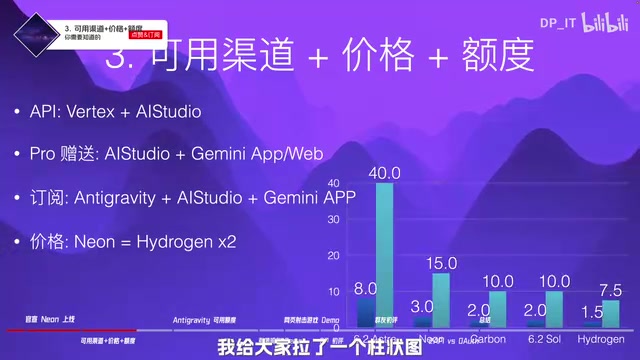
On pricing, Neon's API rates are 3 for input and 15 for output, while Hydrogen (HG) is 1.5 and 7.5—exactly half of HG. The creator pulled a bar chart comparing the Carbon series and HG series, finding that Neon offers good value compared to Carbon (especially considering Carbon's price doubles after November 30). On the right side, GPT 6.2 Soul is priced close to HG, which is reasonable for an execution model.
This leads to a conclusion: Neon's quota is half of HG's, because the price difference is twofold. But this is just surface numbers—what really matters is the quota consumption rules in AntiGravity.
"Input/output" in API pricing refers to how large language models bill separately for input tokens (prompts) and output tokens (generated content) when processing requests. Output token unit prices are typically much higher than input tokens because the generation process requires more computational resources. In this article, Neon's pricing of "input 3, output 15" means $3 per million tokens for input and $15 per million tokens for output, while Hydrogen is 1.5 and 7.5—exactly half of Neon. This pricing difference directly reflects differences in model scale or inference costs, and is an important trade-off factor when users choose models.
AntiGravity Quota Mechanism: Carbon Consumes Three Times, Neon and HG More Durable
This is a key point the creator emphasized: in AntiGravity, calling Neon and HG deducts quota according to API list prices, but calling Carbon consumes quota at 3 times the API price. This conclusion comes from cross-verification by group members' testing and B1, an expert who has long studied AntiGravity.
Converting this, on Pro, Ultra 5X, and Ultra 20X subscriptions, the five-hour quota and weekly quota both show the same pattern. Taking Pro as an example, within five hours Carbon's available quota is 5, while Neon and HG's available quota is 35. In other words, Neon and HG quotas are far more durable than Carbon's.
This is good news for heavy users—the previous complaints about insufficient Gemini quota have been somewhat alleviated. But the creator also notes that insufficient compute and zero-buffering issues persist, and request speeds can sometimes slow noticeably.
AntiGravity is an AI agent platform launched by Google that allows users to automatically complete complex tasks such as programming, video generation, and game development through natural language instructions. It calls the Gemini series models behind the scenes, but quota consumption rules differ from directly calling the API: the platform deducts subscription quota based on the model's API list price multiplied by a coefficient. This article points out that calling Carbon uses a coefficient of 3, while calling Neon and Hydrogen deducts at list price (coefficient 1). This means under the same subscription quota, Neon and HG can execute more tasks, which is more friendly to heavy users.
Available Channels and Subscription Restrictions
Neon is available without restrictions through Vertex and AI Studio in API channels. But in AntiGravity, subscription type determines availability: student and Jew subscriptions cannot use it; Pixel or paid Pro subscriptions can; Ultra subscriptions also can.
In summary: gifted Pro subscriptions can only use Neon in AI Studio and Gemini App; paid Pro or higher Ultra subscriptions are required to call Neon in AntiGravity, AI Studio, and Gemini App.
Community Testing: Video Generation and Game Demos Perform Impressively
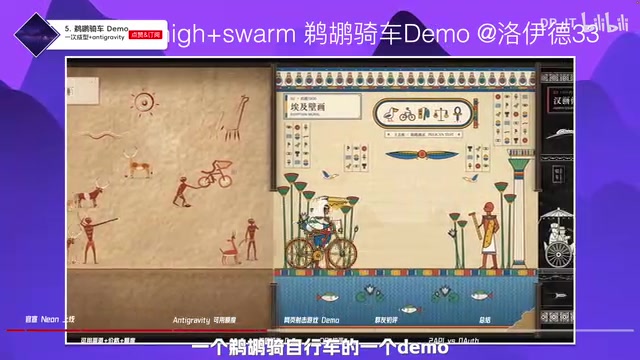
Group member Luoyide33 used Neon in AntiGravity with X-High and Swim modes to generate a video of someone riding a bicycle in the sky in one shot, with surprisingly impressive detail. Another group member Cangtiange used GM9 for Neon to create a shooting game demo, also completed in one pass, with high-quality shooting operation details and completeness. The creator said they would post the HTML prompts and related content on their website for reference.
Usage Recommendations and Risk Warnings
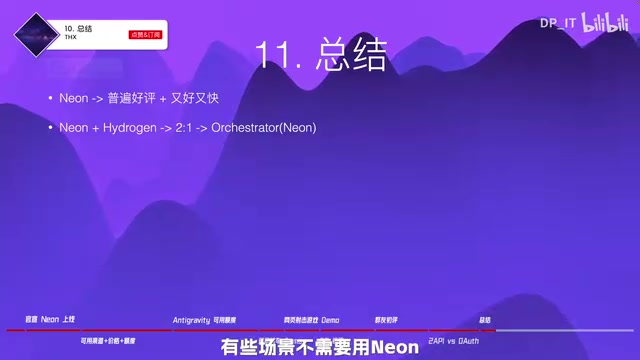
The creator recommends focusing on the combination of Neon and Hydrogen, since their prices are in a 2:1 ratio. Some scenarios don't require Neon—using Hydrogen for execution is sufficient, combined with Orchestrator mode to schedule Neon.
Regarding 2API (third-party API relay) and OAuth, the creator explicitly warns: users who choose 2API will ultimately get their accounts banned, which is very troublesome. If banned, there is only one chance for unbanning, requiring filling out a form through a designated link. The creator also suggests that the official team consider opening OAuth as a transitional solution.
2API (third-party API relay) refers to users calling model APIs through unofficial relay services, typically marketed with lower prices or bypassing regional restrictions. But such services often violate terms of service and carry risks of key leakage and service instability. In this article, the creator explicitly warns that using 2API will result in account bans, with only one chance for unbanning. OAuth is an official authorization mechanism that allows third-party applications to access account resources with user authorization, offering higher security. The creator's suggestion to open OAuth as a transitional solution is precisely to balance convenience and compliance.
Summary: Neon Is a Sweet-Spot Mainstay Model, but AntiGravity Remains the Weak Point
Pros: qualitative leap in speed; can serve as a main replacement, especially for Carbon; broad use cases; more durable quota (three-times quota mechanism); Google accounts relatively easy to obtain.
Cons: AntiGravity is the biggest complaint; about 10% of scenarios may be worse than Carbon; historical issues like slow speeds and zero-caching persist.
The creator ends with a question: given Gemini 4's current state and the model selector screenshot Google showed in AI Studio, will there be an even stronger model released above Carbon? Judging from the model selector layout, the Gemini 4 family's expansion is far from over—and the time and space left for open-source model vendors may not be much.
One-line Summary
Gemini 4 Neon review: benchmark scores rival Carbon, quota more durable, but AntiGravity remains the weak point.
Paragraph Summary
Google suddenly launched Neon, the fourth model in the Gemini 4 series, positioned between Carbon and Hydrogen, but actual benchmarks closely track Carbon—even one point higher—and it can replace 90% of Carbon scenarios. API pricing is input 3/output 15, twice that of Hydrogen, offering better value than Carbon (whose price doubles after November 30). Key finding: in AntiGravity, Carbon quota consumption is 3 times the API price, while Neon and HG are charged at list price—so within five hours on Pro subscription, Neon's available quota is 35 vs. Carbon's 5. Available channels: gifted Pro subscriptions cannot use Neon in AntiGravity; paid Pro or Ultra required. Community tests show impressive video generation and game demos. The creator warns that 2API relay leads to account bans with only one unban chance. Overall, Neon is a sweet-spot mainstay model, but AntiGravity's stability and speed issues remain weak points.
Related articles

Gemini 4 Helium Coming Soon? Signals of Google Loosening Subscription Restrictions
Google team member hints releases will continue; community speculates Gemini 4 Helium (Flash Lite) may be next. Subscription ban controversy gets a response as product lead says "Soon," suggesting restrictions may be lifted. This article covers Gemini developments, OpenAI Coding Agent and risk management, Doubao real-time audio-video API, and compute business dynamics.

AI-Assisted React Development in Practice: Optimizing a Video App and Handling Errors
A 14-year veteran developer demonstrates AI-assisted React video app optimization: compressing video from 80MB to 5MB (~94%) via ImageKit, plus reliable error handling and retry mechanisms. Includes planning, code understanding, and verification methods for working with AI.

Incident Response in the Age of AI Attackers: A 6-Month Retrospective and the Four Pillars
AI attackers are making attacks on AI infrastructure more frequent. This article explains MarkTechPost's four-pillar incident response playbook based on a 6-month retrospective, with Fireworks AI and Klue case studies on implementation.