Gemini 4 Hydrogen Benchmark Scores Explained: Coding and AI Agent Performance
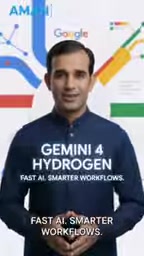
Gemini 4 Hydrogen focuses on execution and agent capabilities, with standout computer operation and automation benchmarks, but weaker code fixing.
Gemini 4 Hydrogen is a new Google model targeting everyday tasks, coding, and AI agents, emphasizing execution efficiency over general conversation. It scores 13.5% on SWE-bench but 57% on Terminal Bench, showing tool calling and terminal operation outperform complex code fixing; Automation Bench 76.76% and Knowledge Work 71.6% indicate more stable process-driven performance; OS World 77.6% shows outstanding GUI operation, while MMMU 53.44% indicates medium multimodal understanding. It supports a 1M token context, scores 58.8% on HLE Diamond, and its API starts at $1.5 per million input tokens. Overall, it is better suited as an underlying engine for AI agents rather than a pure conversational assistant.
Gemini 4 Hydrogen Benchmark Scores Explained: Coding and AI Agent Performance
Google has released a new model called Gemini 4 Hydrogen. According to the YouTube channel Aman Tech, the model's positioning is very clear: it targets everyday tasks, coding, and AI agent scenarios, with a focus on execution speed and task completion efficiency. For developers watching how large models get deployed, this positioning alone is worth noting—it doesn't emphasize general conversation ability, but puts the weight on "getting work done."
This article breaks down Gemini 4 Hydrogen's performance across different dimensions based on the channel's hands-on testing and published benchmark data, and analyzes what these numbers mean for practical use.
Coding Ability: SWE-bench and Terminal Bench Performance
Coding is the most closely watched part of the data released this time. Gemini 4 Hydrogen scores 13.5% on SWE-bench and 57% on Terminal Bench.
These two metrics point to different types of coding ability. SWE-bench typically measures a model's ability to resolve issues in real code repositories, involving multi-file understanding, patch generation, and logical reasoning—it's quite difficult. Terminal Bench leans more toward operations and task execution in a command-line environment, examining the model's stability in terminal interactions. The 57% Terminal Bench score shows it has a certain level of usability when it comes to "operating a system environment according to instructions," while the SWE-bench result reflects that real-world engineering fix scenarios remain a challenge.
The gap between the two also suggests a judgment: Gemini 4 Hydrogen's strengths are more likely in tool calling and task orchestration rather than building complex code patches from scratch.

The difference between SWE-bench and Terminal Bench
SWE-bench, short for Software Engineering Benchmark, is derived from resolved GitHub issues in real open-source repositories (such as Django and scikit-learn), requiring the model to generate a patch that passes tests given a codebase and problem description. It tests cross-file localization, dependency understanding, logical reasoning, and patch correctness—an "end-to-end bug fixing" capability. Scores are generally low, and even current top models often land in the 20%–40% range.
Terminal Bench focuses on the command-line environment: the model needs to execute commands in a shell, read and write files, install dependencies, and complete specified tasks, with the criterion being whether the final system state is correct. It's closer to the "agent operating a computer" scenario, testing instruction following, error recovery, and tool-calling stability. The large difference between the two scores precisely shows that the model's strength lies in interactive execution rather than pure code reasoning.
Knowledge Work and Automation: Knowledge Work 71.6%, Automation Bench 76.76%
On knowledge work tasks, the model scores 71.6% on the Knowledge Work benchmark and 76.76% on the Automation Bench.
Looking at these two scores together is interesting. Automation Bench being higher than Knowledge Work shows the model performs more steadily on structured, process-driven automation tasks, with a slight drop-off in knowledge work scenarios that require comprehensive understanding and judgment. This aligns with its product positioning of "targeting everyday tasks and agents"—clear, repetitive processes are exactly the part AI agents are best at taking over.
For teams planning to integrate the model into workflow automation, a level of 76.76% means most standard process tasks can be handed to the model, but a human verification step should still be retained.
What Knowledge Work and Automation Bench measure
The Knowledge Work benchmark typically simulates white-collar daily tasks such as organizing materials, writing summaries, and comparing information across documents, requiring the model to comprehensively understand, judge, and produce usable results. The difficulty lies in fuzzy task boundaries and the need for common sense and contextual grasp. Automation Bench targets structured processes, such as filling in forms according to fixed rules, triggering multi-step operations, and handling standardized data flows, where task steps are clear and success conditions are quantifiable.
The lower score on the former shows the model still fluctuates on open-ended judgment, while the higher score on the latter reflects stable execution on tasks with clear rules and enumerable steps. This comparison offers direct reference for deployment selection: the more standardized the process, the more reliable the model takeover; the more judgment depends on context, the more human review is needed.
Computer Operation and Multimodality: OS World 77.6%, MMMU 53.44%
In terms of Computer Use capability, Gemini 4 Hydrogen scores 77.6% on OS World. This number is quite prominent, showing the model achieves a high completion rate on tasks simulating operating system interface operations (clicking, typing, interface navigation)—a core capability supporting AI agents in autonomously operating software.
On multimodality, the MMMU score is 53.44%. Compared with the high score in computer operation, multimodal understanding is at a medium level, suggesting it is not strongest in image-text hybrid reasoning. If your scenario is mainly interface operation, this shortcoming has limited impact; but if the task relies heavily on image understanding and cross-modal reasoning, careful evaluation is needed.

What OS World and MMMU test
OS World is an agent benchmark in a real operating system environment, where the model observes the screen through screenshots and outputs actions such as clicks, typing, and scrolling to complete cross-application tasks (such as opening a browser to look up information and fill it into a form). It tests visual localization, interface understanding, and multi-step planning simultaneously; 77.6% is a relatively high level, indicating the model has fairly reliable GUI operation capability.
MMMU (Massive Multi-discipline Multimodal Understanding) uses university-level, cross-disciplinary image-text questions to test multimodal reasoning, covering charts, formulas, diagrams, and more, requiring the model to combine images and text for deep understanding. 53.44% is in the medium range, indicating it is not top-tier in pure visual semantic reasoning, forming a combination with the high OS World score of "can operate but may not deeply understand images."
Context Window and High-Difficulty Reasoning: 1 Million Tokens and HLE Diamond 58.8%
Gemini 4 Hydrogen's context window reaches 1 million (10 Lakhs) tokens. This capacity means a large codebase, long documents, or complete conversation history can be placed in at once, offering direct value for tasks like code review and long-document analysis.
On the high-difficulty reasoning benchmark HLE Diamond, the model scores 58.8%. This result shows it has strong capability on questions requiring deep reasoning, complementing the earlier execution-oriented positioning: it can both take action and handle complex problems that require thinking.

The significance of HLE and a million-token context
HLE (Humanity's Last Exam) is a high-difficulty comprehensive test for large models launched in recent years, with questions written by experts in various fields, covering mathematics, physics, law, humanities, and more, aimed at distinguishing top models—ordinary models often score in the single digits. HLE Diamond is its high-difficulty subset or a specific version; 58.8% is a score significantly above average, showing the model has a strong foundation in deep reasoning and cross-disciplinary knowledge retrieval.
A million-token context means a single request can hold roughly hundreds of thousands of Chinese characters or tens of thousands of lines of code, suitable for whole-repository review, long report analysis, and multi-turn conversation memory. But note that long context linearly drives up input cost, and the model's recall of mid-section information in ultra-long texts may still decay, so key information should be placed toward the beginning or end in actual use.
API Pricing and Applicability Assessment
On pricing, Gemini 4 Hydrogen's API starts at $1.5 per million input tokens. Combined with the above data, a rough applicability assessment can be given:
- Suitable for: scenarios requiring the model to operate system interfaces, execute process-driven automation tasks, and handle ultra-long context documents;
- Needs evaluation: high-difficulty real-world code fixing and tasks relying on deep multimodal understanding;
- Cost consideration: although million-level context is powerful, long input significantly drives up per-call cost, so budgeting should be based on actual task length.
Overall, Gemini 4 Hydrogen is a model leaning toward "execution capability"—high scores on computer operation and automation benchmarks, combined with million-level context and a relatively affordable input price, make it more suitable as the underlying engine for AI agents rather than a pure conversational assistant. The above data all come from the Aman Tech channel's introduction; actual performance still needs to be confirmed by more independent testing.
One-line Summary
Gemini 4 Hydrogen focuses on execution and agent capabilities, with standout computer operation and automation benchmarks, but weaker code fixing.
Paragraph Summary
Gemini 4 Hydrogen is a new model from Google targeting everyday tasks, coding, and AI agents, emphasizing execution efficiency over general conversation. Test data shows it scores only 13.5% on SWE-bench but 57% on Terminal Bench, indicating tool calling and terminal operation are stronger than complex code fixing; Automation Bench 76.76% and Knowledge Work 71.6% show more stable performance on process-driven tasks; OS World 77.6% shows outstanding GUI operation capability, while MMMU 53.44% indicates medium-level multimodal understanding. The model supports a 1 million token context, scores 58.8% on HLE Diamond, and its API starts at $1.5 per million input tokens. Overall, it is better suited as an underlying engine for AI agents rather than a pure conversational assistant.
Related articles

FBI Warns: Hackers Weaponize AI Agent ARTEX to Attack 200+ Organizations
FBI warns that AI penetration framework ARTEX is being used to attack 200+ organizations, with CrowdStrike tracking the VaporPanda group. We break down ARTEX's agent orchestration architecture, the real attack chain, loss data, and the FBI's five defense recommendations.

FBI Warns: Free AI Hacking Tool Artex Spirals Out of Control, Breaches Cloud Systems in Three Hours
FBI warns that the free open-source AI penetration tool Artex is being abused by criminals and state-backed hackers to breach cloud systems in as little as three hours. This article analyzes real attack cases, overlooked side-door risks, and defense measures enterprises and individuals can take immediately.

Verse Engine: Turn Blender/Unity/Unreal Scenes into Browser 3D Links in One Click
Verse Engine by Ctruh is a browser-native 3D and XR engine that publishes Blender, Unity, and Unreal scenes as browser links in one click. View-based streaming opens a 1.03 billion-triangle city scene on a laptop. It offers embeds, API, and SDK for developers, 3D artists, architecture, and e-commerce teams.