Gemini 4 Hydrogen Hands-On: Google's New Daily Driver Model

Google launches Gemini 4 Hydrogen, a speed-first daily driver model with outstanding value.
Two days after releasing Gemini 4 Carbon, Google launched Gemini 4 Hydrogen—not a replacement, but a speed-focused "daily driver" for everyday use. According to early hands-on testing, Hydrogen responds noticeably faster than stronger models in knowledge work like admin tasks, emails, and PDFs/spreadsheets. Benchmarks show it wins most comparisons and surpasses the previous flagship Argon on the Artificial Analysis Intelligence Index at the default high thinking level. API pricing is $1.50/$7.50 per million input/output tokens—cheaper than Carbon but pricier than Flash. Tests generated a space fighter game in 15 minutes and an explainer video in under 10, with writing quality near human level. Hydrogen rolls out globally, with free users accessing it through automatic model selection and developers able to use it on AI Studio and other platforms.
Google Releases Gemini 4 Hydrogen: A Daily Driver, Not a Flagship Replacement
According to a hands-on review shared by a Bilibili creator, Google launched Gemini 4 Hydrogen just two days after releasing its frontier model Gemini 4 Carbon. Contrary to speculation, Hydrogen is not a replacement for Carbon, but rather Google's new "daily driver" model aimed at everyday use cases. The creator received about a day of early access and conducted preliminary testing.
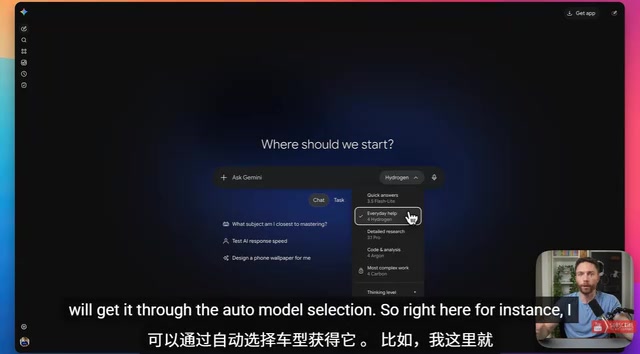
Google's official announcement highlights four areas where Hydrogen excels: rapid debugging and iteration of codebases, open-ended agentic execution, multimodal knowledge work, and web development. Overall, Google's positioning of Hydrogen centers on speed. The creator felt this keenly in knowledge work scenarios: when handling administrative tasks, assisting with emails, drafting PDFs, creating spreadsheets, charts, and presentations, Hydrogen's response speed is noticeably faster than more powerful models.
Performance and Cost: Balancing Intelligence and Overhead
According to benchmarks provided by Google, Hydrogen was compared against Sonnet and Terra and won in most tests. More importantly, at the default high thinking level, Hydrogen surpassed Argon—Google's previous generation's most advanced model—on the Artificial Analysis Intelligence Index. This means that in some respects, Hydrogen's capabilities have already exceeded those of the previous flagship.
In terms of API pricing, Hydrogen costs $1.50 per million input tokens and $7.50 per million output tokens. This is more expensive than Gemini 3.8 Flash but cheaper than Carbon. Note that Carbon is currently in a discount period; once the discount ends, the price gap between Hydrogen and Carbon will become more significant.
The Artificial Analysis Intelligence Index is an independent third-party benchmarking platform that comprehensively scores mainstream large language models through a series of standardized tasks (such as reasoning, coding, math, and knowledge Q&A), presenting results as radar charts or overall scores. The index is widely cited in the industry because its test set covers a broad range and is updated promptly, providing a relatively objective reflection of each model's strengths and weaknesses across different capability dimensions. It is worth noting that the Intelligence Index focuses on general capabilities and does not directly equate to real-world performance in specific scenarios (such as code debugging or multimodal generation), so it is often used as one reference metric for model selection rather than the sole basis.
"Per million tokens" in API pricing is the standard unit for measuring the cost of calling large models. A token is the smallest unit of text a model processes, roughly equivalent to one English word or half a Chinese character. Input cost refers to the token cost of the prompts users send to the model, while output cost refers to the token cost of the model's generated responses. Output costs are typically higher than input costs because the generation process requires more computational resources. Taking Hydrogen as an example, $1.50 per million input tokens means processing roughly 750,000 Chinese characters' worth of prompts costs $1.50, while $7.50 per million output tokens corresponds to the cost of generated content. This pricing method helps developers estimate expenses for batch calls or high-frequency usage.
Hands-On Examples: Rapidly Generating Games and Videos
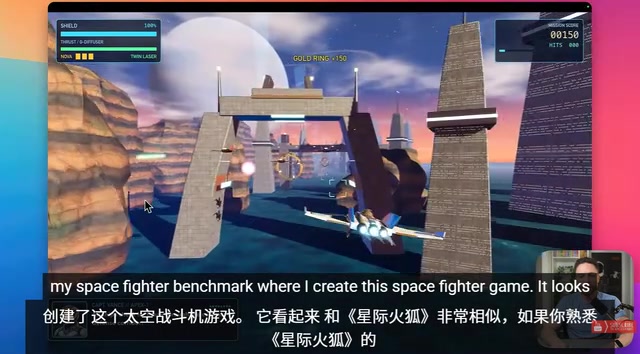
The creator demonstrated several examples built with Hydrogen. The first is a space fighter game called "Space Fighter Benchmark," styled similarly to Star Fox. Using Gemini 4 Hydrogen High, the entire game took only 15 minutes to generate. Although the visuals are more blocky and retro than the version generated by Carbon, it has a unique feature: messages from teammates and enemies pop up in the bottom-left corner, which other versions lack. For a game generated in 15 minutes, the result is impressive.
The second example is an ink-style explainer video, requested with no sound and no narration—just visuals. It was generated in under 10 minutes, and the visuals are quite good. The creator deliberately gave the model greater freedom to see how it would perform autonomously. While more dynamism was desired, the overall look is solid.
The third video allowed sound and took about 23 minutes. The concept involves two people being chased by wolves, with the animation style switching each time they pass through a door. The creator liked some of the animation styles but admitted the video is far from perfect, with certain parts turning chaotic. Still, it was generated in a single pass.

The creator's conclusion: if you need highly polished games or motion graphics, use a more powerful model like Carbon; but for rapid generation and prototyping, Hydrogen is faster and cheaper. You can use Hydrogen first to nail down the concept, then switch to Carbon for refinement.
The "High" thinking level is a reasoning-intensity adjustment mechanism introduced in Google's Gemini series models. Before generating a response, the model performs internal "thinking" (i.e., chain-of-thought reasoning). The higher the thinking level, the more reasoning tokens the model consumes, and the more rigorous and less error-prone the answer typically is—but at the cost of slower response and higher expense. Hydrogen offers levels such as High, which users can select based on task complexity. The article mentions that "at the default high thinking level" Hydrogen surpasses Argon on the Intelligence Index, meaning that even at higher reasoning intensity, Hydrogen maintains its speed advantage—reflecting improvements in architectural efficiency.
Writing and Administrative Tasks: Approaching Human Level
Hydrogen performs excellently in administrative work and writing. The creator asked it to write a script for a new cloud feature called Claude Whiteboard, and the model accessed a folder containing tone and style guidelines, as well as transcripts of past YouTube videos. The generated script opens as follows: "Claude Whiteboard solves this by giving you a live visual board right inside your Claude. You can speak messy thoughts and let Claude organize them into shapes, arrows, and timelines, and collaborate with your team on the board..."
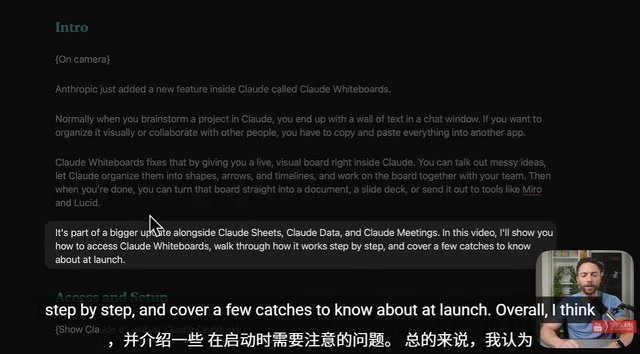
The creator rated this as a very strong YouTube video opening—AI often struggles to write text that sounds human, but Hydrogen does it well. Gemini has always performed well in writing, and Hydrogen continues that strength.
Availability and Summary
Hydrogen is rolling out globally starting today, and nearly everyone can use it. Free users gain access through automatic model selection. Developers can use it across all tiers of Google AI Studio, the Gemini API, and paid tiers of Android Studio. In Anti-Gravity and Google Sheets, Google AI Pro and Ultra subscribers are required.
Having tested it for less than 24 hours, the creator emphasizes these are only preliminary impressions. While Hydrogen is not as powerful as Carbon, it strikes a good balance between intelligence and cost, making it an ideal daily driver: cheap enough to use all day, yet smart enough to be worth using frequently. Argon and Carbon are suited for the most important tasks and planning, while everyday use calls for a model like Hydrogen. The creator says this is exactly the new Google daily driver he has been waiting for.
One-line Summary
Google launches Gemini 4 Hydrogen, a speed-first daily driver model with outstanding value.
Paragraph Summary
Two days after releasing Gemini 4 Carbon, Google launched Gemini 4 Hydrogen—not a replacement, but a "daily driver" model for everyday use cases, emphasizing speed. According to the creator's early hands-on testing, Hydrogen responds noticeably faster than more powerful models in knowledge work scenarios such as administrative tasks, email assistance, and creating PDFs and spreadsheets. Benchmarks show it wins in most comparisons, and at the default high thinking level, it surpasses the previous flagship Argon on the Artificial Analysis Intelligence Index. API pricing is $1.50 per million input tokens and $7.50 per million output tokens—cheaper than Carbon but more expensive than Flash. In testing, it generated a space fighter game in 15 minutes, an explainer video in under 10 minutes, and produced writing quality approaching human level. Hydrogen is rolling out globally, with free users accessing it through automatic model selection and developers able to use it on platforms like AI Studio.
Related articles

OpenAI to Shut Down Agent Builder and Two Other Services on November 30, Developers Must Migrate Urgently
OpenAI will shut down Agent Builder, the evals dashboard, and reusable prompts on November 30; evals is already read-only. Here's the scope, OpenAI's migration paths (Agent SDK, PromptFu, your own code), and what developers should export and rebuild this week.

RankSpot: A Pay-Per-Use SEO & AI Search Execution Layer That Lets Agents Write, Publish, and Build Backlinks for You
RankSpot is an SEO & AI search execution layer for AI Agents. Connect via MCP to Claude or ChatGPT to write, publish & build backlinks. Pay-per-use, $3/article.

Appxiom: Giving AI Coding Assistants Production Context
Appxiom gives AI coding agents production context—crashes, jank, memory leaks, failed network calls—across Android, iOS, Flutter, KMP, and Web, ranking bugs by Goal Friction Impact.