Gemini 4 Hydrogen Hands-On: Google's New Everyday Workhorse Model
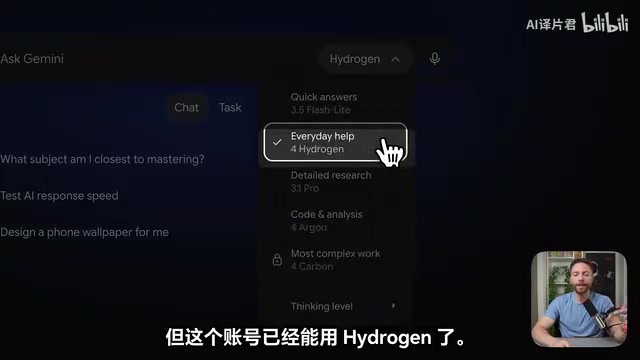
Gemini 4 Hydrogen replaces Flash as Google's new everyday workhorse model, built for speed and cost-effectiveness.
Two days after Gemini 4 Carbon, Google launched Gemini 4 Hydrogen—not a flagship replacement but the everyday workhorse taking over from Flash, focused on balancing speed and cost. It launched globally on day one, is available to free users via automatic model selection, and covers Pro subscribers and developer tiers, with API pricing at $1.50 input and $7.50 output, between Flash and Carbon. It beats Sonic and Terra on many benchmarks and, at high thinking levels, surpasses Argon in part on the Artificial Analysis Intelligence Index. Hands-on tests show it generates a space fighter mini-game in 15 minutes and a multi-style animated video in about 23 minutes, making it suited to rapid prototyping rather than polished output; its writing stands out for scripts that read naturally and more like human writing.
Google has released yet another new model. Just two days after Gemini 4 Carbon made its debut, Gemini 4 Hydrogen has arrived. But Hydrogen isn't a replacement for Carbon—it's aimed at a different slot: Google's new everyday workhorse model, meant to take over the role Flash played. According to hands-on impressions shared by Bilibili creator Paul J Lipsky, this may be the most important model Google has released in a long time.
Hydrogen's Positioning: A Speed-First Everyday Workhorse
In its release notes, Google lists four standout directions for Hydrogen: fast debugging and rapid codebase iteration, open-ended agentic execution, multimodal knowledge work, and web development. Overall, what Google values most in Hydrogen is speed.
That orientation is obvious in practice. The creator used it for everyday tasks—writing emails, building PDF tables and charts, making presentations—things stronger models can also do, but Hydrogen does them much faster. That speed advantage makes it the kind of model that's "cheap enough to use all day, every day, yet smart enough that you actually want to keep using it."
By comparison, models like Argon and Carbon are exciting, but they serve the most important tasks and planning scenarios. Everyday use calls for a workhorse model, and Hydrogen looks like Google's answer.
The Flash model is a lightweight model series Google has offered since the Gemini 1.5 era, positioned as a cost-effective, fast-response model typically used for latency-sensitive, cost-sensitive, high-volume everyday calls. Compared with models like Pro and Ultra that emphasize reasoning depth, Flash trades some complex reasoning capability for a lower price per token and faster first-token latency. Hydrogen taking over from Flash means Google has completed a generational switch in the everyday workhorse tier—the positioning logic continues (fast, cheap, good enough), but the underlying capability has been upgraded enough to beat the previous generation's flagship on some benchmarks. This also explains why the article stresses that Hydrogen is Google's most important recent release: the Flash series carries the layer of users with the highest actual call volume, so its generational change has a far broader impact than any single flagship launch.
Availability and Pricing Strategy
Hydrogen launched globally on day one, with fairly broad coverage. Free users can access it through automatic model selection; Pro-tier subscription accounts can already use Hydrogen, while Carbon remains locked on that account. Developers can use it across all tiers in Google AI Studio, and paid tiers can also access it via the Gemini API and Android Studio. In Antigravity and Gemini for Google Sheets, it's first available to Google AI Pro and Ultra subscribers.
On API pricing, input costs $1.50 and output costs $7.50. That's more expensive than Gemini 3.8 Flash but cheaper than Carbon—though at current prices, it's not much cheaper than Carbon. The key point is that Carbon currently has a discount; once that ends, the price gap between the two will widen.
Benchmarks: Beating Sonic and Terra, Stronger Than Argon in Some Cases
Google officially compared Hydrogen with Sonic and Terra, which says something about its tier. Results show Hydrogen beats Sonic and Terra on many benchmarks—not all, but many, making it quite capable for this tier.
One point the benchmarks don't reflect is even more noteworthy: at the default high thinking level, Hydrogen actually surpasses Argon on the Artificial Analysis Intelligence Index. In other words, at least in some respects, Hydrogen is stronger than Google's previous most advanced model.
The Artificial Analysis Intelligence Index is a composite model-capability score maintained by the third-party evaluator Artificial Analysis. It aggregates benchmarks such as MMLU-Pro, GPQA, LiveCodeBench, mathematical reasoning, and instruction following, converting them into a single score with unified weights for cross-vendor comparison. One feature of the index is that it distinguishes "thinking levels" or reasoning budgets: the same model scores noticeably differently in high-thinking mode (longer chain of thought, more sampling) versus standard mode. So when the article says "Hydrogen surpasses Argon at the default high thinking level," it means a comparison at equivalent reasoning effort, not raw model capability. Note that a composite index masks huge differences between task types—leading on a single score doesn't mean it's stronger on every sub-item, and actual model selection should still involve targeted evaluation against specific workloads.
Hands-On Case: A Space Fighter Game in 15 Minutes
The creator designed a "space fighter benchmark," asking Hydrogen to build a small Star Fox–style game. Using Gemini 4 Hydrogen High, the entire game took only 15 minutes, with a ship you can move, shoot, and barrel-roll with, plus enemies and rings you must fly through.

Compared with Carbon's version, Hydrogen's visuals are blockier and more old-school, while Carbon's is clearly smoother and more polished. But Hydrogen's version has a detail the others lack: messages from teammates and enemies pop up in the bottom-left corner. Overall, a game generated in 15 minutes reaching this level is quite impressive.
Multimodal Knowledge Work: Where He Felt the Biggest Difference
The creator especially emphasized that multimodal knowledge work is where he saw the biggest difference.
Ink-style explainer video: He asked for no sound, no voiceover, just visuals, and generation took under 10 minutes. He deliberately gave no specific requirements to see what the model would do on its own. He felt the explanation itself was well done and that it works visually, though he wished there were more motion.
Multi-animation-style chase video: The setup was two people being chased by a wolf, with the animation style changing each time they pass through a door, to test which animation styles the model could come up with; the model also added its own sound effects. This one took about 23 minutes. Some animation styles worked well, but the video is far from perfect—there's a stretch in the middle that clearly falls apart.

The common conclusion from these cases: if you want a polished-looking game or dynamic visuals, you may need a stronger tool like Carbon; but if you just need to generate something quickly, Hydrogen produces results faster and is great for prototyping. You can do it more cheaply and quickly with Hydrogen, then switch to Carbon once the concept is more or less settled.
Multimodal knowledge work refers to task types where a model handles multiple inputs—text, images, charts, audio, video, etc.—simultaneously and produces structured or rich-media results, such as turning a PDF financial report into a slide deck with charts, extracting information from screenshots and generating an explainer video, or converting content back and forth between documents and canvases. Unlike simple image recognition or video generation, these tasks require the model to maintain semantic consistency across modalities and sustain longer task chains. They place high demands on context length, cross-modal alignment, and tool-calling orchestration, and are one of the main battlegrounds where today's models differentiate themselves. Hydrogen generating a voiceover-free explainer video in 10 minutes and a multi-style chase animation in 23 minutes is exactly a demonstration of this end-to-end multimodal orchestration capability.
Writing Ability: Text That Reads More Like a Human Wrote It
The creator asked Hydrogen to write a script introducing Claude's new features: he gave it access to a folder on his computer (containing files on his preferred tone and script style) and also opened up transcripts of all his past YouTube videos as reference.
The generated opening introduced Claude Whiteboard—after brainstorming in Claude, you can turn the large blocks of text piled up in the chat window into visual diagrams, arrows, and timelines, collaborate with your team on a canvas, and even turn the canvas directly into a document, slide deck, or send it to other tools. It's part of a larger update (which also launched Cloud Sheets, Cloud Data, and Cloud Meetings).
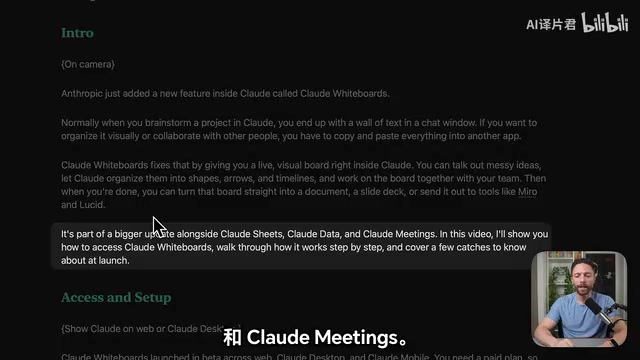
The creator's assessment: as an AI-generated YouTube opening, this is very strong. Writing text that reads more like a human wrote it rather than an AI is exactly what AI has long struggled with, and this time it did well. Writing has always been an area Gemini excels at, and Hydrogen carries that forward.
The Everyday Workhorse Worth Waiting For
It should be noted that these are only initial impressions from less than 24 hours, far from a full review. Hydrogen is of course not as powerful as Carbon, but it strikes a good balance between intelligence and cost, and it's a strong model.
For a large volume of everyday tasks, that balance may matter more than peak capability—you don't have to bring out the most expensive model for every small task, nor do you have to put up with sluggish responses. Hydrogen fills exactly that gap, and the creator says this is precisely the model he personally has been waiting for.
One-line Summary
Gemini 4 Hydrogen takes over from Flash, becoming Google's new everyday workhorse model through speed and cost-effectiveness.
Paragraph Summary
Two days after Gemini 4 Carbon, Google launched Gemini 4 Hydrogen, positioned not as a flagship replacement but as the everyday workhorse taking over from Flash, with a core focus on balancing speed and cost. It launched globally on day one, is available to free users through automatic model selection, and covers Pro subscribers and developer tiers, with API pricing at $1.50 input and $7.50 output—between Flash and Carbon. It beats Sonic and Terra on many benchmarks and, at high thinking levels, surpasses Argon in part on the Artificial Analysis Intelligence Index. Hands-on tests show it can generate a space fighter mini-game in 15 minutes and a multi-style animated video in about 23 minutes, making it suitable for rapid prototyping rather than polished final products; its writing ability stands out in particular, producing scripts with a natural style that reads more like human writing.
Related articles

OpenAI to Shut Down Agent Builder and Two Other Services on November 30, Developers Must Migrate Urgently
OpenAI will shut down Agent Builder, the evals dashboard, and reusable prompts on November 30; evals is already read-only. Here's the scope, OpenAI's migration paths (Agent SDK, PromptFu, your own code), and what developers should export and rebuild this week.

RankSpot: A Pay-Per-Use SEO & AI Search Execution Layer That Lets Agents Write, Publish, and Build Backlinks for You
RankSpot is an SEO & AI search execution layer for AI Agents. Connect via MCP to Claude or ChatGPT to write, publish & build backlinks. Pay-per-use, $3/article.

Appxiom: Giving AI Coding Assistants Production Context
Appxiom gives AI coding agents production context—crashes, jank, memory leaks, failed network calls—across Android, iOS, Flutter, KMP, and Web, ranking bugs by Goal Friction Impact.