Gemini 4 Hydrogen Hands-On Test: Has Google Finally Caught Up in Coding?

Gemini 4 Hydrogen test: usable backend, standout value; frontend aesthetics and hard reasoning still trail flagships.
Bilibili creator A Jiang tested Gemini 4 Hydrogen: about 80 points, ranking 11th, close behind Claude Sonnet 5.5 and much improved over Gemini 3.8 Flash. Backend scored 83, enough for most coding; frontend 3D interactions work but aesthetics trail Claude Opus 5.5 and GPT-6.2 Azure. It passed 12 magic-restoration questions but scored 43 on Sokoban. A large ERP task ran into API arrears and took four hours, finishing at 77.9 in a subscription environment. Sharing Gemini Flash quota, it used just over 20% of weekly quota in a day—cost-effectiveness is the highlight.
Title
Gemini 4 Hydrogen Hands-On Test: Has Google Finally Caught Up in Coding?
Meta Description
Gemini 4 Hydrogen hands-on test: about 80 points on a third-party leaderboard, ranking 11th; backend 83 points, capable of writing most code; frontend aesthetics trail Claude Sonnet 5.5; Sokoban only 43 points; quota cost-effectiveness significantly improved.
Article Content
After Google released its new model Gemini 4 Hydrogen (named after the element hydrogen), Bilibili creator A Jiang ran a hands-on test right away. The model scored about 80 points on a third-party evaluation leaderboard, ranking 11th and closely trailing 9th-place Claude Sonnet 5.5—a notable improvement over the previous generation, Gemini 3.8 Flash. So the question is: has Google's coding ability finally become competitive this time?
Leaderboard Results: Clear Progress, But Still a Gap
On the creator's own question bank, Gemini 4 Hydrogen scored about 80 points overall, placing 11th, while Claude Sonnet 5.5 ranked 9th. Compared with the previous generation Gemini 3.8 Flash, the improvement is considerable—the creator recalls that 3.8 Flash felt like "fast output, but coding ability wasn't outstanding."
Breaking it down by dimension, the new model shows clear progress in backend, frontend, knowledge reasoning, and "world aesthetics." It scored 83 points on the backend sub-item, ranking around 11th on the leaderboard. The creator's assessment is that this backend level "can write most backend code."
Worth mentioning is the change in quota strategy. Previously, Gemini Argon consumed quota extremely fast and wasn't cost-effective; Hydrogen, however, can share Gemini Flash's existing quota. After testing for a day with a $20 subscription, the creator's weekly quota only dropped by just over 20%, a clear overall improvement in cost-effectiveness.
The difference between third-party evaluation leaderboards and self-built question banks
The "third-party evaluation leaderboards" mentioned in the article usually refer to public benchmarks such as LMArena, Artificial Analysis, and Aider Polyglot, which use uniform questions and scoring rules to compare models side by side. Their advantage is strong comparability; their disadvantage is that once questions are public, vendors can optimize specifically for them. The creator's self-built question bank is the opposite: questions are not public and closely reflect his real workflows (3D frontend, ERP backend, Sokoban reasoning, etc.), so it can reflect how the model feels in actual use—but the sample size is small, scoring involves subjectivity, and scores across different videos aren't fully comparable. Therefore, "80 points, ranking 11th" should be understood as a relative position within this creator's evaluation system, not an industry-wide ranking.
The naming logic of "Flash," "Argon," and "Hydrogen"
Google's Gemini series has long used speed/cost tiers for naming: Flash emphasizes low latency and low cost, Pro emphasizes balance, and Ultra emphasizes maximum capability. Element names like Argon and Hydrogen appearing in the article seem more like new codenames added beyond the original tiers, possibly corresponding to different training recipes or release batches. Readers should note that under the same "Gemini 4" there may be multiple variants whose quota rules, context lengths, and pricing are not consistent—so when choosing a model, don't look only at the major version number.
Frontend Hands-On: It Can Deliver, But the Aesthetics Aren't as Stunning as Before
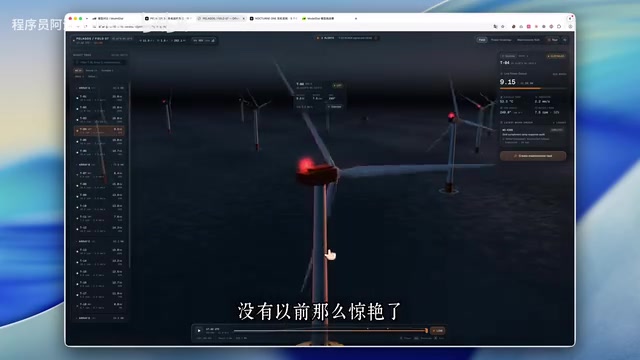
Following the channel's convention, the creator used a 3D wind turbine inspection system to test frontend capability. Hydrogen can complete interactions such as the entrance screen and faulty turbine localization, but the visual effect is only "okay"—in the creator's view, it's not much different from Gemini Argon and lacks the stunning "excellent frontend visuals" of the original Gemini models.
Side-by-side comparison is more telling. In the same 3D scene, Claude Sonnet 5.5 performs better in detail after rotation and zooming, as well as in overall frontend aesthetics; DeepSeekAd's 3D capability is "relatively okay too" and cost-effective; and the ceiling remains flagship models like Claude Opus 5.5 and GPT-6.2 Azure—the turbine visuals they produce are "very realistic," with obvious differences in maintenance passages and zoomed-in details.
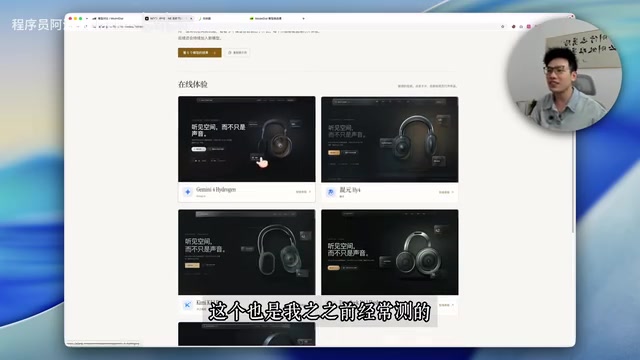
In the headphone product page test, Hydrogen can complete interactions such as the appointment-for-audition popup, the 50-second story, and the cavity coordinate display, with results similar to DeepSeek—"not that stunning, but it can still achieve good results." The three-layer structure display completed by Claude Sonnet 5.5, however, is clearly better overall. The creator's personal habit is: for frontend, Claude and Opus 5.5 feel safer; for backend, GPT is better.
Intelligence and Reasoning: Good World Knowledge, but Sokoban Falls Flat
Beyond regular coding, the creator also has a Python-based "intelligence challenge" in which the model is exposed to only one tool, cannot write code, and must rely entirely on its own thinking.
In tests like "magic restoration" with 12 questions, Gemini 4 Hydrogen solved all of them, outperforming some domestic models, which shows that its world knowledge and reasoning ability are indeed solid.
But when it came to Sokoban, the difficulty spiked: six levels ranged from beginner to advanced, each with three lives, and Hydrogen performed "so-so," ultimately scoring 43 points. For reference, DeepSeek completed only two levels, and Kimi K3 completed only one (that level had a time limit). The creator notes that for Sokoban, currently only flagship models like Claude Opus 5.5 and GPT-6.2 Azure perform relatively well.
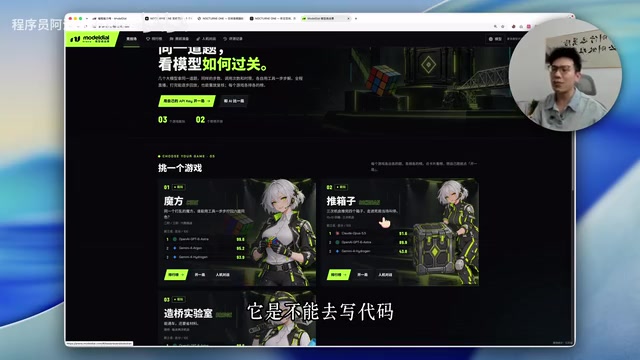
In the bridge-building experiment, Hydrogen ranked around 7th, but three questions were not completed due to API return issues; the creator says he will test again later.
Why Sokoban is a hard indicator of reasoning ability
Sokoban is a classic PSPACE-complete problem: the state space grows exponentially with level size, and there are many traps where a move "looks feasible but actually pushes a box into a dead corner," making it a strong test of a model's long-horizon planning and backtracking. More importantly, the setup in the article—"only one tool exposed, no code writing"—means the model must rely purely on linguistic reasoning to simulate each step's board-state changes in its head, with no search algorithm or brute-force enumeration as a fallback. This precisely strips away the path large models are best at—"write a script to solve the problem"—and directly measures their intrinsic spatial reasoning and world-model quality. Therefore, a low Sokoban score often says more than a coding failure: it shows that the model still depends on external tools for tasks requiring multi-step lookahead.
Large Code Tasks: It Can Run, But It's Too Expensive and Too Slow
The "death three code" test includes three ERP questions written in Python (involving query, VR, etc.), with a single file possibly exceeding 10,000 lines—a hard test of the model's engineering capability.
For domestic models, the creator sampled Hunyuan, DeepSeek, and MiniMax; in the first round, basically none could complete the tasks and all needed hints. DeepSeek still failed to complete the T2 question after three rounds of hints. GPT-6.2, with the highest backend score, passed all three questions in one round.
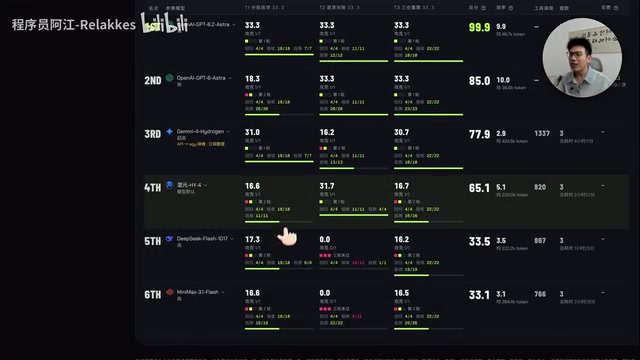
Hydrogen ran into a real-world problem in this segment: the creator first ran it with the official API, and the result was that "it ran up over a hundred yuan and went into arrears." The task took about four hours (domestic models previously took about two hours). In the end, it could only be completed in the anti-gravity subscription environment, scoring 77.9. The creator also admits that this score is "not particularly fair," because the agent and API environments are not fully consistent, and it is for readers' reference only.
The difference between agent environments and raw API calls
The article's mention of "running into arrears with the official API and switching to the anti-gravity subscription environment to finish" involves an important distinction: raw API calls require you to implement your own loops for file reading/writing, command execution, error retries, and so on, with every round of context billed again, so token consumption multiplies on long tasks. Agent subscription products like anti-gravity, by contrast, have built-in tool-calling frameworks, context compression, and caching strategies, so the same task consumes far less quota—but what trimming happens internally is not transparent. Scores from the two therefore cannot be directly compared: an agent environment may score higher due to better context management, or lower due to tool limitations—which is exactly why the creator calls the 77.9 score "not particularly fair."
Conclusion: It's Usable Now, and Cost-Effectiveness Is the Biggest Highlight
Overall, Gemini 4 Hydrogen is "much better" than Gemini 3.8 Flash—going from not very usable to usable. Its backend level is enough to cover most daily needs, and the quota strategy also gives it decent cost-effectiveness. The shortcomings are that frontend aesthetics still trail the top Claude models, extreme reasoning tasks (such as Sokoban) still show a clear gap from flagships, and large code tasks are relatively high in time and cost.
For developers who want to use Google models for coding, this generation is worth putting back into the toolchain and trying; but if you're pursuing the upper limit of frontend visuals and complex reasoning, the flagships from Claude and GPT remain unavoidable choices.
How quota strategy affects the real cost of use
The cost of subscription-based AI coding tools is often not reflected in the sticker price, but in quota consumption speed and reset cycles. The article's statement that it "shares Gemini Flash's existing quota, with only just over 20% of weekly quota used in a day" means the model has been placed in a lower billing tier; for heavy users, the effective usable amount may be several times higher than the previous generation. When evaluating whether a model is worth adding to your toolchain, besides leaderboard scores, you should also watch three things: whether the quota is shared with lower-tier models, whether there is a context-length penalty for individual requests, and whether failed long tasks are billed repeatedly. Together these three determine whether "it can run" can translate into "you can afford to use it."
One-line Summary
Gemini 4 Hydrogen hands-on test: usable backend, standout cost-effectiveness; frontend aesthetics and extreme reasoning still trail flagships.
Paragraph Summary
Bilibili creator A Jiang ran a multi-dimensional hands-on test of Google's new model Gemini 4 Hydrogen. It scored about 80 points on his self-built question bank, ranking 11th and closely trailing 9th-place Claude Sonnet 5.5—a clear improvement over Gemini 3.8 Flash. It scored 83 points on the backend sub-item, enough for most backend coding needs; in frontend 3D scenes it can complete interactions, but visual aesthetics trail Claude Sonnet 5.5 and flagships such as Opus 5.5 and GPT-6.2 Azure. On reasoning, it passed all 12 magic-restoration questions but scored only 43 points on six Sokoban levels. The large ERP code task ran into arrears due to high API costs and took about four hours; it was ultimately completed in a subscription environment with a score of 77.9, so its reference value is limited. Quota can be shared with Gemini Flash—just over 20% of weekly quota was used in one day of testing—making cost-effectiveness the biggest highlight.
Related articles

OMLX 0.7.1 Integrates Splash: Major Speedup for MLX Model Inference on Mac
OMLX 0.7.1 adds Splash as an external engine, letting standard MLX models (Qwen 3.6 35B) match Splash custom setups at 92.8 tokens/s. Setup, D-Flash2 requirements, and M1/M2 compatibility explained.

Running Uncensored AI Locally on Your Phone: LFM3 Hands-On Test and Guide
Learn how to run Liquid AI's LFM3 1.7B uncensored model locally on iPhone and Android—no GPU or network needed. Includes On Device LLM and Layla steps, speed tests, and privacy benefits.

Claude Launches Collaborative Sheets and Whiteboards, Taking On Microsoft and Google Directly
Anthropic rolls out beta Claude Sheets and Whiteboards to paid users, enabling one-prompt spreadsheets with formulas and turning verbal plans into collaborative boards—taking on Microsoft and Google directly.