Gemini 4 Hydrogen Hands-On: The Trade-off Between Speed and Cost

Gemini 4 Hydrogen price and performance hands-on: how much thinking is worth paying for at the same score.
Google launched Hydrogen, a fast Gemini 4 model replacing 3.8 Flash for everyday coding and document tasks, priced at $1.50/M input and $7.50/M output tokens. It aced Plotly's tricky 43-question test, slightly beating flagship Carbon, but GPT 6.1 Sol matched it at under half the cost and faster. Cross-benchmark results show no universal winner—Sonnet leads Terminal Bench 4.1 while Hydrogen leads OS World. Thinking levels matter most: medium-to-high adds 10 points, high-to-ultra only 3, yet costs climb sharply. Verify with your own tables and tested bugs.
Title
Gemini 4 Hydrogen Hands-On: The Trade-off Between Speed and Cost
Meta Description
Google Gemini 4 Hydrogen scored 43/43 on the Plotly test, but GPT 6.1 Sol matched it at less than half the cost. This article breaks down Terminal Bench, thinking-level costs, Plotly test data, and hands-on AI Studio testing to help you decide which model to use for everyday tasks and how much thinking to pay for.
Article Content
Google has launched Hydrogen, a fast model in the Gemini 4 family aimed at everyday tasks, positioned as the successor to Gemini 3.8 Flash. It scored a perfect 43/43 on the Plotly data analysis test, edging out its own flagship Carbon by a slim margin. But GPT 6.1 Sol, competing in the same arena, achieved the same score at less than half the price. This comparison reveals not just model rankings, but the practical question of "how much thinking you should pay for."
Hydrogen's Positioning and Pricing Logic
Hydrogen targets everyday coding, tool calling, and document processing, while Carbon and Argon remain reserved for more complex tasks. It's available through the Gemini app, Search, API, and Google AI Studio. API pricing is $1.50 per million input tokens and $7.50 per million output tokens, with a uniform rate across the 1 million token context window—long context is workspace, but input and generated content are billed as usual.
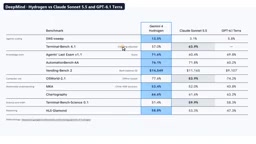
Google's own coding comparison shows Hydrogen scoring 57% on Terminal Bench 4.1, versus 18.2 for 3.8 Flash, and Hydrogen completes tasks 2.5 times faster than Flash. There's an easy pitfall here: the Terminal Bench 4.0 chart measures a different version, and scores can't be carried across charts.
Cross-Benchmark Analysis: No Universal Winner
According to DeepMind's evaluation table, Claude Sonnet 5.5 leads on Terminal Bench 4.1 with 63.9 versus Hydrogen's 57—this source contrasts with Google's own data above. Hydrogen leads on the offline computer use test OS World 2.1, and leads Sonnet and GPT 6.1 Tera on Agent's Last Exam and Multimodal Knowledge Agent Benchmark respectively.
The cross-source consensus is that these benchmarks measure different capabilities. Recovering from terminal command failures and turning a pile of visual files into usable deliverables are two different skills. One early Antigravity user mentioned that Sonnet flagged more issues in log files—this is just a single-source anecdote, and the number of issues alone can't tell you which findings are real. To verify debugging ability, give the model a log with known causes and see how many it finds and how many it fabricates.
Terminal Bench, OS World, and Agent's Last Exam measure different dimensions of capability, and mixing scores leads to wrong conclusions. Terminal Bench focuses on completing multi-step command-line tasks in a real terminal environment, testing the ability to recover from errors and use toolchains correctly; OS World has agents operate graphical interfaces to complete cross-application tasks, measuring visual grounding and interface interaction; Agent's Last Exam is closer to long-chain, comprehensive tasks requiring planning and tool calling. Additionally, different versions of the same benchmark (such as 4.0 and 4.1) have different question sets and scoring rules, and scores can't be compared across versions. Therefore, "a model leads" must be tied to a specific benchmark and version, and can't be extrapolated to mean it's stronger overall; when choosing, prioritize the benchmark closest to your actual task shape.
Thinking Levels: The Real Reason Your Bill Changes
Artificial Analysis's model page shows four settings for the same model: low at 27 points, medium at 41, high at 51, and ultra at 54 (this is an index score across a task suite, not a percentage). High means more reasoning tokens and longer waits, and the organization reports a cost of about $1.87 per index task at high. This number explains the trade-off better than looking at per-million-token prices alone.
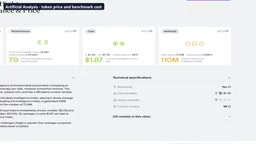
Google's launch post gives Argon at 50 on this index and Carbon at 60 at high, explaining why the flagship still has a place. At the same per-token price, bill differences come from how many tokens the model consumes for the same question: going from medium to high adds 10 points, while high to ultra adds only 3. When doing spreadsheet checks, first pick the level that catches the errors you care about, and only pay more when extra thinking finds problems you would otherwise miss.
Reasoning tokens and thinking levels are key to understanding bill differences. The four levels—low/medium/high/ultra—essentially determine how much "internal thinking" the model is allowed to generate before giving a final answer: low barely expands reasoning, while high has the model write out lengthy intermediate steps, self-checks, and alternatives before concluding. These reasoning tokens are billed at the output price just like final output, so the same question at ultra might consume several times the tokens of low. Artificial Analysis's index score is a composite of multiple normalized benchmarks, not single-task accuracy, so 54 points doesn't mean 54% accuracy. This is also why "per-million-token price" can't be directly converted to "per-question cost"—what really determines the bill is how much thinking the model writes for a question and how many times it retries.
Plotly Test: Same Score, Different Price
Plotly's test was deliberately tricky: messy tables, vague questions, statistical traps, and requests the data itself couldn't answer. Hydrogen scored a perfect 43/43 with a median time of 32 seconds per question. Carbon scored 42, Argon 41. GPT 6.1 Sol also scored 43, with a median time of 18 seconds, costing $2.61 for the whole exam versus $6.36 for Hydrogen and $11.55 for Carbon's full run.
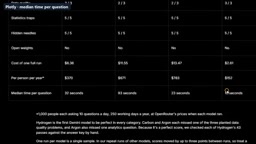
Both conclusions hold: Hydrogen is the strongest Gemini on Plotly's exam; Sol delivers the same score at lower price and shorter time. Plotly notes that 88% of Hydrogen's input came from cache, and a different workload or repeat input volume would change the bill entirely—verify costs with your own actual usage rather than copying test numbers.
Prompt caching is an important mechanism explaining Hydrogen's cost structure. When multiple requests share the same prefix content (such as a system prompt, the same table, or the same code context), the server can reuse already-processed intermediate state and bill that input at a discounted rate rather than full price. In the Plotly test, 88% of Hydrogen's input came from cache, meaning its sticker cost was greatly reduced; but in scenarios with low cache hit rates—such as attaching a different long document with each question, or input spread across changing multi-turn conversations—the same model could be much more expensive. When evaluating costs, focus on two things: how high your workload's cache hit rate is, and whether cache writes themselves carry extra fees. Comparing different models horizontally based on public test dollar figures alone easily leads to conclusions opposite to actual usage.
Interactive Demos and a Small Hands-On Test
Google's demos show another side of the model's capabilities. GeminiLand lets players describe structures and then walk into a voxel world; the Storefront demo includes a thermal splitting slider, 3D spec view, and live finish selector, relying on Google's front-end design skills; there's also turning a spreadsheet into pixel animation using Python, spreadsheet formulas, and conditional formatting, and a globe that maps lightning locations into visual ripples and sound.
I also did a small test in Google AI Studio: I gave Hydrogen an inventory CSV containing exact duplicate rows, negative quantities, and missing prices. It rejected rows 2 and 5, kept A 15 units, B 7 units, C 5 units, totaling 27 units, and correctly stated it couldn't calculate profit. This is just one run on a small synthetic file, and its value lies in how easy each step is to verify.
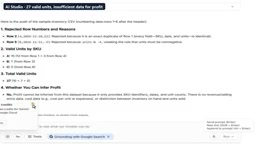
The hands-on approach isn't complicated: take a table you already understand and write down the answer first; give two settings the same file and prompt, time from clicking run to finishing verification of the answer, counting time spent asking for corrections or process explanations; do the same for code tasks, repeating the process with a bug that has tests.
Antigravity's Orchestration Approach
Antigravity's orchestrator can switch between Carbon and Hydrogen. Imagine Carbon reviewing the plan while Hydrogen implements or verifies fragments in an independent workspace. Google reports that this combined approach uses 24% less quota and completes 19% faster on Terminal Bench 4.0, while approaching Carbon's success rate—this is Google's result for that combination. To verify yourself, give both approaches the same repository, tests, and time budget, count passing items, inspect diffs, and compare total run costs.
Additionally, Hydrogen is upgrading Search, bringing broader query fan-out and more visual answers; Vercel has integrated it into its AI gateway, offering teams another trial path. If you were previously using Flash, start with an everyday task—a messy table or a small bug with tests—and compare time to a usable answer, total cost, and number of interventions needed to judge which thinking level is truly worth paying for.
Orchestrators and multi-model division of labor refer to a scheduling layer that decomposes tasks and dispatches them to different models: letting a stronger-reasoning model handle planning and review, a faster cheaper model handle implementation, test runs, and fragment verification, then aggregating results. The value of this pattern is applying expensive high-thinking levels to the steps that truly need judgment and handing mechanical execution to low-cost models. But it also introduces new cost items—orchestration's own scheduling overhead, context passing between models, and extra calls for cross-workspace synchronization. To judge whether division of labor is worthwhile, fix the same repository, same test set, and time budget, and compare single-model versus orchestrated approaches on pass rate, human intervention count, and total token spend, rather than looking only at one speedup number.
One-line Summary
Gemini 4 Hydrogen price and performance hands-on: how much thinking is worth paying for at the same score.
Paragraph Summary
Google launched Hydrogen, a fast model in the Gemini 4 family, succeeding Gemini 3.8 Flash for everyday coding, tool calling, and document processing, with API pricing at $1.50 per million input and $7.50 per million output tokens. It scored a perfect 43/43 on Plotly's tricky 43-question data analysis test, slightly beating flagship Carbon, but GPT 6.1 Sol matched the score at less than half the cost and shorter time. Cross-benchmark analysis shows no universal winner: Sonnet is stronger on Terminal Bench 4.1, Hydrogen leads on OS World and others. More importantly, thinking levels: medium to high adds 10 points, high to ultra only 3, yet costs rise significantly. The author recommends verifying answer quality, total cost, and interventions with your own tables and bugs with tests rather than copying public test numbers.
Related articles

OpenAI to Shut Down Agent Builder and Two Other Services on November 30, Developers Must Migrate Urgently
OpenAI will shut down Agent Builder, the evals dashboard, and reusable prompts on November 30; evals is already read-only. Here's the scope, OpenAI's migration paths (Agent SDK, PromptFu, your own code), and what developers should export and rebuild this week.

RankSpot: A Pay-Per-Use SEO & AI Search Execution Layer That Lets Agents Write, Publish, and Build Backlinks for You
RankSpot is an SEO & AI search execution layer for AI Agents. Connect via MCP to Claude or ChatGPT to write, publish & build backlinks. Pay-per-use, $3/article.

Appxiom: Giving AI Coding Assistants Production Context
Appxiom gives AI coding agents production context—crashes, jank, memory leaks, failed network calls—across Android, iOS, Flutter, KMP, and Web, ranking bugs by Goal Friction Impact.