Gemini 4 Hydrogen Lands on AI Gateway: Agentic Coding Levels Up Again

Gemini 4 Hydrogen succeeds 3.8 Flash, boosting agentic coding and tool calling at the same latency, now on Vercel AI Gateway.
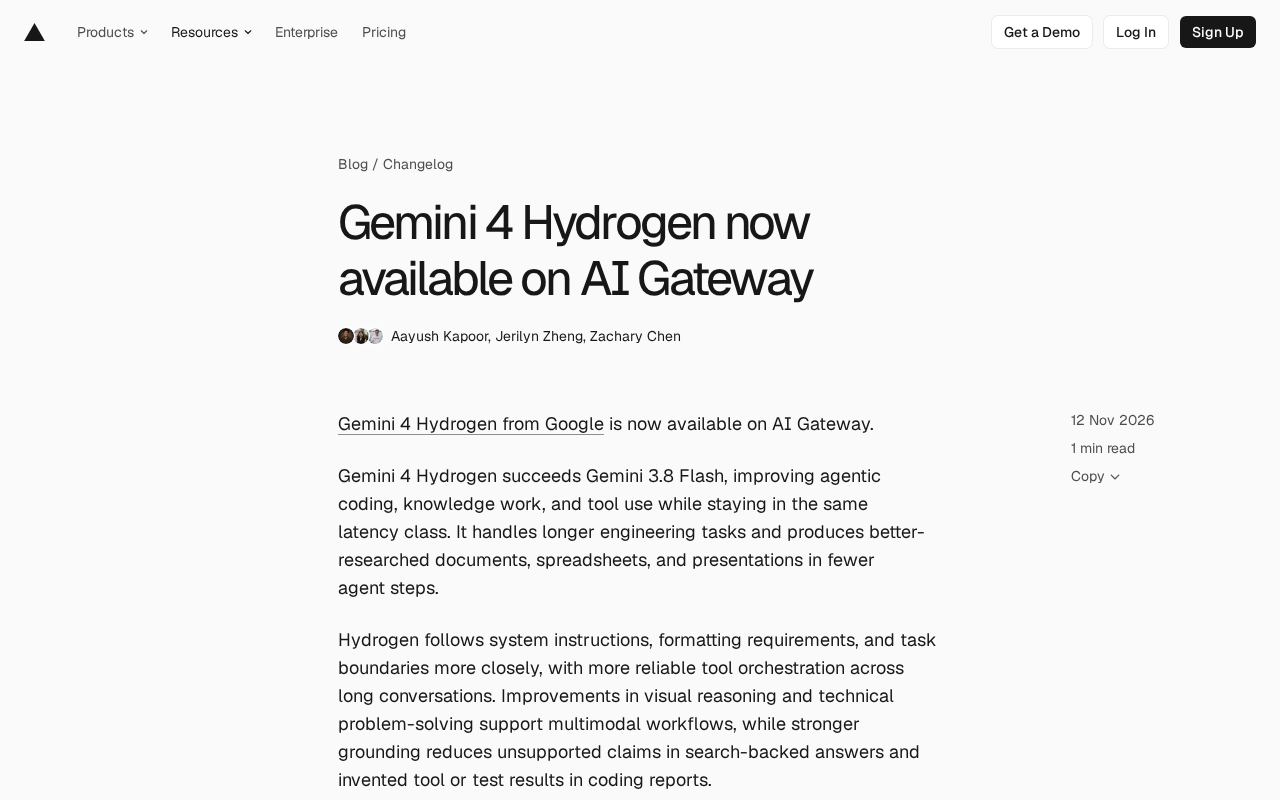
Gemini 4 Hydrogen is the successor to Gemini 3.8 Flash, now live on Vercel AI Gateway and callable via google/gemini-4-hydrogen. Positioned as "same latency, stronger capability," it improves agentic coding (longer tasks, fewer steps, better-researched outputs), instruction following and tool orchestration in long conversations, and grounding to reduce fabricated claims and test results in coding reports. It works with AI SDK's streamText and coding agents like Claude Code, Codex, and Cursor via Vercel CLI. AI Gateway offers a unified API, usage and cost tracking, retry and failover, no markup, and BYOK support.
Google's Gemini 4 Hydrogen model is now available through Vercel AI Gateway. As the successor to Gemini 3.8 Flash, it delivers the same latency level while focusing on improvements in agentic coding, knowledge work, and tool calling — giving developers a more reliable experience for long-running tasks.
Model Positioning: A Smooth Succession with a Capability Leap
Gemini 4 Hydrogen isn't a standalone version update — it's an explicit successor to Gemini 3.8 Flash. According to official information, the new model sits at the same latency level as its predecessor, meaning developers can gain stronger task-handling capabilities without compromising on response speed.
This "same latency, stronger capability" combination is especially critical for coding assistants and document generation tools that depend on real-time interaction. If capability gains come with significantly higher latency, they often cancel out the real-world improvement in experience; Hydrogen chose to add capability within the existing latency envelope, which is a clear positioning.
Three Core Areas of Improvement
Agentic Coding: Longer Engineering Tasks with Fewer Steps
According to the official description, Gemini 4 Hydrogen can handle longer engineering tasks and produce better-researched documents, spreadsheets, and presentations in fewer agent steps. This improvement directly addresses a core pain point in current agentic applications: context loss and efficiency loss in multi-step tasks.
Fewer steps means lower token consumption and shorter task completion times — a quantifiable cost optimization for teams building automated coding pipelines.
Instruction Following and Tool Orchestration: Stability in Long Conversations
The new model adheres more tightly to system instructions, formatting requirements, and task boundaries, while achieving more reliable tool orchestration in long conversations. Tool calling is a key link in putting agents into production, and the reliability of orchestration directly determines whether complex workflows can run stably.
Visual Reasoning and Grounding: Improvements in Both Multimodality and Trustworthiness
Enhanced visual reasoning and technical problem-solving support multimodal workflows. More notably, there's "stronger grounding" — officials say it reduces unsupported claims in search-backed answers, as well as fabricated tools or test results in coding reports.
Agents fabricating passing test results in coding reports is a headache developers frequently encounter in practice. If Hydrogen's improvements in this area work as described, they will significantly boost the credibility of automated coding reports.
Agent Steps refers to the number of "think—act—observe" loops an AI agent executes to complete a task. In each loop, the model may initiate a tool call (such as searching, running code, or reading/writing files), then decide the next step after getting results. Fewer steps generally means more precise planning and fewer futile attempts, resulting in lower token consumption and lower end-to-end latency. In automated scenarios like coding pipelines, step count is a metric that translates directly into cost, so "completing longer tasks in fewer steps" is an important dimension for measuring the practicality of agentic models.
Grounding refers to anchoring model-generated statements to verifiable external sources — such as retrieved web pages, documents, or actual execution results — rather than "making things up" from parametric memory alone. In search-augmented Q&A, grounding manifests as answers with traceable citations; in coding agent scenarios, it manifests as tool calls, test runs, and passing results mentioned in reports having actually occurred. Without grounding, models tend to produce plausible-sounding but unsupported claims — the so-called "hallucinations" — which is precisely why automated reports are hard to trust directly.
Getting Started: Unified API and Coding Agent Support
To use the model, simply specify the model name google/gemini-4-hydrogen in your request. The official docs provide an AI SDK example:
import { streamText } from 'ai';

const result = streamText({
  model: 'google/gemini-4-hydrogen',
  prompt: 'Write a TypeScript retry helper with exponential backoff and jitter.',
});

for await (const text of result.textStream) {
  process.stdout.write(text);
}
To use it in coding agents like Claude Code, Codex, or Cursor, install the latest Vercel CLI and run npx vercel ai-gateway setup, then select google/gemini-4-hydrogen in the agent. A direct try-it-out entry is also available in the model playground.
AI SDK and streamText: AI SDK is an open-source TypeScript library from Vercel that wraps the calling differences between model providers behind a unified interface; streamText is its streaming text generation function. The returned object includes an async iterable textStream property, allowing callers to read generated content chunk by chunk and output it immediately — enabling typewriter-style incremental responses. In the example, writing the model directly as a "provider/model" string like 'google/gemini-4-hydrogen' is precisely so the same code only needs this one parameter changed when switching between models.
The Value of AI Gateway: A Unified Entry Point with Controllable Costs
AI Gateway provides a unified API for calling models, with usage and cost tracking, retry and failover configuration for uptime beyond any single provider. It includes built-in custom reporting, zero data retention support, API key budgets, routing rules, and more.
On pricing, AI Gateway reflects provider prices with no markup, charges no platform fee for inference, and BYOK (bring your own key) requests are treated the same. For teams that need to switch between multiple models, this markup-free aggregation layer lowers vendor management costs.
BYOK (Bring Your Own Key) means developers use their own API keys obtained from model providers, with requests forwarded through the gateway. For the aggregation layer, BYOK lets teams reuse existing provider contracts and quotas while still benefiting from the gateway's usage statistics, retry, and failover capabilities; for developers, it avoids purchasing duplicate keys across multiple platforms. Relatedly, failover means that when a provider or model call fails or times out, the gateway automatically routes to a backup model according to preset rules, minimizing the impact of single points of failure on production services.
What It Means for Developers
Judging from the capability descriptions, Gemini 4 Hydrogen's improvements concentrate on two dimensions of agentic scenarios: "reliability" and "efficiency." Reliability shows up in instruction following, tool orchestration, and grounding; efficiency shows up in completing longer tasks in fewer steps. These two points map precisely to the main obstacles preventing agentic coding applications from moving from demos to production environments.
For developers already using AI Gateway, upgrading is as simple as switching the model name — migration cost is minimal. For teams evaluating coding agent solutions, capability gains at the same latency mean they can attempt more complex automation tasks without sacrificing interactive experience.
One-line Summary
Gemini 4 Hydrogen succeeds 3.8 Flash, strengthening agentic coding and tool calling at the same latency, now live on Vercel AI Gateway.
Paragraph Summary
Gemini 4 Hydrogen is the successor to Gemini 3.8 Flash, now live on Vercel AI Gateway and callable via the model name google/gemini-4-hydrogen. Its positioning is "same latency, stronger capability": without sacrificing response speed, it focuses on three improvements — agentic coding can handle longer engineering tasks and produce well-researched documents, spreadsheets, and presentations in fewer steps; instruction following and tool orchestration in long conversations are more stable; visual reasoning is enhanced, and grounding is stronger, reducing unsupported claims in search-backed answers and fabricated tools or test results in coding reports. It supports AI SDK's streamText and can be selected in coding agents like Claude Code, Codex, and Cursor after configuration via Vercel CLI. AI Gateway offers a unified API, usage and cost tracking, retry and failover, prices at provider rates with no markup and no inference platform fee, and supports BYOK.
Related articles

AI Agent Orchestration Framework Tier List: Who's Overrated, Who's Legendary
A blunt tier-list evaluation of AI Agent orchestration frameworks: why CrewAI and LangGraph are legendary, OpenAI Agents SDK and Agno are only good, LlamaIndex and Cloudflare Agents are overrated, and why TypeScript developers should choose Mastra.

Giving AI Agents Memory: OpenAI SDK + Mem0 in Practice
Use the OpenAI Agent SDK with Mem0 to add persistent memory to AI agents: from installing dependencies and configuring credentials to creating a memory client and isolating users by ID, build a memory-enabled conversational agent in three steps.

Svelte: The Compile-Time Framework That Makes Web Development Simple Again
Svelte is a compile-time frontend framework with 89k+ GitHub stars, no virtual DOM, and tiny bundles. This article covers its core differences, the SvelteKit ecosystem, use cases, and drawbacks.