Gemini 4 Hydrogen Lands on Databricks: Accelerating Tasks in Tandem with Carbon

Gemini 4 Hydrogen achieves Day 0 availability on Databricks, collaborating with Carbon to boost multi-agent workflow efficiency.
Google's Gemini 4 Hydrogen model is available Day 0 on Databricks, allowing users to call it on release day. Paired with the Carbon framework, it builds a layered multi-agent workflow: Carbon handles planning and coordination, Hydrogen handles execution and verification of sub-agent tasks. Google reports Hydrogen's task completion speed is 2.5 times that of Gemini 3.8 Flash, though specific test conditions are not disclosed. Unity Gateway provides a unified governance entry point for both, centrally managing access control and auditing. For developers, Day 0 support shortens integration cycles, but actual benefits need validation on small-scale workflows per official documentation.
Gemini 4 Hydrogen Launches Day 0 on Databricks, Advancing Multi-Agent Collaboration
Google's Gemini 4 Hydrogen model is now available Day 0 on the Databricks platform. This means Databricks users can call this new version directly on the data platform the moment the model is released. According to official tweets, Gemini 4 Hydrogen paired with the Carbon framework enables the construction of more efficient multi-agent workflows. Google reports that task completion speed reaches 2.5 times that of Gemini 3.8 Flash.
For teams focused on deploying AI applications, Day 0 support means a shorter integration cycle. Databricks, as a unified platform for data and AI workloads, embeds model capabilities directly into existing data pipelines, reducing friction from model experimentation to production deployment. The introduction of Carbon turns the "plan-execute-verify" division of labor into an actionable engineering practice.
Day 0 Availability is a release strategy in cloud platform–model vendor partnerships, meaning a new model can be called on a third-party platform on the official release day without waiting for the platform to complete adaptation and integration. This typically requires the platform to obtain model weights or API interfaces in advance and complete compatibility testing and deployment. For enterprise users, Day 0 support means they can use the latest model in their familiar development environment without building inference infrastructure or waiting for the platform to catch up, thereby shortening the cycle from model release to business validation. Databricks, as a unified data and AI platform, its Day 0 support also reflects model vendors' emphasis on the data platform ecosystem.
The Division of Labor Between Carbon and Hydrogen
Separation of Planning Coordination and Execution Verification
The tweet explicitly states that Carbon is responsible for "planning and coordination," while Hydrogen is responsible for "executing and verifying sub-agent tasks." This architecture breaks complex tasks into manageable subtasks: Carbon, as the coordination layer, decides task allocation and workflow direction; Hydrogen, as the execution layer, completes the running and result validation of specific sub-agent tasks.
This separation brings two practical benefits. First, planning logic and execution logic are decoupled, making it easier for teams to iterate separately—adjusting coordination strategies doesn't require retraining execution models, and vice versa. Second, the verification step is built into the execution layer, so results of sub-agent tasks are checked before returning to the coordination layer, reducing the risk of error propagation.
Multi-Agent Workflow refers to a system architecture that breaks complex tasks into multiple subtasks completed by multiple agents working in division of labor. Typical patterns include: an orchestrator responsible for planning tasks, allocating subtasks, and aggregating results; multiple executors responsible for running and verifying specific subtasks. The advantage of this architecture lies in scalability and fault tolerance—a single subtask failure can be reassigned or retried by the orchestrator without affecting the overall workflow. The division between Carbon and Hydrogen exemplifies this pattern: Carbon acts as the coordination layer, Hydrogen as the execution layer, and the two interact through standardized interfaces, allowing planning logic and execution logic to iterate independently.
What 2.5x Task Completion Speed Means
Google reports that Hydrogen's task completion speed is 2.5 times that of Gemini 3.8 Flash. This comparison data comes from official sources and targets the dimension of task completion speed. For multi-agent workflows, speed improvements directly translate into an increased number of subtasks that can be processed per unit time, with particularly noticeable impact in scenarios requiring frequent sub-agent calls.
It should be noted that the tweet does not disclose the specific test conditions, task types, and benchmark settings for this comparison. Therefore, this figure is better used as directional reference: Hydrogen shows significant improvement in execution efficiency, but actual gains will vary depending on workflow complexity, subtask granularity, and platform environment.
Unified Governance via Unity Gateway
The tweet finally mentions that Carbon and Hydrogen are governed through Unity Gateway. In multi-agent systems, the coordination layer and execution layer often involve different permissions, call quotas, and audit requirements. The value of a unified gateway lies in converging access control, monitoring, and policy management for these two layers into a single entry point, avoiding governance logic scattered across multiple components.
For enterprise deployments, this is particularly critical. When Carbon plans tasks and Hydrogen executes subtasks, the gateway can centrally record call chains, enforce policy validation, and provide a foundation for subsequent cost attribution and compliance auditing. The tweet does not elaborate on the specific functional details of Unity Gateway, but its positioning is clear: providing a unified governance plane for multi-component collaboration.
Unified Governance Plane refers to an architectural design that centralizes governance functions such as access control, call quotas, audit logs, and policy validation into a single entry point in multi-component systems. Its core value lies in avoiding governance logic scattered across components, reducing management complexity and security risks. In enterprise AI deployments, the governance plane typically needs to support fine-grained permission management (e.g., isolation by role or project), real-time monitoring of call chains, and cost attribution analysis. Unity Gateway's positioning is to provide such a unified entry point for Carbon and Hydrogen, enabling enterprises to configure policies, view call records, and provide a basis for compliance auditing in one place.
Practical Implications for Developers
Day 0 availability on Databricks, combined with Carbon's division of labor, provides a relatively clear path for building multi-agent applications. Developers can leverage the platform's existing data capabilities to integrate Gemini 4 Hydrogen into existing pipelines and use Carbon to organize task flows. Speed improvements help shorten the overall time for multi-round subtask calls.
However, the tweet information is relatively concise. The specific integration approach for Carbon, configuration details for Unity Gateway, and the applicable boundaries of the 2.5x acceleration all require reference to more complete official documentation. For teams planning to adopt, it is recommended to first validate the actual benefits of the division-of-labor model on small-scale workflows before gradually expanding scope.
Key Takeaways
- Gemini 4 Hydrogen achieves Day 0 availability on Databricks, shortening the integration path from model to production.
- Carbon handles planning and coordination, Hydrogen handles execution and verification of sub-agent tasks, forming a layered collaboration architecture.
- Google reports Hydrogen's task completion speed is 2.5 times that of Gemini 3.8 Flash, but specific test conditions are not disclosed.
- Unity Gateway provides a unified governance entry point for Carbon and Hydrogen, facilitating access control and auditing.
- Actual implementation requires verifying configuration details and the applicable scope of acceleration gains against official documentation.
Related articles
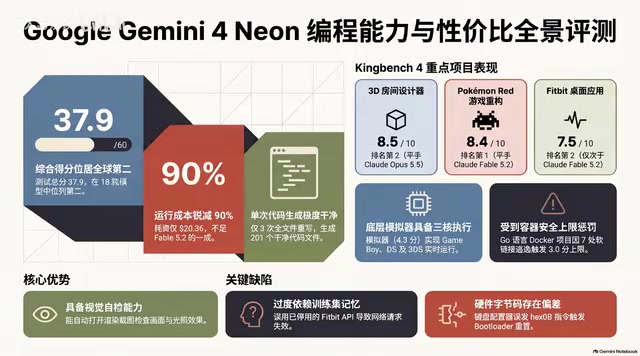
Gemini 4 Neon Hands-On: Value King or Confident Catastrophe?
Gemini 4 Neon review: 1M-token context, four thinking levels, 201 files in one KingBench4 pass at one-tenth Fable 5.2's cost—but it hallucinates fake data, leaves 7 symlink escapes, and bricks keyboards.

Google Gemini 4 Neon Hands-On: 6 3D Works That Impress and Fail
Hands-on with Google Gemini 4 Neon on a 3060 laptop: 6 3D works tested. Sunshower Fishing Harbor and mechanical keyboard impress; soft-body physics and faces fall short.
Gemini 4 Neo Web Novel Writing Test: Faint AI Flavor, Textured Dialogue
Bilibili creator's first-look review of Gemini 4 Neo for Chinese web novel writing: testing a Three Kingdoms transmigration opening with faint AI flavor, emotionally textured dialogue, and strong crisis building, plus comparison of 4A/4H/4C models and full workflow demos.