Gemini 4 Hydrogen Released: A New Coding Model Combining Speed and Intelligence
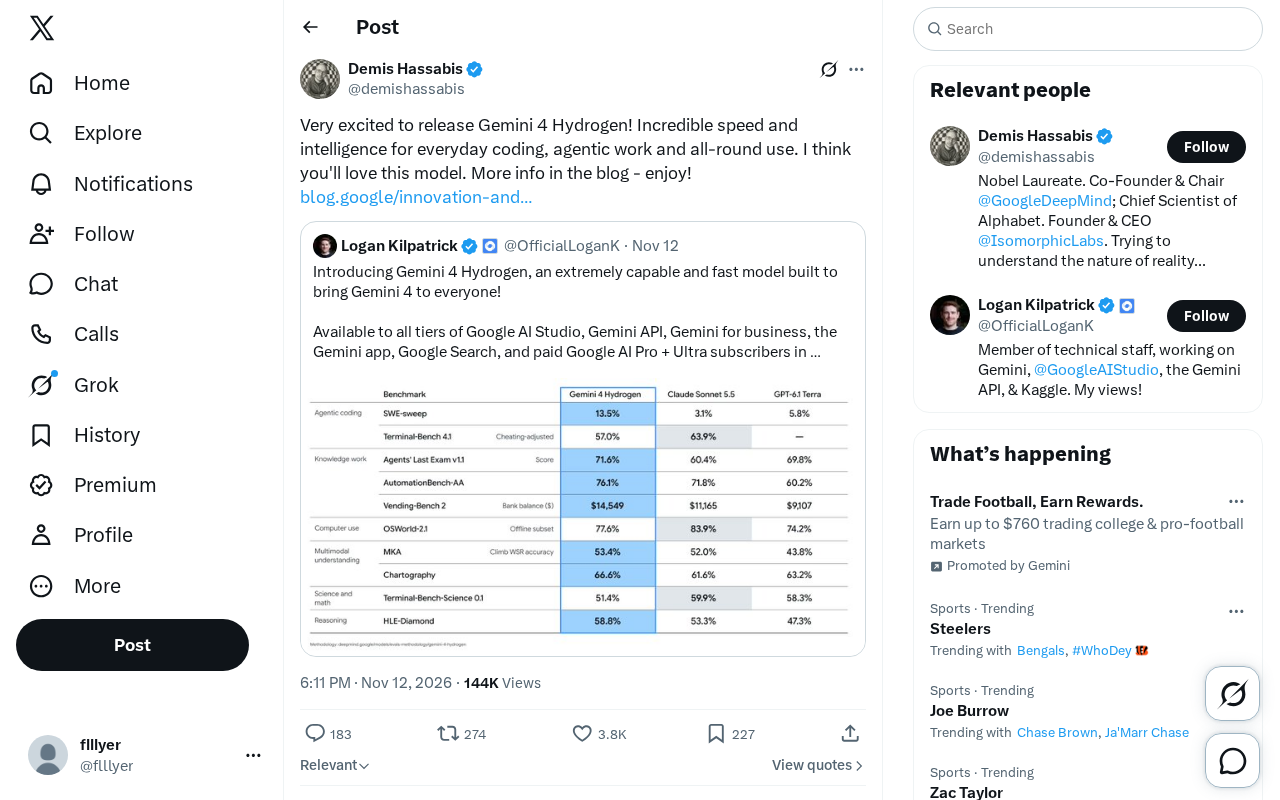
Google releases Gemini 4 Hydrogen, combining speed and intelligence for everyday coding and agentic tasks.
Google has launched Gemini 4 Hydrogen, the newest member of the Gemini series, with an official tweet boldly announcing significant gains in both speed and intelligence. Positioned for everyday coding, agentic tasks, and all-round use cases, its core selling points center on response speed and overall intelligence. The tweet specifically highlights agentic work, indicating the model was designed with multi-step planning, tool invocation, and autonomous execution in mind. However, the tweet is a teaser and does not disclose parameters, benchmarks, pricing, availability, or API access; actual performance still awaits the official blog details or third-party evaluations.
Gemini 4 Hydrogen Officially Unveiled
Google's Gemini series welcomes a new member—Gemini 4 Hydrogen. According to the official announcement on Twitter, this model delivers significant improvements in both speed and intelligence, positioned to cover everyday coding, agentic tasks, and all-round use cases.
The official tweet strikes a confident tone, stating outright "I think you're going to love this model," and includes a blog link for users to learn more. Although the tweet itself does not disclose specific parameters or benchmark data, the phrasing "Incredible speed and intelligence" suggests that Gemini 4 Hydrogen's core selling points center on two dimensions: response speed and overall intelligence.
Speed and Intelligence: Optimized for Everyday Coding
For everyday coding scenarios, a model's response speed directly affects developers' workflow experience. By leading with "speed" in its promotion, Gemini 4 Hydrogen hints at targeted optimizations for high-frequency interaction tasks such as code completion, real-time Q&A, and code review.
On the other hand, the word "intelligence" indicates that the model has not compromised on understanding complex requirements or generating high-quality code in exchange for speed gains. The official description as "all-round use" means it is not intended to serve a single scenario but rather to cover a broad range of needs, from lightweight scripting to complex engineering tasks.
Agentic Tasks Emerge as a Key Focus
The tweet specifically mentions "agentic work"—that is, agent-related workloads. This reflects that Gemini 4 Hydrogen was designed with agentic application scenarios in mind, including multi-step task planning, tool invocation, and autonomous execution.
For developers building AI Agents, a model's reasoning stability and response latency are key metrics. The official emphasis on combining speed with intelligence precisely addresses agentic applications' need to be "fast without being dumb." However, actual performance in areas such as tool-calling accuracy and long-task-chain stability still requires verification through the detailed blog post or third-party evaluations.
What Are Agentic Workloads?
Agentic tasks refer to scenarios where the model no longer merely answers single-turn questions passively but acts as an autonomous entity—planning across multiple steps toward a goal, invoking external tools (such as search, code execution, APIs), observing results, and iteratively correcting until the task is complete. Typical forms include automatic bug fixing, multi-file code refactoring, and web information gathering and summarization. Compared with ordinary conversation, these tasks are characterized by long call chains, many states, and errors that accumulate and amplify along the chain. As a result, the demands on the model go beyond single-step answer intelligence to include long-horizon reasoning stability, format accuracy in tool calls, and the ability to self-correct from failed results. Response latency is also more critical, because a single task may involve dozens of model calls, multiplying the impact of each call's latency.
Release Information and Access Channels
Currently, detailed information about Gemini 4 Hydrogen is primarily being released through the official blog. The tweet itself is a teaser and does not cover pricing, availability regions, API access methods, or other practical details. For developers, directions worth watching include: whether the model will be offered through Google AI Studio or Vertex AI, whether there will be a free tier, the context window size, and performance differences compared with other Gemini versions.
Judging from the product cadence, the Gemini series has been updating frequently lately, and the Hydrogen naming continues the series' style. For teams currently selecting an AI coding assistant, this model deserves a place on the comparison list.
Summary
The release of Gemini 4 Hydrogen sends a clear signal: Google is betting on both speed and intelligence, targeting two high-frequency scenarios—everyday coding and agentic tasks. Whether the official high-profile claims can be delivered depends on the technical details disclosed in the follow-up blog post and real-world user experience. Developers are advised to watch for official blog updates and to run targeted tests as soon as the model becomes available.
Related articles

OMLX 0.7.1 Integrates Splash: Major Speedup for MLX Model Inference on Mac
OMLX 0.7.1 adds Splash as an external engine, letting standard MLX models (Qwen 3.6 35B) match Splash custom setups at 92.8 tokens/s. Setup, D-Flash2 requirements, and M1/M2 compatibility explained.

Running Uncensored AI Locally on Your Phone: LFM3 Hands-On Test and Guide
Learn how to run Liquid AI's LFM3 1.7B uncensored model locally on iPhone and Android—no GPU or network needed. Includes On Device LLM and Layla steps, speed tests, and privacy benefits.

Claude Launches Collaborative Sheets and Whiteboards, Taking On Microsoft and Google Directly
Anthropic rolls out beta Claude Sheets and Whiteboards to paid users, enabling one-prompt spreadsheets with formulas and turning verbal plans into collaborative boards—taking on Microsoft and Google directly.