Gemini 4 Hydrogen Released: Faster and Cheaper, but Cost-per-Task Is What Really Matters
Gemini 4 Hydrogen doubles unit price but cuts cost per task to a quarter, signaling a shift to task-based model selection.
Google released Gemini 4 Hydrogen, a fast everyday model replacing Gemini 3.8 Flash and forming a lineup with frontier models Carbon and Argon around 'deep thinking + fast execution.' Its token price doubled, yet cost per completed task fell from about $7.77 to $1.87; the core argument is that cost per task, not per token, is the metric that matters. Independent scores show near-frontier intelligence, with medium thinking level the best value. Google also launched Orchestrator in Antigravity—Carbon plans, Hydrogen executes—achieving near-frontier success at lower quota and faster speed. Benchmarks are largely vendor-reported, though, and cheaper small models may win on simple high-volume tasks.
Google has released its next-generation model Gemini 4 Hydrogen, positioned as a fast, efficient everyday model. Its price tag has doubled, yet the cost to complete a single task has dropped to roughly a quarter. Behind this seemingly contradictory number lies an important shift in the logic of AI model selection.
Naming and Positioning: A Product Line from the Periodic Table
Google's current model generation is named after chemical elements. Gemini 4 Carbon and Gemini 4 Argon arrived first; they are frontier models responsible for deep, long-chain reasoning. Hydrogen is the lightest element and also the starting point of the product logic—it is the fast, efficient everyday option in the lineup, replacing Gemini 3.8 Flash. With this release, Google has also officially retired the Flash naming that had been in use for more than a generation.
Google's own framing is straightforward: Carbon and Argon handle deep thinking, while Hydrogen handles getting everyday work done quickly.
Paper Specs and Independent Scores: An Everyday Model Punching Above Its Weight
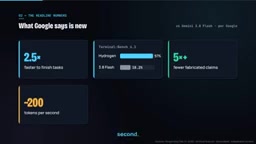
The numbers Google provides include: significantly faster task completion than Gemini 3.8 Flash; a score of 57% on Terminal Bench (a test of real command-line coding tasks), versus 18% for Flash; several times lower frequency of fabricated statements; a generation speed of about 200 tokens per second; and support for up to one million input tokens and one million output tokens—enough to process dense PDFs, spreadsheets, charts, audio, and video in a single pass.
But company data needs external validation. Artificial Analysis's composite intelligence index shows Hydrogen scoring 51 at its default high level—1 point above the larger frontier model Gemini 4 Argon—with the newly added extra-high level reaching 54. For comparison, Gemini 3.8 Flash scores 31, Claude Haiku 5.5 tops out at 36 at its highest level, and the larger Claude Sonnet 5.5 scores 55. A model positioned as an everyday option has intelligence approaching that of the previous generation of frontier models.
Terminal Bench is a benchmark that evaluates a large language model's ability to complete coding and operations tasks in real command-line environments. It simulates the terminal operations developers face daily—such as diagnosing build errors, fixing Git conflicts, and handling the file system—requiring the model to maintain state across multiple rounds of command interaction and use tools correctly. Because tasks feature long chains, tool calls, and immediate feedback, Terminal Bench scores reflect a model's practical usability in agent scenarios better than traditional single-turn code generation benchmarks. Hydrogen's jump from Flash's 18% to 57% on this benchmark indicates substantive improvements in tool-use capability and multi-step reasoning stability, not just better answer quality.
The Price Paradox: Unit Price Doubles, but Task Cost Plummets
Hydrogen is priced at $1.50 per million input tokens and $7.50 per million output tokens—exactly double Gemini 3.8 Flash. That sounds like a price increase, but the real variable is this: to complete the same intelligence-index task, Flash consumes more tokens and time, at about $7.77 per task, while Hydrogen costs about $1.87. Unit price doubles while task cost drops to roughly a quarter because it thinks more efficiently and finishes sooner.
This is the most important takeaway from the entire launch—price per token is the wrong metric; cost per completed task is the number to watch.
That said, Hydrogen is not the cheapest model on the market. VentureBeat notes that its token price is roughly 15 times the lowest standard rates of small models like Claude Haiku 5.5 and OpenAI GPT-6.0. Small models still have much lower per-task costs and lower scores, but for simple, high-volume tasks they may be the more economical choice. Another variable: Gemini 3.8 Flash's price will rise to the same level on January 1, so the cheap option is disappearing anyway.

Thinking Levels: Choosing Different Levels for Different Tasks
Hydrogen offers four levels of thinking depth: low, medium, high (default), and the newly added extra-high. More thinking yields better answers, but also more waiting and higher cost. At the extra-high level, the first character of an answer may take more than half a minute to appear. Independent testers found that medium may be the sweet spot: an index score of 41 at about 80 cents per task.
The practical conclusion: don't just pick a model—pick both the model and the thinking level based on the task type.
Thinking level (thinking level / reasoning effort) refers to the amount of reasoning computation a model is allowed to invest before generating a response. Raising the level typically leads the model to unfold longer internal chains of thought and try more verification paths, improving success rates on complex tasks—at the cost of higher first-token latency and more output tokens. Different vendors name and adjust this differently; some use levels, others use reasoning-budget token counts. For developers, thinking level is an adjustable cost-quality lever: low levels suffice for simple classification tasks, while only architecture-level problems justify going to extra-high. The "first-token latency exceeding half a minute" mentioned in the article is a typical cost of high levels, and medium achieving a balance between index score and cost also aligns with industry experience for most everyday tasks.
Model Teams: Orchestrator and Antigravity
Google has also introduced Orchestrator in its coding tool Antigravity. Rather than running a single model from start to finish, it switches between models: the large Carbon plays senior architect, handling planning and key decisions; Hydrogen plays the role of a fast engineering team, writing code, running tests, and checking work. Google says that on coding benchmarks, this combination approaches Carbon's success rate while substantially reducing quota consumption and completing faster.
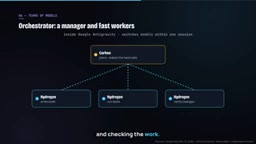
This points to AI's next form: not one large model doing everything, but a managing model plus a fleet of fast executors. Demos include a 3D globe driven by real-time lightning data, shrinking spreadsheet cells into a pixel canvas, and generating slides from a keynote video and then autonomously reviewing them—detecting overlapping text and fixing the layout on its own. The real message of that last demo is this: it doesn't just generate work, it proactively checks and fixes it.
Orchestrator mode is one implementation of multi-agent orchestration: a more capable "managing" model handles task decomposition, planning, and result acceptance, then dispatches specific subtasks to cheaper, faster execution models, passing results back for the planning model to review when necessary. The value of this architecture is that it concentrates expensive reasoning on the nodes that truly require judgment while handing a large amount of repetitive labor to low-cost models—keeping overall success rates close to frontier models while lowering quota consumption and latency. It differs from a simple model cascade, which merely escalates calls level by level according to difficulty; Orchestrator emphasizes role division and a feedback loop, and it also more readily exposes bottlenecks in the execution model's tool use and context passing.
Where You'll Use It, and Safety Claims
In Google Search's AI Mode, Hydrogen becomes the default engine for everyone; Google says it better understands messy multi-part questions, gives more visual answers, and covers a broader range of websites. This is worth attention for web publishers. In the Gemini app, free users get it through automatic model selection. It is also the primary model in the $4.99-per-month Google AI Plus plan and is gradually rolling into Google Sheets, starting with Pro and Ultra subscribers; developers can use it via the Gemini API, including a free tier.
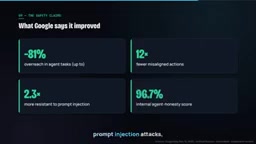
On safety, Google claims Hydrogen reduces out-of-bounds behavior in agent tasks to a small fraction of the original, cuts inconsistent actions by an order of magnitude, more than doubles resistance to prompt injection attacks, and scores 97% on internal agent honesty tests. These figures come from Google's own evaluations; only independent testing can verify their true quality.
How to Think About Benchmarks
Benchmarks are standardized tests. They are useful, but every company picks the tests that favor it—and new benchmarks designed in-house deserve extra caution. The most reliable signals are independent leaderboards and your own real-world testing on your own tasks.
An Honest Conclusion
What seems real: independent scores confirm a major jump in intelligence, and while token unit prices rose, cost per task did fall. What needs watching: many benchmarks are new, some created by Google; competitors still lead on certain tests; and for simple, high-frequency tasks, cheaper models may still be more economical.
The bigger story isn't Hydrogen itself, but that AI is splitting into specialized roles—deep thinkers and fast executors working together, with smart users learning to route each task to the right model. If you're building products with AI, three actions: measure cost per completed task rather than cost per token; test thinking levels, starting from medium; and let large models plan while fast models execute. Hydrogen is the lightest element in the universe, and Google is betting that the most useful AI can be equally light, fast, and ubiquitous.
Prompt injection refers to attackers hiding malicious instructions in content the model will read—web pages, documents, emails, or tool return results—tricking the agent into deviating from its original task, leaking information, or performing dangerous operations. For coding agents with browser, file system, and command-line access, this is one of the most realistic security risks. Common mitigations include isolating untrusted content from instructions, whitelisting permissions for tool calls, requiring secondary confirmation before critical actions, and training models to recognize "instructions within data." The article claims Hydrogen more than doubles resistance to prompt injection; such metrics depend heavily on how the test set is constructed, so evaluation should focus on whether attack types are comprehensively covered and whether multi-step indirect injection is included—not just a single percentage.
One-line Summary
Gemini 4 Hydrogen doubles unit price but cuts cost per task to a quarter, revealing a shift toward task-based rather than token-based selection.
Paragraph Summary
Google released its fast everyday model Gemini 4 Hydrogen to replace Gemini 3.8 Flash, forming a lineup with frontier models Carbon and Argon built around "deep thinking + fast execution." Its token unit price doubled, but the cost of completing the same intelligence-index task fell from about $7.77 to about $1.87; the core argument is that price per token is the wrong metric and cost per completed task is what matters. Independent scores show its intelligence now approaches the previous generation of frontier models, and among four thinking levels, medium is considered the best value. Google also launched Orchestrator in Antigravity, letting Carbon plan and Hydrogen execute, achieving success rates close to frontier models at lower quota consumption and faster speed. The article also cautions that many benchmarks are vendor self-assessments, competitors still lead on some tests, and cheaper small models may be more economical for simple, high-volume tasks.
Related articles

OpenAI to Shut Down Agent Builder and Two Other Services on November 30, Developers Must Migrate Urgently
OpenAI will shut down Agent Builder, the evals dashboard, and reusable prompts on November 30; evals is already read-only. Here's the scope, OpenAI's migration paths (Agent SDK, PromptFu, your own code), and what developers should export and rebuild this week.

RankSpot: A Pay-Per-Use SEO & AI Search Execution Layer That Lets Agents Write, Publish, and Build Backlinks for You
RankSpot is an SEO & AI search execution layer for AI Agents. Connect via MCP to Claude or ChatGPT to write, publish & build backlinks. Pay-per-use, $3/article.

Appxiom: Giving AI Coding Assistants Production Context
Appxiom gives AI coding agents production context—crashes, jank, memory leaks, failed network calls—across Android, iOS, Flutter, KMP, and Web, ranking bugs by Goal Friction Impact.