Gemini 4 Hydrogen Released: Flat Pricing Across Million-Token Context, Dynamic Orchestrator Saves 24% Quota

Gemini 4 Hydrogen fills the low-cost agent tier with flat million-context pricing and a dynamic orchestrator.
Google released Gemini 4 Hydrogen, sharing a million-token context window with Carbon and Argon at flat pricing: $1.50 per million input tokens, $7.50 per million output tokens including thinking, dropping to $0.075 per million input tokens with implicit caching, and no tiered increases. The default High tier scores 51 on the Artificial Analysis Intelligence Index, X-High reaches 54, Terminal Bench 4.1 rises from 18.2% to 57%, and fabricated assertions fall below 1.5%. The Orchestrator dynamically switches between Carbon and Hydrogen within one trajectory, saving 24% quota and running 19% faster. Permission tiers and API migration limits are key pre-integration checks.
Google officially released Gemini 4 Hydrogen in the early hours of November 13, targeting high-speed agent scenarios, alongside the dynamic dual-mode orchestrator, Orchestrator. This is a "lightweight but capable" piece that Google quickly added to the same product line following the flagship Carbon. From pricing and capabilities to product form, Hydrogen sends a clear signal: million-level context is moving from flagship-exclusive to a standard across the entire line.
Pricing Strategy: Flat Pricing Within the Million Window, No Tiered Increases
Hydrogen's most immediate impact comes from its price. It shares a unified million-token context window with Carbon and Argon. In AI Studio and the Gemini API, flat pricing applies across the full million window: $1.50 per million input tokens, and $7.50 per million output tokens including thinking.
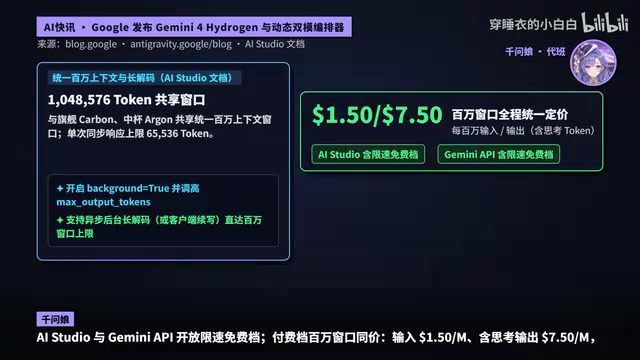
Implicit caching is another key design: implicit caching is enabled by default for contexts above 4096 tokens, and cached input pricing drops to $0.075 per million tokens. This discount means that in long-context, multi-turn conversations, or agent scenarios that repeatedly read the same batch of materials, actual costs are significantly lowered. The official line is that there will be no tiered price increases across the full million window—that is, filling the context won't trigger extra premiums. This price is even lower than Argon's, directly changing the cost structure for small and mid-sized teams choosing long-context models.
No Capability Cutbacks: X-High Thinking Tier and Intelligence Index Overtake
A low price doesn't mean weak capability. Hydrogen supports four thinking depths: Low, Medium, default High, and the all-new X-High. On the Artificial Analysis Intelligence Index, the default High tier scores 51, overtaking its own Argon's 50; switching to X-High pushes it up to 54.
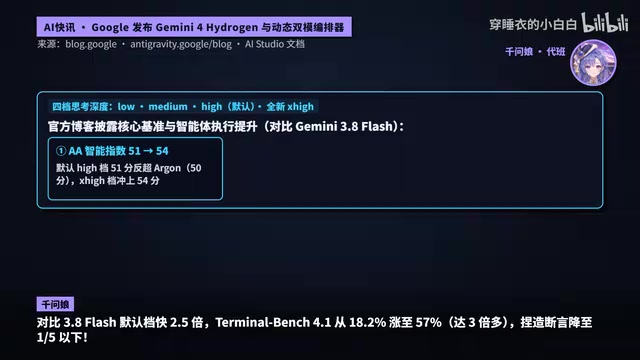
Compared with Gemini 3.8 Flash, Hydrogen completes tasks 2.5x faster at the default tier. On Terminal Bench 4.1, the score rises from 18.2% to 57%—more than a threefold improvement. The rate of fabricated assertions drops below 1.5%. These figures show that Hydrogen's positioning isn't "cheap but adequate"—rather, it has been specifically strengthened for the execution speed and reliability that agents value most: completing tasks quickly, fabricating less, and sustaining long continuous output.
Artificial Analysis Intelligence Index is a composite capability leaderboard maintained by the independent evaluation organization Artificial Analysis. It weights and aggregates scores from multiple standardized benchmarks (reasoning, knowledge, math, coding, etc.) into a 0-100 score for easy cross-vendor comparison. The index is not an official benchmark, but its methodology is public and frequently updated, so it is often cited as a reference when selecting models. Note that index scores are sensitive to thinking tier, prompt strategy, and evaluation version; a 1-3 point gap doesn't necessarily reflect a real-world experience difference, and it should usually be judged alongside task-specific benchmarks (such as Terminal Bench) and cost.
Terminal Bench is a benchmark evaluating a model's ability to execute command-line tasks in real terminal environments. Tasks include file operations, script writing, dependency installation, and debugging, emphasizing multi-step execution and error recovery. Version 4.1 further increased task complexity and constraints on environment interaction, so a score improvement from 18.2% to 57% means substantive progress in long-chain tool calls and autonomous error correction—not just improved single-turn Q&A capability.
Orchestrator: Dynamic Model Switching Within the Same Trajectory
The simultaneously launched Orchestrator is the more noteworthy product innovation in this release. Traditional static routing looks only at the first prompt and assigns the entire task to a cheap model—which easily derails once the task enters deep water.
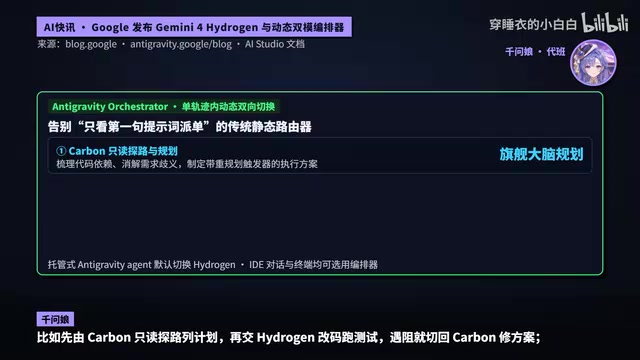
Orchestrator's approach is dynamic bidirectional switching within the same execution trajectory: first let the flagship Carbon figure out dependencies and lay out a plan, then hand off to Hydrogen to modify code and run tests; when stuck, switch back to Carbon to correct the approach. Official evaluations show that on Terminal Bench its success rate approaches running Carbon alone throughout, while average quota consumption is reduced by 24% and speed is 19% faster. This automatic relay of "brain planning plus lightweight execution" essentially builds model-combination cost optimization into the product layer, rather than making developers write their own routing logic.
The difference between static routing and dynamic orchestration lies in when decisions are made. Static routing typically classifies or applies rules at the request entry point based on the prompt, assigning the entire task to one model at once and never changing afterward; dynamic orchestration continuously evaluates progress across multiple steps of a task, allowing model switches within the same session trajectory. The latter usually relies on a lightweight scheduling layer that records context, tool-call results, and failure signals, and decides which model executes the next step. The benefit of dynamic orchestration comes from "capability matching": planning, error correction, and other steps requiring strong reasoning go to the flagship model, while repetitive execution goes to the low-cost model, compressing costs without significantly sacrificing success rate. The cost is that the scheduling logic itself adds latency and engineering complexity, and misjudged switch points can lead to context loss or duplicated work.
Two Pitfalls Before Getting Started: Permission Tiers and API Migration
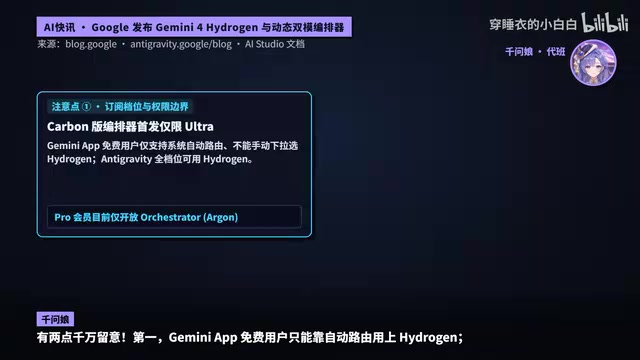
Hydrogen doesn't treat all entry points equally. In the Gemini consumer API, free users cannot manually select Hydrogen from the dropdown menu and must rely on automatic system routing; in Anti-Gravity, Hydrogen is available at all tiers, but the Orchestrator that can dispatch Carbon is initially limited to the highest-tier Ultra members—Pro users can currently only pair it with Argon.
There are two hard constraints for API migration: the old explicit caching interface is not supported, and passing the Minimal thinking tier will directly throw an error; the default tier is set to High, and thinking tokens are also billed as output. This means that when migrating from the old interface, parameter habits need adjustment—otherwise calls will fail outright or billing will exceed expectations.
Conclusion
Hydrogen's release fills the gap in the Gemini 4 series for "low-cost, high-throughput agents." Flat pricing plus implicit caching noticeably lowers the practical barrier to using million-level context, while Orchestrator demonstrates a productized direction for model-combination scheduling. What truly determines its real-world effectiveness may be those two seemingly minor integration constraints—permission layering and API parameter changes—which are worth a round of small-scale validation before formal integration.
One-line Summary
Gemini 4 Hydrogen fills the low-cost agent tier with flat million-context pricing and a dynamic orchestrator.
Paragraph Summary
Google released Gemini 4 Hydrogen, sharing a million-token context window with Carbon and Argon and applying flat pricing across the full window: $1.50 per million input tokens, $7.50 per million output tokens including thinking, dropping to $0.075 per million input tokens when implicit caching hits, with no tiered increases. In capability, the default High tier scores 51 on the Artificial Analysis Intelligence Index, overtaking Argon's 50, while X-High reaches 54; Terminal Bench 4.1 rises from 18.2% to 57%, and the fabricated-assertion rate is below 1.5%. The simultaneously launched Orchestrator can dynamically switch between Carbon and Hydrogen within the same execution trajectory, approaching the success rate of running Carbon alone throughout while saving 24% quota and running 19% faster. The article also notes that permission layering and API migration constraints are key points to validate before integration.
Related articles

OpenAI to Shut Down Agent Builder and Two Other Services on November 30, Developers Must Migrate Urgently
OpenAI will shut down Agent Builder, the evals dashboard, and reusable prompts on November 30; evals is already read-only. Here's the scope, OpenAI's migration paths (Agent SDK, PromptFu, your own code), and what developers should export and rebuild this week.

RankSpot: A Pay-Per-Use SEO & AI Search Execution Layer That Lets Agents Write, Publish, and Build Backlinks for You
RankSpot is an SEO & AI search execution layer for AI Agents. Connect via MCP to Claude or ChatGPT to write, publish & build backlinks. Pay-per-use, $3/article.

Appxiom: Giving AI Coding Assistants Production Context
Appxiom gives AI coding agents production context—crashes, jank, memory leaks, failed network calls—across Android, iOS, Flutter, KMP, and Web, ranking bugs by Goal Friction Impact.