Gemini 4 Neon: Six Hands-On Tests — Wins Benchmarks, But Independent Leaderboards Aren't Convinced
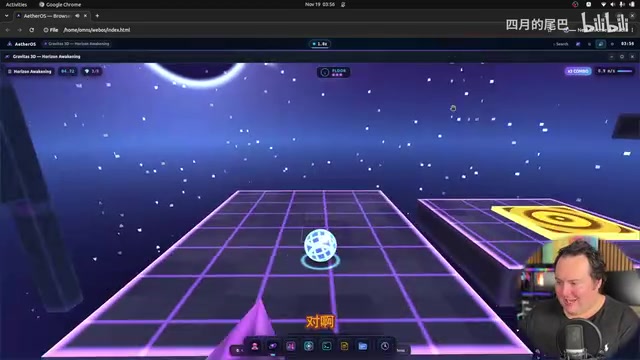
Google Gemini 4 Neon hands-on: standout visual-spatial ability, but comprehensive benchmarks don't top the charts — a gap between reputation and leaderboard rankings.
Google released its third frontier model in ten days, Gemini 4 Neon, and a Bilibili creator tested it across six task categories. Neon ranks below Carbon and above Hydrogen, focusing on in-depth analysis, but due to Carbon's promotion, Neon's actual price is higher. In testing, the photo-to-fighting-game room 3D replication was most impressive, with the creator calling it one of the best visual models they've seen; the robotic arm test completed tasks through unconventional means like ramming cars for leverage; creative writing quality was praised but 100% flagged as AI-generated by detection tools. Independent leaderboards didn't rank Neon at the top, creating a gap with social media praise. The creator believes Neon is more like a specialized tool: prioritize it for visual-spatial tasks, but leave code and complex reasoning to Carbon.
Title
Gemini 4 Neon: Six Hands-On Tests — Wins Benchmarks, But Independent Leaderboards Aren't Convinced
Meta Description
Full record of six hands-on tests of Gemini 4 Neon: from BrowserOS, C++ games, and 3D printing to turning photos into fighting games, visual-spatial ability stands out, but it hasn't topped independent leaderboards. An analysis of Neon's positioning between Hydrogen and Carbon, pricing misalignment, and why benchmarks diverge from reputation.
Article Content
Google released its third frontier model in ten days — Gemini 4 Neon. A Bilibili creator got their hands on it immediately and ran it through six categories of tasks. Interestingly, social media is full of praise for this model, but independent evaluation leaderboards haven't placed it at the very top. This gap between benchmark scores and reputation is precisely the key to understanding Neon's positioning.
Naming Chaos: Where Does Neon Actually Rank?
The naming scheme of the Gemini 4 series has left many users scratching their heads. According to the creator's breakdown, this generation has at least three tiers: Hydrogen handles everyday questions, Neon focuses on in-depth analysis, and Carbon is dedicated to code and complex tasks. Neon sits slightly below Carbon in capability hierarchy but clearly above Hydrogen.
There's a counterintuitive pricing detail: because Carbon is currently on a half-price promotion, Neon's actual price ends up higher than Carbon's. In other words, you're paying more for a model that isn't the most powerful in the lineup. The creator said directly in the video that this misalignment between positioning and pricing is "quite interesting" — it suggests Google's expectations for Neon aren't about being all-around, but about depth in specific scenarios.
According to the creator, independent leaderboards compare Neon in the same tier as models like Slot Opus 5.5 and GPT 6.2 Astra, but don't rank it at the top. This stands in stark contrast to the enthusiastic feedback on social platforms.
Synthwave Style: The article repeatedly mentions the synthwave visual tone across the entire Gemini 4 lineup, referring to a nostalgic aesthetic movement originating in the late 2000s. It's characterized by 80s electronic music, neon color palettes, grid horizons, and chrome metallic textures, commonly seen in retro-futuristic illustrations and UI design. In AI generation, synthwave style — with its high color saturation and formulaic compositions — easily becomes a model's default output tendency. This ensures visual consistency but also sparks "cookie-cutter" criticism. The creator's criticism of Neon's visual consistency essentially points to the model's trade-offs in stylistic diversity.
Basic Specs: Unified Context and Multimodal Input
Neon's technical foundation is a unified one-million-token context window, with thinking levels adjustable to the highest setting. Input covers text, images, audio, and video — full omnimodal support. The knowledge cutoff is listed as March 2026, and web search can bypass this limit to retrieve newer information.
These specs aren't surprising in themselves — million-token context and multimodality are already standard among this generation of frontier models. What truly sets it apart is the visual-spatial understanding demonstrated in the six hands-on tests below.
Test 1: BrowserOS and Synthwave Aesthetics
The first test ran BrowserOS in cluster mode at ultra-high intensity. The output continued the synthwave visual style consistent across the entire Gemini 4 lineup — the creator noted that from the 3.8 Flashlight edition to the 3X series Flashlight models, almost every Gemini 4 variant has this tone.
The interface itself is quite polished — time display, right-click menus, and news feed layout are all in place. But in the GTA-style idle scene, there were signs of inflated performance: some objects' rendering quality didn't match the overall scene. The creator commented on details like fire hydrants, utility poles, water surfaces, and taxis item by item, concluding the visuals "aren't the best" — models like FarNet are superior in realism.
Test 2: C++ Games and Skateboard Remake
In the C++ game test, Neon showed traits consistent with previous Gemini models: the visuals aren't stunning at first glance, but game logic and actual playability are solid, with smooth physics.
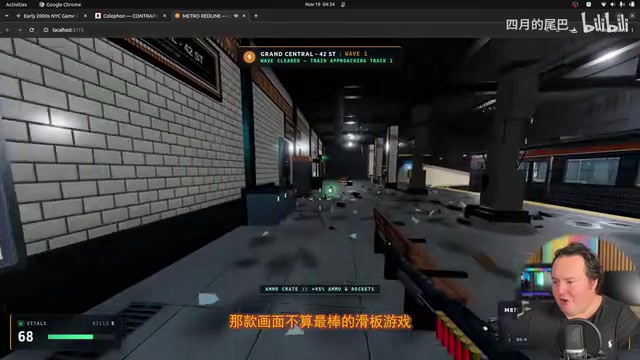
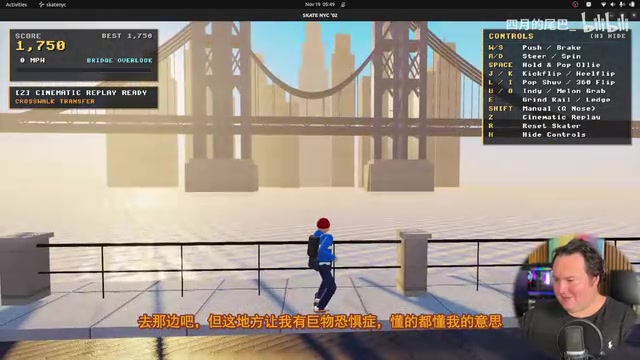
More interesting was a reference-image remake task: the creator provided an early-2000s high-fidelity 3D New York-style image and asked to revamp a low-poly skateboarding game to match the reference. The result included subtle leaf swaying, pedestrians, and waterside scenes — the creator called it "almost beautiful" but didn't hide dissatisfaction with the replay camera angles. What makes this test convincing is that it validates the model's ability to translate a static reference image into an interactive 3D scene, not just image generation.
Test 3: Unexpected Robotic Arm Behavior
The robotic arm test initially ran at medium intensity. The creator wasn't watching at first, and only discovered upon reviewing the recording that the model's behavioral path was quite unusual: it moved by ramming into cars, then used the robotic arm like a person using a broom to reach things, sliding the target out.
Switching to ultra-high intensity, the model completed the task in 31 minutes. It accidentally pushed the car a few times during the process, but ultimately returned it to position and autonomously generated an infographic analyzing how to properly grasp the vehicle. This kind of "unexpected but effective" solution demonstrates the model's reasoning flexibility better than a standard answer.
Reasoning Flexibility: This is a term used in the evaluation to describe a model's ability to break out of preset paths and combine multiple strategies to achieve goals when facing non-standard tasks. Unlike standard benchmarks, it emphasizes the model's adaptive performance when environmental feedback is incomplete or task constraints are ambiguous. Neon's approach in the robotic arm test — using a car as leverage to slide the target out — is exactly this kind of flexibility: the model didn't follow the conventional "direct grasp" solution but used physical interaction to create a new operational path. This capability is extremely valuable in robot control and complex task planning, but it also means reduced behavioral predictability, placing higher demands on safety evaluation.
Test 4: Creative Writing and 100% AI Detection
Creative writing is the one task the creator explicitly said they "regretted doing." The task required simulating a blog with extreme viewpoints: avant-garde design, articles with strong stances, topics including "AI influencers shouldn't exist at all" and "GPUs are fundamentally flawed computing devices," plus details like a PhD author byline and PGP-signed email rules.
Neon implemented all these settings completely, and the generated content was evaluated by the creator as "superbly written." But when the first paragraph was fed into an AI detection tool, the result was 100% flagged as AI-generated. This result itself is worth pondering: the model's writing quality passes muster, but the "AI flavor" can't hide from detectors — the simulation level hasn't reached the point of passing as human.
How AI Detection Tools Work: The article mentions creative writing being 100% flagged as AI-generated, which involves the technical logic of AI text detectors. Mainstream detectors typically rely on text perplexity and burstiness — i.e., word predictability and sentence length variation patterns. AI-generated text tends to have low perplexity (more common word choices) and weak burstiness (uniform sentence structures), thus getting flagged. But detectors have obvious limitations: high misjudgment rates for text that's been human-polished or tuned with specific prompts, and different tools may reach contradictory conclusions. Therefore, "100% flagged" reflects more the statistical differences between text features and human writing, rather than an absolute quality verdict.
Test 5: Photo-to-Fighting-Game — Visual Ability's Highlight
This was the most impressive test of the entire round. The creator provided a room photo and asked to turn two characters into a fighting game, using the entire room as the scene. After about an hour, the game took shape, and the room replication accuracy had the creator repeatedly saying "the advantage is absurdly huge": items on shelves were fully captured, the Macintosh Portable in the corner, Intel tablet, gaming PC, and old Logitech speakers were all in correct positions — even the small cable on the desk wasn't missed.
Based on this, the creator concluded that Neon is "an awesome visual model" — its performance in converting images to 3D space is "absolutely incredible." The fighting functionality itself is also usable, with details like the microphone swaying during combat and computers and heaters getting knocked around. This explains why social media sentiment skews positive: ordinary users are most easily impressed by this kind of visual-spatial task, while independent leaderboards measure more comprehensive dimensions.
Test 6: 3D Printing and Horror Bowling

The last two tests lean toward practical and creative extremes. The 3D printing task required integrating a remote-controlled car's hood, windshield, roof, rear window, and trunk into a file printable in one go, with almost no support structures. Neon decided the model orientation itself, added only a small bottom brim to keep it flat, and additionally designed a hook system to secure the top that would otherwise fall off — the original design had no such structure. The creator confirmed after actually printing that support-free printing succeeded; some ripples at the windshield wiper area were attributed to print bed wobble, not a model issue.
The closing "Bowling Inversion" is a horror game disguised as bowling, made with Blender and Godot. Players bowl at human-sized pins, while pin-sized humans sit at the end of the lane. The creator exclaimed "it's simply indescribable" after watching — camera sound effects and overall atmosphere were all on point.
Why Benchmarks and Reputation Diverge
Back to the gap mentioned at the beginning. Neon excels at visual-spatial understanding, reference-image-to-3D conversion, and unexpected solutions — precisely the abilities ordinary users most easily perceive and share, which explains the social media praise. But independent leaderboards comprehensively evaluate code, reasoning, writing, stability, and multiple other dimensions. Neon's positioning within the lineup is already below Carbon, and factors like synthwave visual consistency controversy, performance inflation, and creative writing's AI detection issues all drag down the composite score.
The creator's usage data is also worth mentioning: all settings were maxed at 100% throughout testing, consuming the weekly quota of 10 uses — under the 200 yuan plan, 10 uses per 5 hours. This consumption pace indicates Neon is designed for high-intensity, low-frequency deep tasks rather than daily calls.
Winning on one benchmark doesn't mean winning on all. Neon is more like a specialized tool: visual-spatial tasks are worth prioritizing, but code and complex reasoning should still go to Carbon. Google's product cadence of releasing three frontier models in ten days also means users need to get used to this new normal where "choosing the right model matters more than choosing the latest version."
One-line Summary
Google Gemini 4 Neon hands-on: visual-spatial ability stands out, but comprehensive benchmarks don't top the charts — a gap between reputation and leaderboard rankings.
Paragraph Summary
Google released its third frontier model in ten days, Gemini 4 Neon, and a Bilibili creator tested it across six task categories. Neon ranks below Carbon and above Hydrogen in the lineup, focusing on in-depth analysis, but due to Carbon's promotion, Neon's actual price is higher. In testing, the photo-to-fighting-game room 3D replication was most impressive, with the creator calling it one of the best visual models they've seen; the robotic arm test completed tasks through unconventional means like ramming cars for leverage; creative writing quality was praised but 100% flagged as AI-generated by detection tools. Independent leaderboards didn't rank Neon at the top, creating a gap with social media praise. The creator believes Neon is more like a specialized tool: prioritize it for visual-spatial tasks, but leave code and complex reasoning to Carbon.
Related articles

The Bottleneck of AI Programming Isn't Generation: Why Software Factories Collapse
After AI coding tools went mainstream, PR review quality dropped and incidents rose. The speaker argues the bottleneck isn't code generation but models' inability to sustain maintainability.
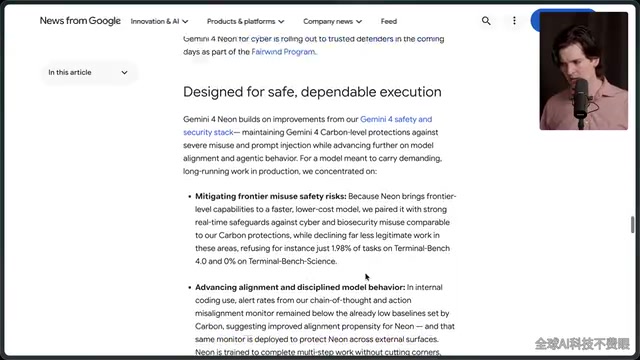
Gemini 4 Neon Hands-On: 10 Hours to Achieve What Opus Couldn't in Days, 20x Faster Warm Start
Google's surprise Gemini 4 Neon release made critic Theo change his tune: 10 hours to finish what Astra couldn't in ten days, 20x faster warm start, coherence beating Opus.

Gemini 4 Neon Hands-On: Which $20 AI Subscription Should You Choose?
Bilibili creator tests Gemini 4 Neon: composite intelligence index 61, beating Claude Opus 5.5, with API 25% cheaper. With a $20 budget, how to choose between Google AI Pro, Claude Pro, and ChatGPT Plus? Includes three must-know pitfalls and recommendations by user type.