Gemini 4 Neon Hands-On: 25% Cheaper Than Opus, But Don't Jump Ship Yet
Gemini 4 Neon excels at visual building and bug fixing, but total task cost and completeness still trail Opus—use them side by side.
Google's Gemini 4 Neon scores 61 on Artificial Analysis, slightly above Opus 5.5's 59, with lower per-task cost ($6.44 vs $10). Developer tests show impressive browser-based visual generation (3D scenes, animations, interactive demos) and bug fixing, plus strong long-document retrieval. However, Neon's greater token consumption can make real task costs higher, and Opus still leads in output completeness. The author recommends using Neon for visual prototypes, bug fixes, and batch API tasks while keeping Opus for long-running agent workflows—coexistence, not replacement.
Google's newly released Gemini 4 Neon scores 61 on the Artificial Analysis leaderboard, beating Opus 5.5's 59, while costing 25% less. But hands-on tests from multiple developers and comparisons by YouTube channels show that this "surpassing" comes with plenty of caveats.
Community Testing: Visual Generation Is the Killer Feature
According to a roundup by a YouTube channel in its video, Neon's standout scenario is anything visible in a browser. Developer bugged dev gave it only a single image of a robot dog carrying a railgun and asked it to "build this 3D model," with no physics or animation hints whatsoever. Neon output a 240Hz physics simulation, inverse kinematics, and full gait cycles (walk, trot, run). The post racked up 150,000 views in a single day.
In another case, Ashatosh gave it a static image and asked only for a Three.js animation. Neon downloaded a depth model from Hugging Face on its own, ran local inference on a Mac to judge foreground-background relationships, layered the image, and produced interactive raindrops, puddle splashes, and a swaying curtain—it even generated rain sounds itself.
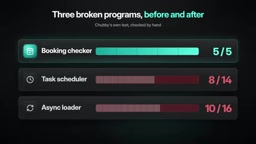
Early adopter Chubby spent one day having Neon build 17 interactive demos. For one called "Terror Breaker," he asked only for "destroy and reset buttons," and Neon added on its own three tools with distinct behaviors: a cannon for large-area destruction, a chisel for small taps, all running at 60fps. More practically, Chubby gave it three broken programs: Neon took the scheduling inspector from 1 of 5 correct to 100%, the task scheduler from 8 of 14 correct to 100%, and the async inspector from partially correct to 100%.

Inverse Kinematics (IK): Inverse kinematics is a core technique in robotics and 3D animation, the counterpart to forward kinematics. Forward kinematics means: given each joint angle, compute the position of the end effector (such as a robot dog's foot). Inverse kinematics goes the other way—given a target position for the end effector, work backward to determine how much each joint should rotate. For a quadruped robot dog, each leg typically has three or more joints; to place the foot at a specific position at a specific moment, you need to solve a set of nonlinear equations that may have multiple solutions or none. Real systems commonly use Jacobian-matrix iteration (e.g., CCD, FABRIK algorithms) or numerical optimization, and must also handle joint limits and velocity constraints. Neon applying inverse kinematics automatically without any hint means it doesn't just write code—it needs to understand mechanical structure and the fundamentals of motion planning, which is far more complex than simply generating a static 3D model.
240Hz Physics Simulation: The update frequency (Hz) of a physics simulation determines its precision and stability. 60Hz means computing position and velocity 60 times per second, while 240Hz computes 240 times per second. Higher frequencies capture collisions, friction, and high-speed motion more accurately, reducing tunneling and jitter, but computational cost multiplies. Running a 240Hz physics simulation in real time in a browser (using engines like Rapier, Cannon-es) requires solid performance optimization, especially while rendering 3D graphics simultaneously. The tester specifically called out the 240Hz figure to show that Neon's generated physics model isn't just "good enough to run"—it meets the standard of professional interactive applications.
Real-World Work Scenarios: Bug Fixing and Long Documents Are Strengths
Beyond visual demos, Neon has independent test evidence for code repair. Developer Powell planted 105 bugs across two real codebases; Neon's top tier scored 63, slightly ahead of Astra 6's 62.7 and above Fable 5.2's 58. On Hacker News, a developer was stuck for two weeks on a low-level graphics issue that OpenAI models and Fable 5.2 had failed to solve; Neon unblocked him in about 20 minutes.
Long context is another selling point Google officially emphasizes. Neon has a million-token window; in Google's own benchmarks, long-document information retrieval accuracy is 95%, versus 67% for Opus. These numbers come from vendor self-testing and should be treated with caution, but the direction aligns with Neon's positioning as a tool for knowledge-work data such as spreadsheets, PDFs, and bills.
Million-Token Context Window: A large language model's "context window" is the upper limit on how much text it can process simultaneously in a single inference, usually measured in tokens. One token is roughly 0.75 English words or half a Chinese character. A million-token window means the model can read in about 750,000 English words at once—several novels, an entire code repository, or hundreds of pages of PDFs. Achieving such long context faces two major challenges: first, attention-mechanism computation grows quadratically with length, requiring optimizations like sparse attention, sliding windows, or linear attention; second, the model must accurately locate relevant passages amid massive information (the "needle in a haystack" test), and long context often comes with "lost in the middle" problems. Google's self-tested 95% long-document retrieval accuracy tests whether the model can extract information from the beginning, middle, and end at extreme lengths—a metric critical for knowledge-work scenarios like spreadsheets, bills, and legal contracts.
"Needle in a Haystack" Test: This is a common method for evaluating long-context model capability: a specific piece of information (the "needle") is randomly inserted at some position in a very long text (the "haystack"), and the model is then asked to find it. By varying insertion depth and text length, you can plot a recall heatmap for the model. 95% accuracy means the model finds the target information across the vast majority of position-length combinations, while 67% indicates a substantial proportion of information is still missed. Note that vendor self-tests typically use simpler retrieval tasks; real-world multi-hop reasoning and complex-format documents will further reduce accuracy, making independent third-party replication tests especially important.
The Cost Ledger: Cheap Unit Price Doesn't Mean Cheap Tasks
Independent leaderboard Artificial Analysis shows per-task cost to complete its test suite: Neon $6.44, Opus 5.5 $10, Fable 5.2 $26. Neon's value-for-money advantage is clear.
But the video author's own API comparison test offers a counterexample: in a "3D coastal city" task, Neon took 3 minutes 17 seconds, output about 25,000 tokens, and cost 37 cents; Opus took 2 minutes 16 seconds, about 16,000 tokens, and cost 32 cents. Although Neon is cheaper per token, it "thinks more and writes more," making total task cost higher. In a dashboard task, the two were nearly tied ($0.40 vs. $0.41).
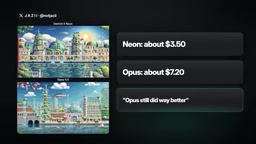
KC's comparison is even more direct: with the same prompt to build a watch configurator, Opus spent $2.74 and produced 42 parts, while Neon spent $1.86 and produced only 9 parts with broken interactions. Another tester reached a similar conclusion—Neon cost about half ($3.50 vs. $7.20) and had richer detail, but overall output preference went to Opus.
The Difference Between Per-Token Price and Total Task Cost: API pricing is usually quoted as input/output cost per million tokens, but what users actually care about is how much it costs to complete a specific task. Total task cost = input tokens × input unit price + output tokens × output unit price + possible caching/inference fees. A model may have a low unit price, but if it tends to generate longer chains of thought ("thinks" more), produce more verbose code ("writes" more), or require multiple rounds of interaction to finish a task, total cost can exceed that of a higher-priced model. In the video author's test, Neon output about 25,000 tokens versus Opus's ~16,000—a typical example. Model efficiency also affects time cost: Neon took 3:17 versus Opus's 2:16; for interactive development, wait time is a hidden cost. So when evaluating value, you should run A/B tests on real tasks, recording total token consumption, conversation turns, and completion quality—not just look at the price sheet.
Batch API Pricing: Many cloud providers offer asynchronous batch interfaces that let users submit large numbers of tasks at lower prices, at the cost of delayed results (usually hours). Batch pricing is typically about half the real-time price. For data labeling, bulk document processing, and offline evaluation, this is a significant cost optimization. The video author's mention that "batch pricing can halve costs" is a hint that high-frequency API users can use this mechanism to further lower Neon's usage cost for non-real-time tasks.
Model Selection Advice: Coexistence, Not Replacement
The video author's conclusion is that the gap between Neon and Opus isn't about "who is stronger" but "who fits this scenario better." For visual prototypes, landing pages, interactive demos, and 3D scenes, Neon is worth trying immediately; it's equally suitable when you're stuck on a bug or need to process large volumes of documents; and if batch API tasks are cost-sensitive, batch pricing can cut costs in half. But for long-running agent workflows, he still stays in Claude Code, using Neon as "outsourcing" and a "second opinion."
He also flags the time-sensitive nature of pricing strategy: Carbon is currently at an introductory price, doubling on December 1 to $4 and $20, while Neon stays at $3 and $15. After that, Neon will be the cheapest route to Carbon-level scores. The author's words are worth remembering: "Don't take the 'beats Opus' headline at face value."

Multi-Model Cross-Review: This is a collaboration pattern in which one model generates or modifies code and another reviews its output to catch errors the first might have missed. Different models have different training data, inductive biases, and failure modes; cross-review leverages this diversity to improve overall reliability. For example, having Gemini review code written by Codex, or Claude review Gemini's output, often catches problems a single model's self-review misses. This is especially effective in code review, security audits, and fact-checking long documents, and costs less than relying entirely on humans. The author's suggestion that "multi-model cross-review may be more pragmatic than betting on a single model" is effectively an acknowledgment that current models each have weaknesses, and combining them is more reliable than chasing an "all-around champion."
Editorial View
Cross-referencing multiple sources, a consensus gradually emerges: Neon has real advantages in two categories of tasks—"things you can see" and "things it can fix"—and both community-driven demos and independent bug tests point the same way. The disagreement is over overall task quality—KC's and the video author's personal tests both show Opus still leads in completeness and efficiency, while Artificial Analysis's score gap (61 vs. 59) is small.
The truly underrated signal is total task cost: cheap per token doesn't necessarily mean cheap per task. For high-frequency API users, this means baselines should be run on your own real tasks when choosing a model, not leaderboard scores or unit-price sheets. Multi-model cross-review (having Gemini review Codex, Codex review Claude) may be more pragmatic than betting on a single model.
One-line Summary
Gemini 4 Neon shines in visual building and bug fixing, but total task cost and output completeness still trail Opus—coexist rather than replace.
Related articles
The New AI Testing Frontier: Deploying Tencent's Open-Source Knowledge Base and Hands-On RAG Evaluation
Starting from AI testing's evaluation challenge, this article covers deploying Tencent's open-source WeKnora, comparing production vs. learning setups, and explaining RAG evaluation principles and hands-on paths.

Why Learn Python in the AI Era? A Deep Dive with the Author of 'Python Crash Course'
Eric Matthes, author of 'Python Crash Course', discusses why Python remains essential in the AI era, the democratization and risks of AI coding tools, and the value of human creators.

Convex Skill Allegedly Uploads User App Ideas to Remote Servers Without Consent
Convex backend skill allegedly sends user app ideas to remote servers without disclosure, sparking Hacker News debate. We analyze the privacy risks and transparency issues.