Gemini 4 Neon Released: A Quarter Cheaper, Scores Beat the Flagship

Gemini 4 Neon scores 61 on the intelligence index at a mid-tier price, dominates long context, and shifts competition to cost per task.
Google released Gemini 4 Neon, its mid-tier model for fast, efficient tasks. It scores 61 on the intelligence index, even beating the pricier Carbon under the highest thinking tier. Priced at $3 per million input and $15 output, it's officially claimed to save 32% over Carbon and 50-80% over same-tier rivals. It leads ultra-long-context retrieval at 95.2% versus 66.8% and 80.1%, but Opus 5.5 leads terminal coding and GPT edges it on dense chart reading—clear specialization. It's available via Pro/Ultra subscriptions and API, in stock at launch. The article argues competition is shifting from intelligence to cost per task, urging developers to route by task type.
Google has been releasing models back-to-back this month, and the latest to arrive is Gemini 4 Neon, the mid-tier member of the family. Its positioning is clear: Carbon handles the hardest work, while Neon takes on fast, efficient tasks. But what's truly surprising is that this "mid-size" model scored 61 on the intelligence index—earned under the highest thinking tier—beating even its own most expensive sibling.
Pricing: $3 per million input tokens, 32% cheaper than the flagship
Gemini 4 Neon is priced at $3 per million input tokens and $15 per million output tokens, compared with Carbon's $4 input and $20 output. The official claim: for the same work, Neon saves 32% over Carbon.
That price gap gets amplified fast in high-volume API scenarios. For most teams plugging models into their product pipelines, a 32% cost reduction isn't a decimal-point optimization—it's the threshold that determines whether a feature can run at all.
Benchmarks: Long-context dominance, but not across the board
Gemini 4 Neon's strength is ultra-long-context retrieval, where it scored 95.2%, versus 66.8 and 80.1 for its two competitors—not a marginal lead, but a full body length ahead.
Its weaknesses are equally obvious. On terminal coding and frontier code tasks, Opus 5.5 leads instead; on dense chart reading, GPT edges ahead in a 55-45 split. In other words, Neon isn't an all-conquering machine—it's a model that's razor-sharp in specific dimensions and merely on par in others.
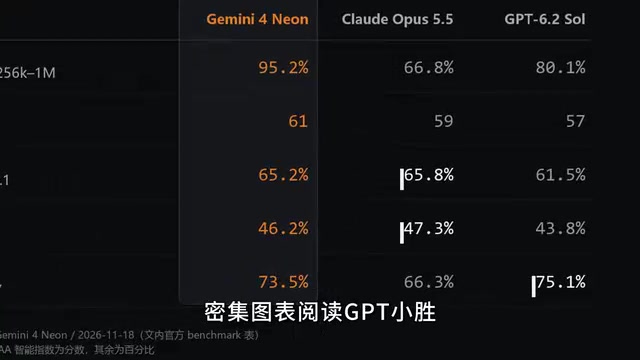
This "specialization" actually fits its product positioning: fast, efficient tasks tend to be exactly long-document retrieval, information extraction, and batch processing—precisely where it's strongest.
Ultra-long-context retrieval refers to a model's ability to accurately locate and use specific information when the input length reaches hundreds of thousands or even millions of tokens. It's not simply about "how much text fits," but rather tests the model's attention allocation, retrieval precision, and noise resistance across long texts. Typical evaluations (such as NIAH, "needle in a haystack") plant a random fact in a long document and require the model to reproduce it accurately; advanced versions add multi-hop reasoning and distractor documents. For enterprise scenarios—contract review, codebase Q&A, financial report analysis, batch information extraction—this capability directly determines whether a model can replace manual retrieval. The gap between 95.2% and 66.8%/80.1% means the former's error rate is an order of magnitude lower on long-document tasks—exactly the main battlefield of Neon's "fast, efficient tasks" positioning.
Capability demos: from a 100,000-cell spreadsheet to 3D mini golf
Two cases in the official demos are worth noting.
One turns a photo into a spreadsheet with 100,000 cells, running edge detection via 500,000 formulas. This task simultaneously tests long context, formula generation, and structured output—a classic engineering job that "looks simple, does extremely hard."
The other writes 3D mini golf from a single sentence, and the model opens a browser to test it and fixes its own bugs. This goes beyond mere code generation into an autonomous debugging loop—the model doesn't just write, it verifies whether what it wrote actually runs.
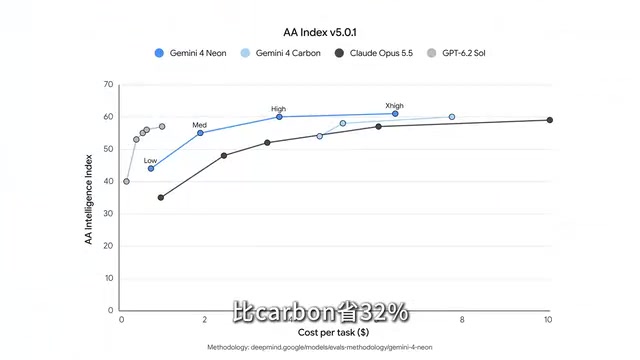
Compared with same-tier rivals, the official claim is that Neon saves 50% to 80%. That's a wide range—the actual savings clearly depend on the task type.
Autonomous debugging loop (agentic debugging) means the model can not only generate code but also actively execute it, observe runtime results, locate errors, and iterate on fixes. This typically relies on tool-calling capabilities: the model is given a browser, terminal, or sandbox environment, and can launch programs, read error messages, modify code, and rerun on its own. Compared with one-shot code generation, the core difficulty of looped debugging lies in interpreting error signals and managing state across multiple rounds—the model must remember previous attempts, avoid repeating mistakes, and judge when to stop. A task like 3D mini golf involves graphics rendering, physics simulation, and interaction logic, with errors scattered throughout—a perfect test of whether the model can complete the full "write-run-fix" cycle without human intervention. This also explains why models specifically optimized for terminal coding and frontier code tasks (like Opus 5.5) still hold an advantage: looped debugging demands far deeper code reasoning than ordinary generation.
Availability and the shift in competitive logic
Available via Pro and Ultra subscriptions and the API, and in stock at launch—no queues, no waitlists. In the current pace of model releases, that alone constitutes a competitive edge.

More intriguing is that the evaluation criteria for this round of competition have changed. It used to be about who's smarter; now it's about how much each task costs. Once the intelligence index reaches the 61-point tier, the gap in "smartness" among top models is narrowing, and cost per task has become the new dividing line. That's exactly the logic behind Gemini 4 Neon's release: deliver a model that holds its own on most tasks at a quarter less than the flagship price.
For developers, this means the selection strategy needs adjusting—no more blindly reaching for the most expensive tier, but allocating models by task type. Long-context retrieval goes to Neon, frontier code may still need Opus 5.5, and dense chart reading stays with GPT. Multi-model routing is shifting from an optional approach to a standard for cost control.
Teams looking to try the latest large models can use Qingyun Top API to access and call them the moment they're released.
Cost per task is replacing raw token pricing as the new metric for model selection. Token prices only reflect input/output billing, but the number of tokens needed to complete the same task, retry counts, and manual rework rates all affect real cost. A model with a slightly higher unit price that gets it right the first time may cost less overall than a cheaper model requiring multiple rounds of correction. Claims of "32%" or "saving 50% to 80%" are essentially comparing price-performance after normalizing for intelligence level. This also explains why "an intelligence index of 61" carries more commercial significance than "a higher score": once the gap among top models on benchmark scores shrinks to single digits, the returns from marginal intelligence gains diminish, while cost differences get multiplied by call volume. Multi-model routing is therefore becoming standard engineering practice—dispatching requests to the most cost-effective model by task type, rather than uniformly using the flagship tier.
One-line Summary
Gemini 4 Neon lands a 61 intelligence index at a mid-tier price, crushes rivals on long context, and shifts competition toward cost per task.
Paragraph Summary
Google released Gemini 4 Neon, the mid-tier member of its family, positioned for fast, efficient tasks. Its intelligence index reaches 61, even higher than its pricier sibling Carbon under the highest thinking tier. Priced at $3 per million input tokens and $15 output, it's officially claimed to save 32% over Carbon and 50-80% over same-tier rivals for the same tasks. On benchmarks, ultra-long-context retrieval leads by a wide margin at 95.2% versus 66.8% and 80.1%, but terminal coding and frontier code are led by Opus 5.5, and dense chart reading is a 55-45 split with GPT—a clear case of specialization. Capability demos include converting a photo into a 100,000-cell spreadsheet with 500,000 formulas for edge detection, and autonomously opening a browser to test and fix 3D mini golf code. Available via Pro and Ultra subscriptions and the API, in stock at launch. The article argues the industry's competitive focus is shifting from model intelligence to cost per task, and developers should allocate models by task type and run multiple models in parallel.
Related articles
GLM-5.4 vs. Opus and Neon: How Far From the Top?
No official benchmarks for GLM-5.4. Based on a YouTube deep test and developer trials, we analyze its gap vs. Claude Opus 5.5 and Gemini Neon, the speed bottleneck from marathon-style thinking, and its real position in enterprise agent scenarios.

From Gobbler to Sloppy Joe: The Hit-Making Playbook of a New Jersey Deli Institution
NYT Cooking visits Milburn Deli in New Jersey to break down the hit logic behind the Gobbler turkey sandwich and the local Sloppy Joe: bread sliced to order, house-made sauces, a group shout culture, and customer co-creation behind six locations.
In the Age of AI Programming, When Do You Still Need to Write Code by Hand?
Is handwritten code still valuable once AI programming agents are widespread? This article outlines three scenarios where handwriting is essential—learning, style development, and prototype validation—and provides a division-of-labor framework between AI and humans to help developers balance efficiency and skill growth.