Gemini 4 Neon Review: Faster and Cheaper Than Opus/Sol, But Korean Is a Letdown
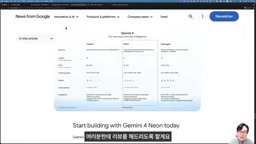
Gemini 4 Neon leads on speed and cost, but Korean regressed and Google's positioning is trending toward the middle.
A Korean tech YouTuber tested Google's new Gemini 4 Neon and found this mid-tier model ($3 input/$15 output per million tokens) sits right between Opus and Sol, leading almost all benchmarks with especially strong prompt injection defense. Across four tasks, Neon took about half Sol's time with an order of magnitude lower token usage, though game detail fell slightly short. Korean capability clearly regressed, so the blogger suggests Hydrogen or GPT for Korean users and using Neon as a worker model in orchestration.
Title
Gemini 4 Neon Review: Faster and Cheaper Than Opus/Sol, But Korean Is a Letdown
Meta Description
Google Gemini 4 Neon hands-on: priced between Opus and Sol, twice as fast on motion/game/website tasks with an order of magnitude lower token usage, but Korean capability clearly regressed. The blogger recommends using it as a worker model in orchestration.
Article Content
The release of Google's new model Gemini 4 Neon has sparked discussion in the AI community. After hands-on testing, a Korean tech YouTuber offered his assessment: this mid-tier model leads competitors by a wide margin on speed and cost, and even rivals top-tier models on some tasks—but its Korean capability has clearly regressed, and Google's overall positioning is becoming somewhat "middle-of-the-road."
Pricing and Positioning: Stuck Between Opus and Sol
According to Google's official release info, Gemini 4 Neon is priced at $3 per million input tokens and $15 per million output tokens. By comparison, Opus is priced at $4/$20 and Sol at $2/$10. Neon lands right in between, but the blogger argues that "this price gap is almost negligible in real-world experience—you can treat them as models on the same tier."
Looking at Google's published benchmarks, Neon outperforms Opus and Sol on almost every dimension, with only three metrics as exceptions. The blogger specifically notes that Google's willingness to benchmark directly against Sol 6.2, which launched just yesterday, shows that "Google has full confidence in its model and believes it can easily crush Sol."
On safety testing, Neon stands out in particular. On the Grayson IPL benchmark, which measures resistance to prompt injection attacks, all Gemini-series models sit on the left side (the best-performing end), far ahead of Claude and GPT. The blogger emphasizes that prompt injection defense is critical for API services—if a model can be easily hijacked by external instructions, many enterprise-grade services simply can't use it.

Prompt Injection is an attack technique targeting large language model applications: attackers disguise malicious instructions as normal input (such as user questions, web content, or document text) to trick the model into ignoring its original system instructions, leaking sensitive information, or performing unintended actions. For models served via API, this defense capability directly determines whether enterprises can launch safely—once a model can be easily hijacked by external content, scenarios like customer service, code generation, and data queries all face data leakage and privilege escalation risks. Benchmarks like Grayson IPL construct various attack payloads to evaluate a model's resistance; the further left the ranking, the better the model is at recognizing and refusing malicious instructions. Gemini's advantage here suggests Google has invested considerable engineering effort in system prompts and content isolation mechanisms.
Product Line Breakdown: Carbon, Neon, and Hydrogen Each Play Their Part
Neon's release finally makes the Gemini product line clear. Carbon is the flagship model—strongest performance but slowest, competing with Anthropic's Astra and Fable tier; Neon sits mid-tier, competing directly with Opus and Sol; Hydrogen takes over the role of the former Gemini Fast, focused on low price and fast response.
The blogger notes that Sol's series (including Terra and Astra) has long occupied the "short turns, low price, good enough" niche, and this positioning "most likely won't change." Meanwhile, Gemini's coverage stretches widely from low to high, especially with Neon, which can adapt to different tasks' efficiency needs.
Interestingly, benchmarks show Carbon outperforming Neon, but the blogger cautions that there's a "late-mover advantage" bias—later-released models benefit on benchmarks, so "you can't simply say Carbon is better than Neon."
The "late-mover advantage" bias in benchmarks refers to: new models often release after their comparison targets, allowing them to optimize for existing benchmarks and even indirectly "see" the test distribution. This means benchmark scores can't fully reflect real capability gaps. Additionally, different vendors' evaluation environments, prompt templates, and sampling parameters are not standardized, so cross-model comparisons require caution. The blogger notes that while Carbon beats Neon on benchmarks, Carbon was released earlier, and Neon may benefit from newer training data and targeted tuning—so you can't assert Carbon is stronger based on scores alone. Understanding this helps readers view vendor-published score tables rationally, rather than equating benchmark rankings directly with real-world experience.
Hands-On: Motion Graphics, Games, Websites—Speed Crushes, But Details Trade Off
The blogger compared Neon and Sol 6.2's real-world performance across four task types.
Motion graphics: With the same prompt, both produced X-ray scanning animations that were "almost identical," evenly matched in completeness and creativity. But Neon took only 22 minutes 32 seconds and 388K tokens, while Sol took 44 minutes 42 seconds and 16 million tokens. The blogger marveled: "Gemini has traditionally used fewer tokens and finished early—it used to be fast but poor quality, and now it's actually fast and good."
Game development: Neon's Roblox-style adventure game fell slightly short of Sol on character detail, but one touch impressed the blogger—the character leans forward when running based on speed, "that dynamic detail was captured really well." Neon took 18 minutes 19 seconds and 313K tokens, while Sol took 49 minutes 41 seconds and 7 million tokens. The blogger suggests that doing 3D modeling first with tools like Tripo and then using Neon to fill in the logic could dramatically cut costs while maintaining render quality.
Website design: Neon's particle animations and scroll effects were smooth, with good overall completeness. But the blogger found one gripe: the Korean interface translated "dark/light mode" as "먹색/미색" (literally "ink color/rice color"), "this is the first time I've seen such terms—it feels like Korean expressiveness is worse than before." He speculates this may relate to a vocabulary randomization mechanism Google recently introduced to detect AI-generated content—abstracting English words is acceptable, but Korean ends up awkward. Sol's output had minor proportion flaws, with overall quality close.
PCB circuit board: Both produced highly similar layouts; Neon took 29 minutes 4 seconds and 468K tokens, while Sol took 56 minutes 32 seconds and 17 million tokens.
Across all four tests, Neon led across the board on time, with token usage an order of magnitude lower. The blogger completed all tests using the Ultra plan, consuming only 1.9% of the weekly quota and 11% of the 5-hour quota.
Korean Capability Regressed, Creative Writing Worse Than Older Versions
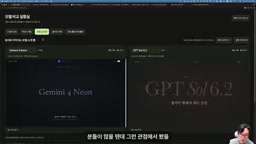
In creative writing tests, Neon's Korean performance disappointed the blogger. A passage describing a Seoul Euljiro street scene contained repetition like "낮아진 해를 낮아진 해를" and semantically jumbled expressions like "키 2 회색 철거 가림망." The blogger stated bluntly: "The old Gemini's Korean was decent, but Neon clearly isn't—I'd recommend Hydrogen or just switching to GPT." He also mentioned that Sonnet 5.5's Korean is worth trying.
Multilingual capability degradation is a common phenomenon in current large model iterations. Models devote the most compute and corpus share to English data; when vendors adjust training ratios to improve reasoning, coding, or safety alignment, low-resource language generation quality may be sacrificed. Korean is an agglutinative language that relies on particles and verb endings to express grammatical relationships, making it more prone to semantic breakdown after vocabulary abstraction or randomization. If the blogger's speculated "vocabulary randomization mechanism" is real, it suggests Google introduced perturbations at the output layer to detect AI-generated content—but such perturbations have larger side effects on non-English languages. For developers, this means you can't assume the same model performs consistently across languages; quality regression testing should be done separately per target language before launch.
Niche Assessment: Google Becomes the "Middle Player"
The blogger offered his take on the current AI coding tool ecosystem: Codex has fast turns and requires frequent intervention, suited for conversational development and meta-prompting scenarios—community reviews are low "mainly because there are too many lazy users"; the Claude series remains strongest for "throw it a one-liner and it gets it done" scenarios; Gemini sits right in the middle—moderate speed, moderate quality, moderate token usage.

On the question of "which one to subscribe to," the blogger's advice is direct: if you're still unsure what you need, pick Claude—"it'll figure everything out on its own"; if you want a second subscription, the safe choice is Codex—"after all, it's always been stable, while Gemini only recently got good"; if you're already locked into an annual Gemini plan, then use Neon as a worker model in your orchestration—it's fast and generous with usage, more cost-effective than Carbon.
As for whether to pay annually, his stance is clear: "Don't pay annually—this industry changes too fast."
One-line Summary
Gemini 4 Neon leads on speed and cost, but Korean regressed and Google's positioning is trending toward the middle.
Paragraph Summary
After hands-on testing of Google's new Gemini 4 Neon, a Korean tech YouTuber concludes that this mid-tier model—priced at $3 input/$15 output per million tokens—lands right between Opus and Sol, leading on almost all benchmarks with especially strong prompt injection defense. Across four real-world tasks, Neon took roughly half the time of Sol with an order of magnitude lower token usage, with motion graphics and website design close in completeness, though game character detail and render refinement fell slightly short. Korean capability clearly regressed, with repetition and semantic confusion in creative writing, leading the blogger to recommend Korean users switch to Hydrogen or GPT. He judges that Google is becoming "middle-of-the-road" in the ecosystem, and suggests using Neon as a worker model in multi-model orchestration rather than as a flagship replacement.
Related articles

Jingle Jam 2026 Registration Opens: Lewis Uses Old Footage to Rally Volunteers for Fundraising
Jingle Jam 2026 fundraising registration is open. Lewis uses old footage edited into a new video, calling on viewers to create fundraising pages at jingle jam.tiltify.com to support eight charities. The event takes place in the first two weeks of December.
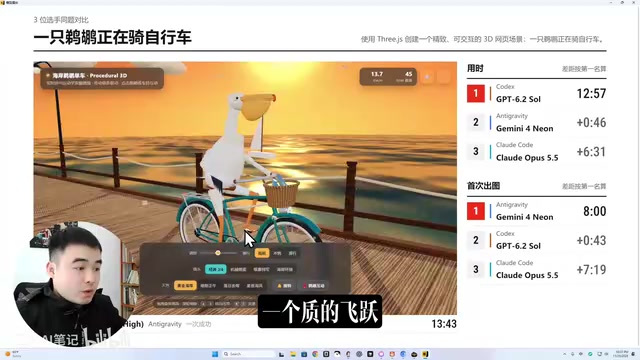
Gemini 4 Neon Hands-On Test: Can It Replace Claude Opus 5.5?
A Bilibili creator tests Gemini 4 Neon, Claude Opus 5.5, and GPT 6.2 across three coding Agent challenges—pelican animation, 3D racing, and code-generated video—to see if Gemini can replace Opus.
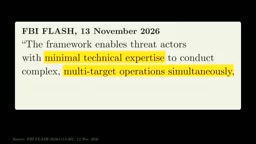
FBI-Warned Artex: How an AI Attack Framework With No In-House Model Pries Open Enterprise Doors
The FBI-warned open-source AI attack framework Artex has no model of its own—it plugs into Claude, GPT, and other external LLMs to drive an agent loop, turning ordinary tools like Nmap into an automated attack pipeline. This article examines three real cases—South Korean finance, ConnectWise, and Barracuda—analyzes the three drivers of speed, cost, and noise, and outlines defenses such as exposure inventory and short-lived credentials.