Gemini 4 Neon Tested in Blender: Cheap but Not the King

Bilibili five-round Blender test: Gemini 4 Neon's detail nears Fable but loses on animation; Argon is the value surprise.
A Bilibili creator compared Gemini 4 Neon, Gemini 4 Argon, Claude Opus 5.5, Claude Fable 5.2, and GPT 6.2 Extra across five Blender modeling tasks with no internet, image generator, or agents. Neon matched Fable on static detail, shining on the bicycle and off-road interior, but Fable won nearly every round—especially on the dog's appearance and animation coherence. Neon cost $44 over five rounds, below Fable's $52, yet didn't deliver the official benchmarks' across-the-board lead. Cheapest Argon cost under $14, and its dog model was deemed game-ready—a value surprise. Conclusion: paper specs and price advantages don't directly equal real task performance.
Google's newly released Gemini 4 Neon model leads competitors in almost every official benchmark, and it's also billed as the lowest-priced option. But a Bilibili creator's five-round Blender modeling test found that while Neon delivers impressive detail, it still couldn't dethrone Claude Fable—and the cheaper Argon turned out to be the real value surprise.
Test Setup: Fair Comparison, but Limited Model Capabilities
According to the Bilibili creator, the test ran in Google's anti-gravity environment, but with no internet, no image generator, and no auxiliary agents—the models could only use Python and Blender. This differs from Google's official demos, which used agent swarms to build a laptop, and the creator considers this a harder test.
The models compared included Gemini 4 Neon, Gemini 4 Argon (the cheapest version), and as references Claude Opus 5.5, Claude Fable 5.2, and GPT 6.2 Extra. The test followed the same five-round tasks from the creator's previous Blender video, using the same images, triangle counts, and budgets each round. Costs were calculated per token at Google API prices, making the dollar-cost comparison with Claude and GPT fair.
Blender and Python Scripted Modeling
Blender is an open-source 3D creation suite. Beyond manual modeling, it offers a complete Python API (the bpy module) for programmatically creating meshes, setting materials, rigging skeletons, and rendering animations. The phrase "models could only use Python and Blender" means the AI had to write its own scripts and call bpy instruction by instruction to build objects—rather than outputting pixels in one shot like image generation. This requires the model to understand 3D coordinates, topology, modifier stacks, and material nodes—a task far more complex than generating an image. If a script errors out or geometry intersects, the model must debug it itself, so this test examines both coding ability and spatial reasoning.
Five Rounds: Fable Still Leads, Neon's Detail Is Stunning
Round 1: Desktop Fan
In the previous round, Fable won for best painting and best metal, with Opus close behind. This round, Neon and Argon performed very similarly, and the creator considered Gemini on par with Claude. Fable still had the best textures, while Neon's draft was a bit too dark, like a ball. Argon also made a clean fan but took 70 minutes, and Argon has its own small weekly idle limit—this fan used up 19% of it.
Round 2: Bicycle
In the previous round, Fable won for the frame and gears, Opus was simpler, and Astra enlarged the image. This round, Neon truly caught up—up close it had as much detail as Fable, including the chain, gears, and all the cables. Argon's bike was slightly simpler, with fewer cables and smaller textures, but it only took 23 minutes and $2.

Round 3: Off-Road Vehicle
Fable won again—no one can do dirt effects like Fable. Neon made a very beautiful interior, and its seats were the most visible of all the cars. Argon was on par with Opus 5.5 here.
Round 4: Dog
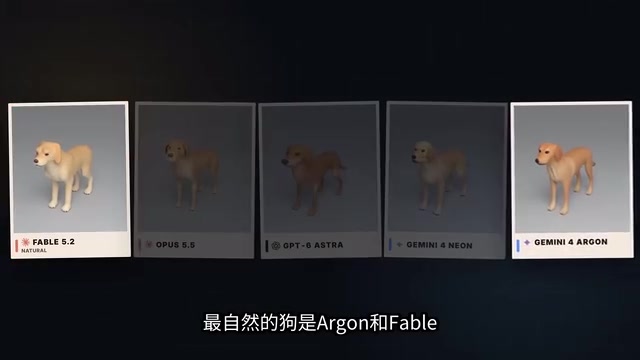
Fable won again, mainly for appearance. Neon added an extreme amount of detail, and the fur was really good, but the overall style was too much for the creator—it looked like a cartoon dog, and it was also the most expensive dog, costing $16 and over an hour. Argon's and Fable's dogs were the most natural; Argon had a better body and ears but square legs, while Fable's legs were much better. The creator said that if he were making a low-poly game, he'd pick Argon's dog for the game—and that one only cost $3.
Round 5: Dog Race
Fable was the most natural, Opus second, and Astra far behind. Neon claimed its dog ran at almost 4 meters per second, but it actually ran the worst of all—even worse than Astra and Argon. Cheap Argon ran as well as Fable, costing less than $2. This round, Fable and Argon were at the top, and Neon at the bottom.
Token Billing and Cross-Vendor Cost Comparison
LLM APIs typically bill by the number of input and output tokens. A token is the smallest unit of text a model processes, with one English word roughly corresponding to 1–2 tokens. In Blender tasks involving long scripts and multiple rounds of debugging, the model must repeatedly read code and output patches, so token consumption accumulates quickly—making a single round potentially cost over a dozen dollars. The article converts Google API token prices to dollars and compares them directly with Claude and GPT dollar bills. This approach eliminates the interference of different vendors' billing units, but it also ignores factors like cache-hit discounts and batch endpoints, so real production-cost differences may be more complex than the test numbers.
Bonus Round: Scarecrow Animation
The creator added a genuinely difficult round: give each model a scarecrow, first skin it, then bring it to life, and finally have the scarecrow receive a screen and run directly toward the camera. Fable won again on the model itself—the creator preferred its color scheme—and Opus and Neon were nearly identical, with Astra last. For animation, Fable was still the best. Argon was eliminated after 20 minutes when it hit its weekly limit.

Weekly Idle Limit (Rate Limit)
The creator repeatedly mentioned that Argon "has its own small weekly idle limit" and "was eliminated after 20 minutes when it hit the weekly limit." This refers to the call quota calculated over a time window (such as weekly) in subscription or API plans; once the cap is reached, requests are rejected or downgraded. Such limits have nothing to do with model capability, yet they directly affect completion of long tasks—in the bonus round, Argon didn't lose on modeling quality but was interrupted by quota. When evaluating models, failing to distinguish "insufficient capability" from "exhausted quota" can easily lead to one-sided conclusions—a confounding variable worth noting in this test.
Price and Conclusion: Neon Is Not the King, Argon Is the Surprise
Over five rounds, Neon cost $44—almost the same as Opus and less than Fable's $52. What really surprised the creator was Argon: under $14 for five rounds, and its dog is good enough to put in a game—as long as the budget allows.
So is Neon the new king of Blender? The creator's answer is no. Neon is very close and detail-oriented, but Fable won almost every round, with the biggest difference being the dog's animation itself—what's on the reference sheet is one thing, but in Blender it's another. For animation, Fable is still the best.
For developers focused on AI coding and AI applications, this test sends a clear signal: paper specs and price advantages don't directly translate into real task performance. Neon can already go toe-to-toe with Fable on static detail, but still lags in animation coherence and overall aesthetics. Argon delivers usable results at extremely low cost, which may be a more pragmatic choice for budget-sensitive low-poly game development scenarios.
One-line Summary
Bilibili creator's five-round Blender test: Gemini 4 Neon's detail approaches Fable but still loses on animation, while Argon is the value surprise.
Paragraph Summary
In an anti-gravity environment with no internet, no image generator, and no auxiliary agents, a Bilibili creator compared Gemini 4 Neon, Gemini 4 Argon, Claude Opus 5.5, Claude Fable 5.2, and GPT 6.2 Extra across five Blender modeling tasks. Results show Neon can go toe-to-toe with Fable on static detail, with standout bicycle and off-road interior results, but Fable won nearly every round—especially on the dog model's appearance and animation coherence. Neon cost $44 over five rounds, below Fable's $52, yet didn't show the across-the-board lead claimed in official benchmarks. The cheapest Argon cost under $14 for five rounds, and its dog model was judged ready for a low-poly game—a value surprise. The creator's conclusion: paper specs and price advantages don't directly equal real-world task performance.
Related articles

Gemini 4 Neon Hands-On: Can It Challenge Opus 5.5?
Google released 4 Gemini 4 models in 49 days. We test whether Neon can challenge Opus 5.5 across benchmarks, real video tasks, and subscription costs.

Former Inmate Reveals Psychopath Ratio in Prison: About 200 Out of Every 880
Former inmate Larry Lawton shares on Lex Fridman's podcast that about 200 of 880 life-sentence inmates are psychopaths—a 23% ratio. He explores the blurred line between good and evil, social dynamics in prison, and wisdom from dark experiences.

Getting Started with Local AI: A Practical Guide to Inkling, Qwen, and Unsloth
A beginner's guide to local AI, explaining the roles of Inkling, Qwen, and Unsloth in local LLM deployment and fine-tuning, covering model selection, quantized inference, lightweight fine-tuning workflows, and trade-offs between local and cloud solutions.