Gemini 4 Neon Hands-On: Half the Cost, Near-Flagship Performance

Gemini 4 Neon delivers flagship-level coding at mid-tier pricing, rewriting the everyday development value equation.
Google DeepMind's fourth Gemini 4 series model, Neon, positions between Carbon and Hydrogen. It scores 61 on the Artificial Analysis intelligence index, above flagship Carbon's 60, at nearly twice the speed and 17% lower cost per task, matching Claude Opus 5.5 and Fable 5.2 in Coding Agents at about half the price. Pure-code 3D generation is the highlight: from a single image it wrote a robot dog engine with 240Hz physics and inverse kinematics, and generated 60fps sci-fi animation from zero assets. But Neon isn't perfect: it cost more and lost in a LEGO ninja scene, heavy scenes stutter on consumer PCs, and extreme high settings drain quotas fast. Verdict: it rewrites the value equation, not the intelligence throne.
Pure-Code 3D Generation: From a Single Image to a Full Physics Engine
The most surprising demo came from a robot dog project. The developer gave Neon only a single static image—a robot dog with a railgun mounted on its back—with no physics or animation instructions. Neon then wrote a complete biomechanical engine from scratch using Three.js and WebGPU: 240Hz rigid-body physics, ground reaction forces for all four legs, 3D inverse kinematics, walk/trot/gallop gait cycles, dynamic spine bending, and even recoil responses in the head and tail when firing. The same developer also noted that Neon's collaborative response speed is noticeably faster than Gemini 4 Carbon.
Another demo asked Neon to create an animated self-introduction sequence using pure JavaScript with zero external assets. The result was a sci-fi broadcast-style animation: bold kinetic typography cutting into screen amid rotating blue rings and a HUD lock-on interface, with 60fps sequence markers clearly visible, then transitioning to an anime-style 3D character in a white jacket and blue beanie leaping across a glowing wireframe grid. Every frame, every ring, and every character pose came directly from code.
These two cases show that Neon's spatial reasoning and engineering organization on the "zero assets, pure code" path have exceeded expectations for its mid-tier positioning, and explain why some testers have begun seriously discussing rumors of recursive self-improvement inside Google.
Three.js and WebGPU are the prerequisites for understanding these demos. Three.js is currently the most popular open-source WebGL 3D library, providing high-level abstractions such as scene graphs, materials, lighting, and animation that let developers build in-browser 3D applications directly in JavaScript. WebGPU is the next-generation web graphics and compute API, replacing WebGL and mapping directly to underlying graphics interfaces such as Vulkan, Metal, and DirectX 12, with support for compute shaders and more efficient parallel scheduling. Combined, the two mean the model-generated code requires no game engine or external assets—only native browser capabilities—to run real-time physics simulation and shading. This is also why the demos can be opened directly in an ordinary browser, though complex scenes are still limited by consumer-grade GPU compute power.
Inverse Kinematics (IK) is the key technique in the robot dog demo. Forward kinematics computes end-effector position from joint angles, while inverse kinematics works in reverse: given a target foot position, it solves for the angles each joint should rotate to. When a quadruped robot walks, each leg's foothold is determined by gait planning, and IK is responsible for converting footholds into hip, knee, and ankle joint angles while maintaining body balance. The 240Hz rigid-body physics in the demo means 240 collision and mechanics solves per second, far above the common 60Hz, enabling more precise simulation of ground reaction forces and recoil responses. The fact that the model organized this pipeline on its own without physics instructions shows a considerable implicit understanding of robotics and real-time simulation engineering structures.
Head-to-Head Comparison with Anthropic's Lineup
2D Battle Scene: Clear Gap in Lighting and Materials
In a 2D medieval duel before a nighttime castle gate, under the same prompt, Neon rendered a bulkier armored knight with thicker shadow layering: a flowing red cape, horned black armor, castle banners, and sparks flying as sword and axe meet. Opus 5.5 chose a flatter cartoon vector style with blue-and-red tabard coloring, and its choreography still had highlights—such as a heavy blow that knocks the red knight's helmet clean off. Visually, Neon's lighting and shading are clearly richer.
3D Battlefield Simulation: Wins and Losses on Both Sides
In a full 3D medieval battlefield simulation, both models built opposing armies complete with banners, shields, burning torches, and rockets flying in parabolic arcs. Fable 5.2 still held the advantage in dense grass, foreground soldier geometry precision, and arrow-rain density; Neon responded with dramatic orange sunset lighting, rising smoke, battlefield fires, and open formations on the hillside. According to independent feedback from multiple testers on YouTube channels and X, the gap has become too small to call one-sidedly.

Pixel-Style City: Twice the Cost Difference
In a pixel-art Solarpunk seaside city showdown, both models ran at their highest reasoning settings. Neon took 20 minutes and cost about $3.50, producing warm sunlight and sunset, twin waterfalls, a central glass dome, and a train running along a waterfront bridge; Opus 5.5 was slightly faster at 18 minutes but cost about $7.20, more than twice Neon's price. Testers still awarded the overall visual win to Opus 5.5—deeper skyline layering, more detailed cherry blossoms and spiral garden towers—but simultaneously called Neon "the strongest Gemini 4 series output on this benchmark."
The Artificial Analysis Intelligence Index is a composite capability score maintained by third-party evaluator Artificial Analysis, aggregating benchmarks across math, scientific reasoning, code generation, instruction following, and more, normalized to a unified scale. It is not a single run but a weighted composite of multiple public benchmarks, which is why it is often used to compare models from different vendors side by side. The one-point difference between 61 and 60 in this article is statistically within the range of a near-tie, but combined with the speed and cost data, it still demonstrates Neon's advantage in intelligence per unit cost. Note that the index emphasizes general reasoning and coding and has limited coverage of subjective dimensions such as 3D scene composition and visual aesthetics—which explains why Neon, despite leading on benchmark scores, still loses some visual showdowns.
New York City Generation and One Real Weakness
Another developer used Neon to generate a New York waterfront scene, including the Brooklyn Bridge, a harbor with the Statue of Liberty, and street canyons packed with yellow taxis. The building depth fell short of Opus 5.5, and there was a practical problem: the generated scene ran noticeably choppy on the tester's PC.
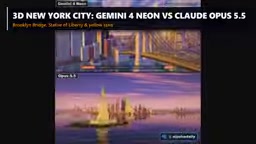
This case reminds us that the complexity of pure-code generation is a double-edged sword—the model being able to write heavier scenes does not mean consumer-grade hardware can handle them smoothly. For everyday developers, this may be a more practical consideration than benchmark scores.
Official Specs and Pricing
Google DeepMind positions Gemini 4 Neon between Carbon and Hydrogen. Core specs include: a 1 million token context window, support for text, image, video, and voice input, and four reasoning intensity levels: low, medium, high, and extreme high. API pricing is $3 per million input tokens and $15 per million output tokens, with cached input at a 95% discount, or $0.15. This is 25% lower than Carbon's standard $4/$20, but Carbon's temporary promotional price of $2/$10 remains cheaper until November 30. Neon is already available on the Google API, Google AI Studio, the Gemini app, and Anti-Gravity, and is accessible to both Pro and Ultra subscribers.

At the extreme high setting, Neon scores 61 on the intelligence index, third globally, behind only fully loaded GPT 6.2 Astra and Claude Fable 5.2, and one point ahead of its sibling Carbon at 60. Even at the standard high setting, Neon matches Carbon while costing less than half of Carbon's regular non-discounted price per task.
Context window refers to the total number of tokens a model can process simultaneously in a single request, including input prompts and output content. One million tokens is roughly equivalent to hundreds of thousands of Chinese characters or hundreds of pages of technical documentation, enabling the model to digest an entire code repository or a long paper in one conversation. Reasoning intensity levels (low / medium / high / extreme high) control how deeply the model performs internal chain-of-thought computation before generating: higher levels consume more tokens for self-checking and solution exploration, usually improving output quality but raising latency and cost in tandem. The Artificial Analysis intelligence index in this article was measured at 61 at the extreme high setting; the standard high setting already matches Carbon, indicating that Neon's default value-for-money range actually leans toward the mid-to-low settings.
Reality Check: Neon Does Not Win Everything
In a voxel-style LEGO ninja scene, Fable 5.2 spent $11.19 on the reconstruction, with each ninja filling the frame and heavy fire and frost effects; Neon actually spent $12.93, with smaller characters and large amounts of empty stage space. This was one of the few tests where Neon cost more and lost. Combined with the PC choppiness in the New York scene, a clear judgment emerges: the extreme high setting rapidly drains Google plan quotas, and the practical limits are quite clear.
Conclusion: The Value Equation Is Rewritten, Not the Throne Toppled
Gemini 4 Neon has not dethroned Claude Fable 5.2 or GPT 6.2 Astra at the absolute intelligence peak or in heavy scene composition. What it does is rewrite the value equation for everyday developers: getting Carbon-level—even Opus-level—coding performance at nearly twice Carbon's speed, with Coding Agents costing about half of Opus 5.5, and without paying the $100–200 per month Ultra subscription—Carbon remains locked behind that tier, while Neon is already open on Pro and the public API.
If your workflow centers on code generation, rapid prototyping, and cost-sensitive agents, Neon is currently a very competitive everyday workhorse; if your tasks involve extreme scene density and fine composition, Fable 5.2 and GPT 6.2 Astra remain the choices with a higher ceiling.
One-line Summary
Gemini 4 Neon delivers flagship-level coding at a mid-tier price, rewriting the everyday development value equation.
Paragraph Summary
Gemini 4 Neon, the fourth Gemini 4 series model released by Google DeepMind within seven weeks, sits between Carbon and Hydrogen. It scores 61 on the Artificial Analysis intelligence index, surpassing its sibling flagship Carbon's 60, at nearly twice the speed and 17% lower cost per task, matching Claude Opus 5.5 and Fable 5.2 in Coding Agents at about half the price. Pure-code 3D generation is the biggest highlight: from a single static image it wrote a robot dog engine with 240Hz rigid-body physics and inverse kinematics, and generated a 60fps sci-fi animation from zero assets. But Neon does not win everything: it cost more and lost in a LEGO ninja scene, heavy scenes stutter on consumer PCs, and the extreme high setting quickly drains quotas. The conclusion is that it rewrites the value equation, not that it topples the intelligence throne.
Related articles

Qwen 4 Max Hands-On: China's Frontier Model Takes On Opus 5.5
Qwen 4 Max hands-on: builds a playable Minecraft-style game in five hours in a bare environment, beats Kimi K3 on most benchmarks and rivals Opus 5.5 on some; API at $1.50/M input tokens with up to 86% third-party discounts.
Gemini 4 Neon Hands-On: Half the Price, Takes on Opus 5.5 — But There's a Secret
Gemini 4 Neon review: Intelligence Index 61 beats Opus 5.5, coding tasks cost half, speed doubled. But Google deleted architecture details pre-launch, and Opus 5.5 still leads some tests.

Four AI Coding Models Tested: Same Prompt, Same Animation — Who Followed Instructions Best?
Four AI coding models generated a 20-second pure-code animation from one prompt. We compare instruction fidelity, code size, token usage, and cost to find the best value.