Gemini 4 Neon vs Claude Opus 5.5 Hands-On Comparison: Which One Is Worth Switching To
Gemini 4 Neon leads Opus 5.5 on most official benchmarks, but real-world tests show its advantages are scenario-dependent.
The article reviews Google Gemini 4 Neon's positioning, pricing, and real-world performance. Neon is the mid-tier family model with a 1M token context and four thinking levels, priced about 25% below Opus 5.5. Official benchmarks show it leading in knowledge work, long context, and scientific reasoning, while lagging slightly in coding. A third-party evaluation gives it an intelligence index of 61, two points ahead, but the ultra-high thinking tier takes about 21 minutes per task and produces verbose output. X user feedback and two rounds of head-to-head tests show Neon was cleaner on the first round while Opus needed one correction. The conclusion: switching is worthwhile for long documents, research, and automation, while Opus retains a slight edge for terminal agentic coding—Google is back at the frontier table but does not dominate across the board.
After Google launched Gemini 4 Neon, its official benchmark table beat Claude Opus 5.5 almost across the board. But benchmarks are one thing, real-world experience is another. A YouTube reviewer, combining user feedback on X and two rounds of head-to-head testing, tries to answer one question: has Google really returned to the frontier this time?
Neon's Position in the Gemini 4 Family
Gemini 4 Neon was released on November 18 and is the mid-tier model in the Gemini 4 family. According to Google's segmentation, Hydrogen focuses on speed and low cost, Carbon is the deep-thinking model that tackles hard problems, and Neon sits in the middle—designed for tasks you run frequently but that still have a certain difficulty. Google's model card states it was adapted from Carbon.
On specs, Neon offers a 1M token context window, up to 65K output tokens per response, and four thinking levels ranging from low to ultra-high. It is already available on the Gemini API, AI Studio, the Gemini app for Pro and Ultra subscribers, and Google's anti-gravity coding tool.
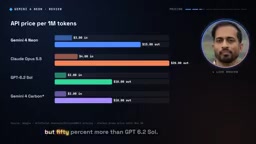
Pricing is a highlight of this launch: $3 per million input tokens and $15 per million output tokens, about 25% cheaper than Opus 5.5's $4.20, but considerably more expensive than GPT 6.2. There's also a twist—Carbon was half-price until November 30, so during those days Neon was actually the most expensive member of the Gemini 4 family.
Thinking Levels is the reasoning-budget control mechanism introduced by the Gemini 4 series, allowing callers to switch between four tiers: low, medium, high, and ultra-high, with the model investing more internal reasoning tokens before answering at higher tiers. This is similar in spirit to OpenAI's reasoning effort parameter: low tiers respond quickly and cheaply, suited for light tasks like classification and extraction; ultra-high suits competition math, complex code repair, and multi-step planning. The cost is a significant rise in latency and output length—the 21-minute single-task time for Neon at ultra-high in the review is a typical example. A common practice is to first run at a high tier to check quality, then drop tiers to verify whether most of the score is retained—the article's note that "the high thinking tier retains about 98% of the score at half the cost" is direct evidence of this cost-performance tradeoff.
Official Benchmarks: Knowledge Work and Long Context Are Its Home Turf
First, look at Google's own published benchmark table, with the caveat that these numbers come from the vendor and are inherently selective.
Neon leads on knowledge-work tasks: a VALS index of 70.9%, slightly above Opus's 70.1%; the gap is larger on the automation benchmark, 56 versus 42. Long context is where the gap is most obvious—in a graph-traversal test ranging from 256K to 1M tokens, Neon scored 95% while Opus managed only 67%. On scientific reasoning, it scored 84 on Ria Man Bench and 71.3 on HLE Diamond.
Coding is not as lopsided as the headline suggests. On Terminal Bench and Frontier Code, Opus 5.5 actually edges out Neon; and for reading charts, GPT 6.2 remains stronger than both.
"Graph traversal" in long-context benchmarks refers to organizing a large number of documents into a graph structure of nodes and edges (for example, an entity-relationship graph or a multi-hop QA chain), requiring the model to retrieve and integrate information hop by hop along a path within a context of hundreds of thousands of tokens, rather than simply finding a sentence at the beginning or end. Such tasks place high demands on positional encoding extrapolation, attention sparsification, and retrieval precision, and are the key test distinguishing "claims to support 1M tokens" from "remains usable at 1M tokens." Neon's 95% versus Opus's 67% on this item is typically interpreted as a difference in long-context training data mix and positional interpolation strategy, rather than a mere contest of window size.
Independent Evaluation: Leads on Intelligence Index, but at the Cost of Being Slow and Verbose
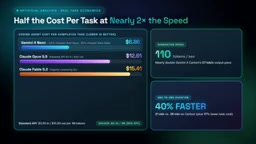
Third-party organization Artificial Analysis places Neon at ultra-high thinking tier at an intelligence index of 61, third overall, two points above Opus's 59. On its coding agent index, Neon scores 59 versus Opus's 58, while Neon's cost per task is roughly half. Valza I ranks it second overall and first on both the finance and law sub-indices.
The cost is also clear. Artificial Analysis measured about 21 minutes per task at the ultra-high thinking tier, with output token volume several times the normal level. In other words, its high scores are bought with time and verbosity.

The Artificial Analysis Intelligence Index is a composite score maintained by a third-party evaluation organization, normalizing and weighting results from multiple public benchmarks such as MMLU-Pro, GPQA, LiveCodeBench, and Math into a single score for easy cross-vendor comparison. Its limitation is that it only reflects static test-set capability and does not measure latency, cost, tool-calling stability, or multi-turn conversation performance, so it is often criticized as "high score, low ability." The article also cites its coding agent index (which measures end-to-end success at having the model autonomously edit repositories, run tests, and fix bugs) and per-task cost precisely to fill in the engineering-usability dimension that a single index cannot see—which is also why the two-point gap of 61 versus 59 must be read together with the 21-minute runtime.
Real Feedback on X
According to tests by X user Pavel Hurin, after planting 105 bugs in two real code repositories, Neon at ultra-high thinking tier led with a score of 63, slightly above GPT 6.2 Astra. Parallel said it is the best model they have tested for web research, at an order of magnitude lower cost than the next best. Valza I also found that the high thinking tier retains about 98% of the score at roughly half the cost—a practical finding for everyday use.

As for personality, both Max Weinbach and Federico Vaitici noticed it is extremely positive, even praising its own image-cropping skills.
Two Rounds of Head-to-Head Testing
The first round is Simon Willison's classic prompt: generate an SVG of a pelican riding a bicycle. Simon ran it on launch day at the high thinking tier and got a well-proportioned pelican riding a red bicycle against a seaside backdrop, at a cost of about 15 cents. His assessment: better than Hydrogen, but not as good as Carbon. As a comparison, Opus 5.5 succeeded on the first try, drawing a pelican with an orange throat pouch, feathered wings, and feet on the pedals, riding a bicycle with clearly rendered spokes along a coastal road. Both completed the task; which is better is for you to judge.
The second round comes from a Data Camp review: build a web page that lets a computer play a full game of chess against itself, requiring its own move generator, search engine, and standard notation. Neon passed all three runs, with all 12 games ending in checkmate, no illegal moves, at about $1 per run.
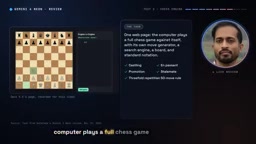
The reviewer gave Opus 5.5 the same task. Every move was legal on the first attempt, and all three games ended in checkmate, but there was a notation bug—knight moves were overspecified. After one fix, the games likewise all ended in checkmate, with notation matching the python-chess library move for move, and it passed all standard move-generation tests. The conclusion is that Neon was cleaner on the first round, while Opus needed one correction. The reviewer also cautions that the two had different configurations and the sample is very small, making this more of a feel test than a rigorous comparison.
"Pelican riding a bicycle SVG" is an informal test prompt proposed by Simon Willison in 2024, which later evolved into a community-recognized benchmark for model feel. It simultaneously tests spatial relationship understanding (the pelican must sit on the saddle, hold the handlebars with its wings, and put its feet on the pedals), physical plausibility (spokes, chain, frame geometry), and pure SVG code-generation ability (path closure, layer ordering, no external dependencies). Because the prompt is open-ended and cannot be scored by memorized test sets, it often exposes a model's weaknesses in compositional generation. It has no objective scoring standard; its value lies in quickly and cheaply observing whether a single generation "looks the part," making it suitable as a subjective comparison rather than a basis for ranking.
Should You Switch?
The criterion actually depends on your use case. If you work with very long documents, do deep research, or run automated pipelines, Neon is the clear choice—and it is cheaper than Opus. If you spend your days in the terminal doing agentic coding, Opus 5.5 still holds a slight edge. If cost is the top priority, after December 1 Neon will be 25% cheaper than Carbon.
The reviewer's final verdict: Gemini 4 Neon is the real deal, but it does not dominate across the board—Google has indeed returned to the frontier competition table.
Related articles

Qwen 4 Max Hands-On: China's Frontier Model Takes On Opus 5.5
Qwen 4 Max hands-on: builds a playable Minecraft-style game in five hours in a bare environment, beats Kimi K3 on most benchmarks and rivals Opus 5.5 on some; API at $1.50/M input tokens with up to 86% third-party discounts.
Gemini 4 Neon Hands-On: Half the Price, Takes on Opus 5.5 — But There's a Secret
Gemini 4 Neon review: Intelligence Index 61 beats Opus 5.5, coding tasks cost half, speed doubled. But Google deleted architecture details pre-launch, and Opus 5.5 still leads some tests.

Four AI Coding Models Tested: Same Prompt, Same Animation — Who Followed Instructions Best?
Four AI coding models generated a 20-second pure-code animation from one prompt. We compare instruction fidelity, code size, token usage, and cost to find the best value.