Gemini 4's Three New Models Explained: The Small Cup Punching Above Its Weight, Built-in Mentor-Apprentice, and Google's Full Suite

Gemini 4's small cup beats the medium cup; built-in mentor-apprentice architecture and membership perks boost value.
Google Antigravity launched the Gemini 4 series in three tiers: small, medium, and large cup. The small cup's measured intelligence and speed beat the medium cup at an entry-level price. Carbon and Argon are built-in mentor-apprentice architectures where the primary model calls the small-cup sub-model to balance accuracy and cost. The overall leaderboard doesn't equal per-task ability—check category rankings by business need. Membership includes a 95G VRAM cloud environment and the Flow suite; the $100 tier can produce roughly 2,000 to 3,000 AI short videos. Slash commands like Goal, Teamwork, Swarm, and runWorkflow cover long-term goals, broad investigations, and procedural tasks. The author also proposes personal AI-fication: package personal data for AI and automate browser operations.
Google's Antigravity platform recently rolled out several new models in the Gemini 4 series, leaving many users puzzled by the model list. This article, based on a hands-on breakdown from a Bilibili creator, clarifies the new models' positioning, cost-effective choices, and hidden perks to help you get the most out of your membership.
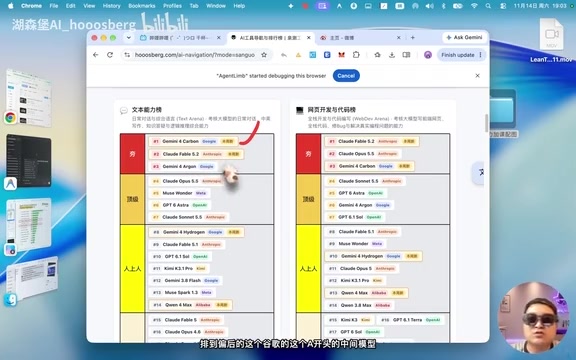
1. Gemini 4's Three Tiers: The Small Cup Punches Above Its Weight
According to the Bilibili creator, the new models are divided into three tiers: "small cup, medium cup, large cup." The small cup (Hedged/Hai Zhi Zhen) targets lightweight, fast tasks; the medium cup (starting with A) handles medium-difficulty tasks; and the large cup (starting with C, named after the periodic table) takes on architecture-level complex programming and refactoring.
But the measured rankings show a "role reversal": the small cup actually beats the medium cup in both speed and intelligence. In several third-party evaluations, the small cup trails only slightly behind Claude Code's Sonnet while outperforming ChatGPT's entry-level models. This means that although it's billed as entry-level, its actual capability approaches the previous generation's top models—yet its price remains entry-level. This is the most outrageous part of Google's latest move.
The medium cup A model actually performs worse than the small cup in the overall rankings. The creator suggests treating the A model as a "mid-tier supplement" rather than assuming it's stronger just because of its name.
"Small cup," "medium cup," and "large cup" are Google's internal tier naming conventions for the Gemini 4 series, corresponding to versions with different parameter scales and inference costs. The small cup usually refers to a lightweight model with fewer parameters and faster inference, suited to high-concurrency or low-latency scenarios; the medium cup is medium-scale, balancing performance and cost; the large cup is the flagship, with the largest parameter count, excelling at complex reasoning and long-context tasks. This tiering isn't strictly linear in capability—actual performance is also affected by training data, architecture optimization, and inference strategy, which is why the small cup can outperform the medium cup in specific evaluations.
2. Built-in "Mentor and Apprentice": Architecture Names, Not Model Names
The "Carbon" and "Argon" in parentheses in the new list aren't the models themselves but architecture names. The logic is that the primary model automatically calls the small cup as a sub-model—like a mentor guiding an apprentice—which both improves accuracy and lowers cost. This aligns with the creator's "apprentice leads mentor" idea from the previous episode; Google has essentially built this method in as two selectable architectures.
The author believes the old 3.8 Flash can be abandoned, because all previous debugging tricks were designed around 3.8 being "too dumb." The new models are smart enough—just use 4 directly.

The "primary model calls sub-model" architecture is often called cascade inference or routing in the AI field. Its core idea is to have a capable but costly primary model understand the task and generate the final answer, while automatically calling lighter, cheaper sub-models to execute simple subtasks or tasks requiring massive parallelism. This maintains output quality while significantly reducing inference costs. Carbon and Argon are two preset architectures Google has productized from this pattern, so users benefit without manual orchestration.
3. Choosing Models by Business Need: Don't Just Look at the Overall Leaderboard
The creator compiled a "from solid to lousy" ranking on his personal blog, emphasizing that overall capability doesn't equal capability in every area. On the text capability leaderboard, Google's new model ranks first, with a clear long-context advantage; it also tops website development and image recognition; and its video generation capability has entered the top tier.
Claude Code ranks first in coding alone but may not lead in every category. For domestic Chinese users, the creator strongly recommends Gemini: Claude Code strictly restricts Chinese IPs and easily bans accounts, ChatGPT has limited quotas, while Gemini is friendly to Chinese users—no account deletion, no hassle.
4. Hidden Membership Perks: 95G VRAM and the Full Suite
Google's membership comes with the most extras of any provider. According to the creator's demonstration, signing up for membership grants a Colab-like cloud environment—equivalent to a GPU with 95G VRAM (H100-class)—capable of running open-source image and video generation models; it also includes the Flow music and film platform, storage space, and more. Taking the $100 Ultra membership as an example, the included quota can produce roughly 2,000 to 3,000 AI short videos—enough to launch an account, according to the creator.
For short-video, short-drama, and editing professionals, this means scripts, voiceover, subtitles, and illustrations can all be completed within a single subscription, with no need to separately buy coding tools to control other video platforms—avoiding paying twice.
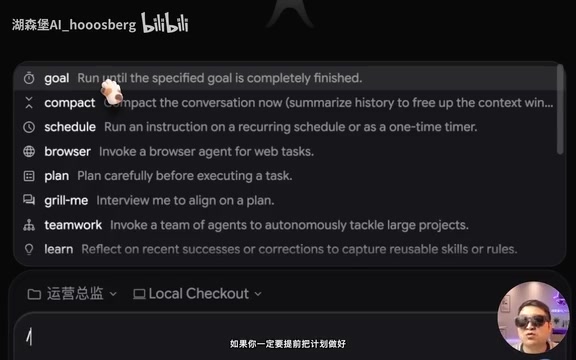
5. Slash Commands in Practice: Goal, Teamwork, and Workflow
Now that the new models are smarter, the old Boost commands designed to "make dumb models smart" are more of a nice-to-have—use them directly for simple tasks, add them for complex ones. Noteworthy slash commands include: Goal for long-term goal-oriented tasks, which requires clear upfront communication and can run for a dozen hours; Compact to compress context; Schedule for scheduled tasks; Browser to control the browser; Plan for planning; Teamwork to automatically distribute tasks to sub-agents, suited to broad investigations; Swarm (bee colony), the flip side of Teamwork, automatically assigning roles like director and screenwriter; and runWorkflow, a dynamic workflow engine that has the AI write reviewable Python scripts on the spot to orchestrate multiple sub-agents completing tasks in series or parallel.
The creator particularly notes that Google Antigravity currently supports only an English interface—multilingual support has been slow to arrive.
A slash command is an interaction method in chat interfaces where typing "/" quickly triggers a specific function, common on platforms like Discord and Slack and later widely adopted by AI assistants. In Gemini 4, these commands are essentially preset prompt templates or tool-call entry points—for example, "/Goal" guides the model into long-term goal tracking mode, while "/Teamwork" automatically enables multi-agent collaboration. They lower the barrier to writing complex prompts, letting non-technical users access advanced features.
6. From Tools to "AI-fication": Hand Your Folder to AI
Finally, the creator shares a broader idea: personal AI-fication. The crudest approach is to package your work and life materials (accounts, income, company, debts, lawsuits) into a folder and hand it to AI, letting it organize, analyze, and continuously answer questions—forming a personal memory bank that grows automatically like a tree.

He believes AI-fication isn't an incremental "AI helps out occasionally" but rather letting AI participate in the continuous iteration of life and earning, forming compound interest. Browser automation is the fastest-deploying piece: the creator has automated his process of uploading videos to Kuaishou, Xiaohongshu, Video Account, Douyin, TikTok, and WeChat Official Accounts, and almost never operates the browser manually anymore. He predicts traditional editing tools will face disruption—in the future, you'll toss raw footage to AI, state your requirements, and editing, voiceover, subtitles, and illustrations will be done automatically.
For ordinary users, the practical advice is: for everyday high-value use, go straight to the Hedged small cup; only open the top model for especially difficult tasks; prioritize versions with strong long-context for writing; and use the mentor-apprentice architecture for investigation- and execution-heavy tasks. Maximize your membership's full-suite quota to truly get your money's worth.
The "personal AI-fication" concept is similar to the "second brain" or "personal knowledge base" idea, emphasizing centralized storage of personal data (documents, emails, account information, etc.) connected to AI, so AI can continuously learn the user's background and offer personalized suggestions. Browser automation, meanwhile, uses scripts or AI agents to simulate human browser operations for repetitive web tasks, such as bulk video uploads and form filling. Combined, these two mean AI shifts from a passive tool to a proactive collaborator in personal workflows.
One-line Summary
Gemini 4's three tiers see the small cup beat the medium cup, while built-in mentor-apprentice architecture and membership perks boost value.
Paragraph Summary
Google's Antigravity platform launched the Gemini 4 series in three tiers: small, medium, and large cup. The small cup's measured intelligence and speed beat the medium cup while staying at an entry-level price. Carbon and Argon are built-in mentor-apprentice architectures where the primary model automatically calls the small-cup sub-model to balance accuracy and cost. The overall leaderboard doesn't equal per-task capability—text, web development, image recognition, and video generation categories should be checked by business need. Membership includes a 95G VRAM cloud environment and the Flow suite; the $100 tier's quota can produce roughly 2,000 to 3,000 AI short videos. Slash commands like Goal, Teamwork, Swarm, and runWorkflow cover long-term goals, broad investigations, and procedural tasks. The author also proposes personal AI-fication, suggesting packaging personal data for AI and automating browser operations.
Related articles

OpenAI to Shut Down Agent Builder and Two Other Services on November 30, Developers Must Migrate Urgently
OpenAI will shut down Agent Builder, the evals dashboard, and reusable prompts on November 30; evals is already read-only. Here's the scope, OpenAI's migration paths (Agent SDK, PromptFu, your own code), and what developers should export and rebuild this week.
RankSpot: A Pay-Per-Use SEO & AI Search Execution Layer That Lets Agents Write, Publish, and Build Backlinks for You
RankSpot is an SEO & AI search execution layer for AI Agents. Connect via MCP to Claude or ChatGPT to write, publish & build backlinks. Pay-per-use, $3/article.

Appxiom: Giving AI Coding Assistants Production Context
Appxiom gives AI coding agents production context—crashes, jank, memory leaks, failed network calls—across Android, iOS, Flutter, KMP, and Web, ranking bugs by Goal Friction Impact.