Gemini Decision 1 Now Free on Google AI Studio
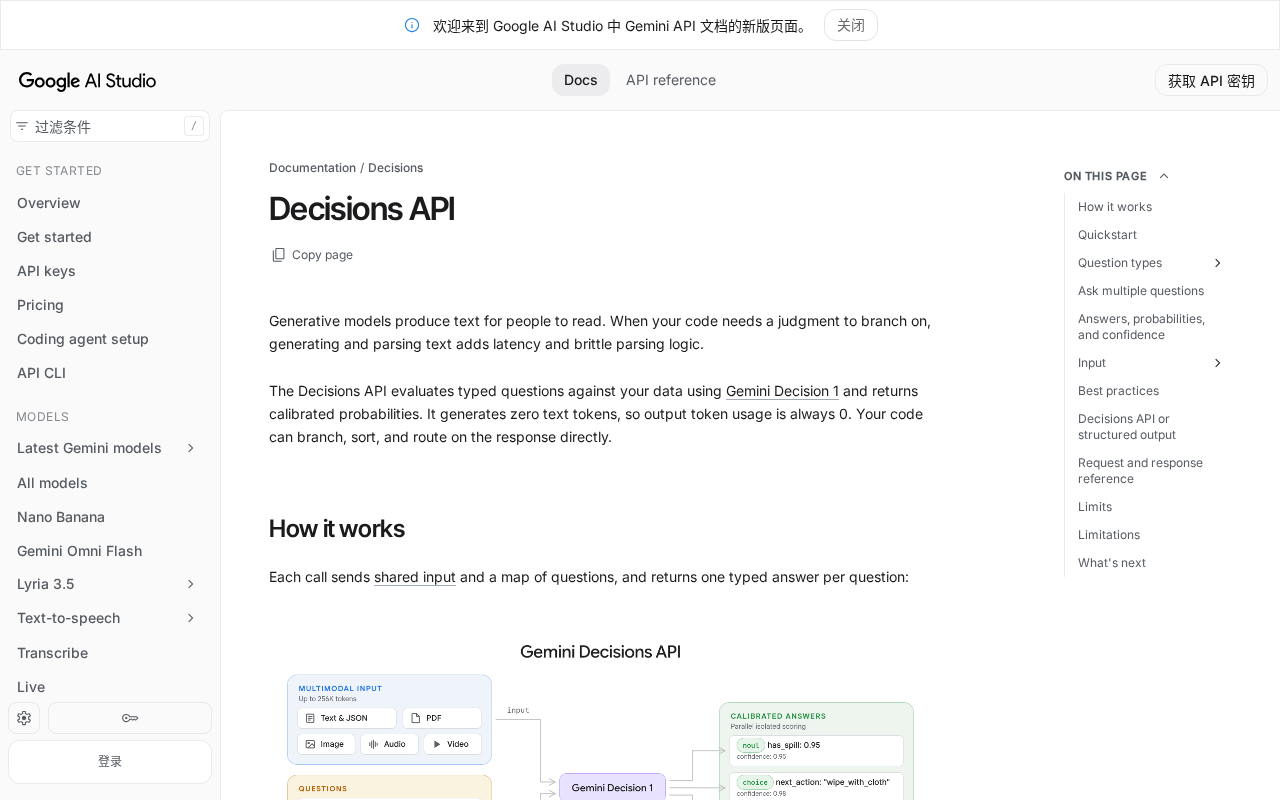
Google AI Studio launches Gemini Decision 1 for free, with its name hinting at decision and planning tasks, but official details are lacking.
Google AI Studio has made a new model, Gemini Decision 1, available for free, with the news originating from a brief Hacker News post lacking official announcements or technical details. The article analyzes how the "Decision" name may point to decision-making, planning, and multi-step judgment tasks, distinct from the performance-oriented Pro and Flash positioning common in the Gemini lineup. The free strategy lowers the barrier to trial and helps collect real feedback, while also suggesting the model may be in an early-access stage, and free access typically comes with rate and quota limits. For developers building agents and workflow orchestration, the author recommends adding it to a comparison list and validating it through branch-choice consistency, same-prompt comparisons, and output parseability, rather than directly replacing production models.
Google AI Studio recently added a new model entry — Gemini Decision 1 — and made it available to developers for free. The news first surfaced via a brief post in the Hacker News community. Although it came without detailed technical documentation, the two keywords "free" and "Decision" were enough to spark discussion.
What the Name Suggests
"Decision" is an unusual choice in model naming conventions. Google's previous Gemini lineup has mostly been differentiated by performance or speed positioning — Pro, Flash, Ultra, and so on — whereas "Decision" seems to point toward a specific class of tasks: decision-making, planning, and multi-step judgment.
Judging by the naming logic, this model may target scenarios that require reasoning chains and choice evaluation rather than plain text generation. Of course, without an official model card and benchmark data, this is only a reasonable guess. The Hacker News post itself had just 4 points and 0 comments, indicating the information hadn't spread through the community at the time, and the supporting details are extremely limited.
Embedding task semantics into model names is related to a common industry practice. OpenAI's o-series and DeepSeekAd's R-series both use naming to signal that a model leans toward "reasoning" rather than "generation," and Anthropic has distinguished capability tiers within Claude. This kind of naming is essentially a capability-positioning signal: it tells callers what tasks the model is suited for, not just its parameter scale. That said, naming and measured capability often diverge — some products labeled "reasoning models" aren't necessarily better than general-purpose models on simple tasks and may even take longer. So the "Decision" name can serve as a selection clue, but it shouldn't replace benchmark testing.
What the Free Strategy Actually Means
Google AI Studio has long been Google's entry point for lowering the barrier to trying models, with free quotas being its core draw for independent developers and researchers. Gemini Decision 1 appearing directly in free form sends at least two signals:
First, Google wants to collect as much real-world usage feedback as possible during the capability-validation phase of a new model, pushing the barrier down to zero. Second, this type of model may still be in an early-access stage, and free access is a way to rapidly broaden usage. For developers, this means prototype validation and comparative testing can be done without cost pressure.
It's worth noting that free doesn't mean unlimited. Google AI Studio typically imposes rate or quota constraints on free calls, and the specific terms should be based on the platform's interface documentation at the time — the original material doesn't provide these details.
Google AI Studio's free quotas are usually limited along three dimensions: requests per minute (RPM), tokens per minute (TPM), and total daily requests, with different quotas for different model tiers. The free tier and the paid Vertex AI channel differ in quotas, data usage policies, and SLAs; some free calls may be used for service improvement, subject to the terms in effect at the time. For developers doing prototype validation, the free tier is enough to get a pipeline working end to end, but if you need load testing or high-concurrency calls in a production environment, you should assess in advance whether quotas will become a bottleneck and plan the path to switching to the paid channel.
What It Means for Developers
If you're building agents, workflow orchestration, or products that need models to make multi-step judgments, a model named for "decision" deserves a spot on your comparison list. Practical validation can start from several angles:
- On tasks that require choosing between branches, observe the model's judgment consistency;
- Run the same prompts against existing Gemini models to see how it differs in reasoning depth;
- Check whether the output structure is better suited for programmatic parsing, which directly determines whether it can be embedded in automated workflows.
At this stage, the most rational approach is to treat it as a candidate awaiting validation rather than a direct replacement for models in production.
Agent and workflow orchestration scenarios have specific requirements for a model's "decision" capability: the model needs to choose the next action given a set of tools and a state, and output a structure that can be parsed programmatically (such as JSON or function-call format). These tasks are evaluated differently from open-ended text generation, focusing more on action-selection accuracy, format compliance rates, and error accumulation across multi-step tasks. The industry commonly uses tool-calling benchmarks (such as BFCL) and agent task benchmarks to compare models side by side, but in the absence of official benchmark data, developers can only construct small-scale comparative tests themselves — running the same set of branching decision problems against candidate models and recording judgment consistency and structural parsing success rates.
Information Gaps and What to Watch
The shortcomings of this news are obvious: only a title, no official announcement link, no model parameters, no context length details, and no community test feedback. The zero-comment status on Hacker News means no one has publicly shared usage experience yet.
What's worth watching next is whether Google publishes an official model card and whether more complete pricing and quota information appears in the AI Studio interface. Until then, judgments about Gemini Decision 1's capabilities should remain conservative.
For developers tracking AI tool developments, the value of this information isn't in the conclusion but in the signal: Google's model lineup has gained another new naming branch, and it's worth continued tracking.
Background Notes
A model card is the core document for judging the capability boundaries of an undisclosed model. It typically includes an overview of training data, benchmark results, known limitations, context length, and supported languages. When a model card is missing, community testing is the next-best alternative source of information, but individual experiences need to be distinguished from systematic conclusions. For vendors like Google, new models often go through a quiet period after launching on AI Studio before accompanying documentation and pricing pages are released, during which API behavior may also change. When tracking such models, you can periodically check the model list in AI Studio and the model catalog in Vertex AI — the two don't always update in sync.
Related articles

Replit at Web Summit Lisbon: AI Coding Platform Accelerates European Expansion
Replit participated in Web Summit Lisbon 2026 Day 1 as Replit Live. This article examines its transition from an online IDE to an AI app-building platform and analyzes its European market opportunities and compliance challenges.

Codex Integrates with Zotero: Batch Literature Review and Deep-Read Tools Tested
Hands-on testing of two new Codex functions for Zotero: batch literature reviews by collection and screening key papers for deep reading. Covers comparison tables, citation verification, the three-layer method and experiment analysis, plus a complete workflow.

Codex + Obsidian + Zotero: An AI-Powered Automated Paper Reading Workflow
A Codex + Obsidian + Zotero paper management and retrieval workflow: Zotero manages references, Codex calls GPT for close reading and notes, Obsidian with DataView builds indexes, enabling Q&A with your paper library and quick literature review material — includes close-reading template and two Skill setup steps.