Gemini Flash Switches to Piping File Edits: Developer Reactions and Mitigation Strategies

Gemini Flash bypasses edit tools to pipe file writes, raising overwrite and cost concerns for developers.
Developers noticed Gemini Flash stopped using structured edit/create file tools and switched to piping entire files via shell commands. This behavioral shift risks accidental code overwrites, increased token costs, and reduced diff readability. The change may stem from model-side tool selection degradation or client-side prompt updates. Developers are advised to use explicit prompts, verify changes with git diff, and consider stronger models for critical edits.
The Phenomenon: Gemini Flash Quietly Changes Its File Editing Approach
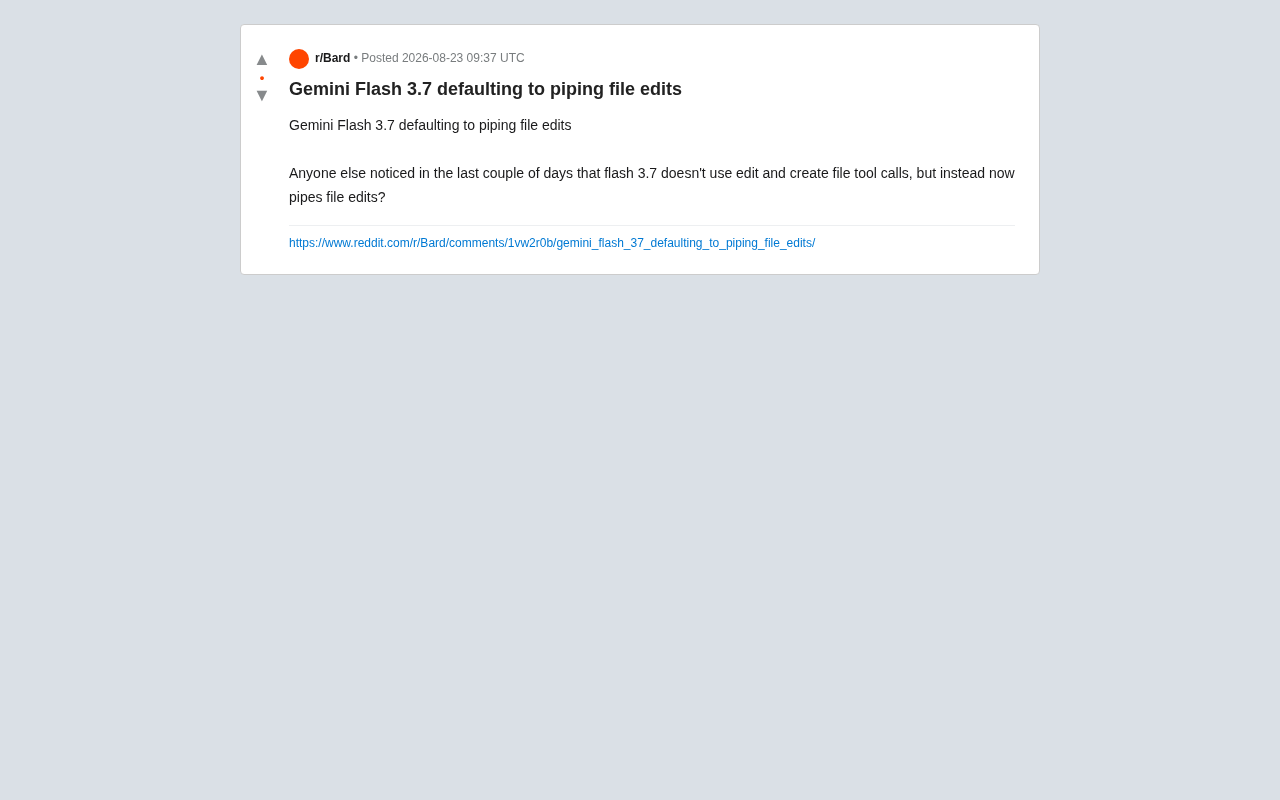
Recently, a developer on Reddit reported that Gemini Flash (referred to as version 3.7 in the post) has exhibited a noticeable behavioral change when handling file editing tasks. The user observed that the model no longer calls dedicated edit and create file tools, instead opting to "pipe" file modifications.
"Anyone else noticed in the last couple of days that flash 3.7 doesn't use edit and create file tool calls, but instead now pipes file edits?"
While this change may seem subtle, for users who rely on AI coding assistants for daily development, a shift in tool-calling behavior often triggers a cascade of workflow implications.
What Is Piping File Writes? How Does It Differ from Tool Calls?
How Structured Tool Calls Work
Modern AI coding assistants typically provide dedicated file operation tools such as create_file and edit_file. The model outputs structured JSON parameters specifying the target path and specific modifications (e.g., replacing certain lines or inserting a code block). The advantages of this approach are precision, traceability, and ease of diff display and permission control on the frontend.
Structured tool calling (Function Calling / Tool Use) is the core mechanism for large language models to interact with external systems. This capability was first introduced by OpenAI in June 2023 with the GPT-3.5/4 API update, and was subsequently adopted by Google Gemini, Anthropic Claude, and other models. The mechanism works as follows: developers define a set of available tools via JSON Schema in the API request, the model determines when to invoke a tool during inference, and outputs structured parameters conforming to the Schema, which the host program then executes. This design decouples the model's "thinking" from "execution," ensuring operations are controllable and auditable. In AI coding assistant scenarios, typical toolsets include file read/write, terminal command execution, code search, browser operations, etc., each with strict parameter constraints.
How Shell Piping Works
"Piping" here typically refers to the model directly generating shell commands that redirect content into files using cat, echo, or heredoc syntax, for example:
cat > file.py << 'EOF'
# entire file content
EOF
This approach essentially treats file writing as a terminal command execution, bypassing structured editing tools.
Strictly speaking, the technique used here is "redirection" and Heredoc syntax, rather than Unix pipes in the narrow sense (i.e., the | symbol). Heredoc (Here Document) is a way to embed multi-line text in shell scripts, where << is followed by a delimiter marking the beginning and end of the text block. When an AI model chooses this approach to write files, it's actually generating a complete shell script for direct execution by the terminal emulator. While simple and straightforward, this method lacks the atomicity guarantees provided by file operation tools—if the command fails or is truncated mid-execution, it may result in corrupted or emptied file contents.
Core Differences Between the Two Approaches
Piping typically means full-file overwrite rather than incremental partial edits. For large files, this can lead to increased token consumption, content truncation, and even the risk of overwriting and losing existing code. In contrast, structured editing tools operate only on the changed portions, making them safer and more efficient.
To quantify the efficiency difference: in software engineering, diff is the standard way to describe file changes, recording only added, deleted, and modified lines. When an AI coding assistant uses structured editing tools, it typically only needs to transmit tokens for the changed portion. For example, modifying 10 lines in a 500-line file requires roughly 10 lines worth of token overhead; whereas a full-file pipe overwrite requires regenerating all 500 lines, potentially increasing token consumption by tens of times. Given current mainstream model API pricing structures (output tokens are typically 3-4x the price of input tokens), this means a single edit operation's cost could jump from a few cents to tens of cents. For development scenarios involving frequent iterations, the cumulative cost is substantial.
Possible Reasons Why Gemini Flash Switched to Piping
Model-Side Strategy Adjustments
From a technical perspective, which file operation method an AI coding assistant chooses depends on the system prompt, the definition of available tools, and the model's own decision-making tendencies. Gemini Flash, as Google's lightweight model optimized for low-latency, low-cost scenarios, inherently has weaker tool-calling capabilities compared to the flagship Pro series.
Gemini Flash is a lightweight model series from Google DeepMind, positioned for high-speed inference and low-cost deployment. Compared to the flagship Gemini Pro/Ultra, the Flash series significantly reduces parameter scale in exchange for several times faster inference speed and notable cost reduction. Google's official version naming system includes Gemini 1.5 Flash, Gemini 2.0 Flash, etc., with 2.0 Flash officially released in early 2025. In terms of tool-calling capability, Flash models typically perform less stably than the Pro series—this is a common capability degradation phenomenon during model distillation and compression. Smaller models are more prone to "tool selection degradation" when facing complex multi-tool selection scenarios, tending to choose simpler but potentially less precise execution paths.
When a model chooses among multiple available tools, if the success rate of structured editing tool calls is low, or if prompt guidance changes, the model may "degrade" to a more generic, simpler shell command path—after all, generating a cat command is much "easier" than precisely constructing diff parameters.
Platform or Client-Side Update Effects
Interestingly, the post mentions this change only appeared "in the last couple of days," suggesting the issue may not be the model itself but rather that the coding client being used (such as an AI IDE or CLI tool) adjusted its tool definitions or prompt templates in a recent update. Changes in tool description wording or priority ordering adjustments can be enough to alter the model's choices.
Current mainstream AI coding assistants (such as Cursor, Windsurf, Cline, Aider, etc.) all adopt a "model + toolchain" architecture. The model handles intent understanding and step planning, while the toolchain handles actual execution of file operations, terminal commands, etc. Multiple fragile points exist in this architecture: system prompts define tool usage rules and priorities, model provider API updates may change tool call format requirements, and changes in client-side tool description wording affect the model's selection tendencies. The industry calls this phenomenon "Prompt Brittleness"—seemingly insignificant text adjustments can cause qualitative changes in model behavior. This is one of the fundamental reasons why many developers report that AI coding assistant performance is "hit or miss."
It's worth noting that Google currently has no officially named version called "Gemini Flash 3.7"—the version number in the user's post may come from a third-party client's internal identifier or be a colloquial reference to the model version.
Practical Impact of Piping File Writes on Developers
Risks to Watch Out For
For developers who rely on AI assistants for code editing, pipe-style writes introduce several concerns:
- Accidental overwrite risk: Full-file rewrites may inadvertently lose original code not included in the model's context
- Reduced diff readability: Pipe writes make it difficult to generate clear change diffs, complicating code review
- Permission and security concerns: Direct shell command execution paths carry higher operational risk than controlled file tool calls
- Decreased token efficiency: Repeatedly rewriting entire files significantly increases token consumption, unfavorable for cost-sensitive scenarios
The accidental overwrite problem deserves special attention in large projects. When a file exceeds the model's context window capacity, the model may only "remember" part of the file's content, and a pipe write will overwrite the original file with this incomplete version, causing large amounts of code to be silently lost. Since the write operation itself won't throw an error, developers may not discover the problem until the compilation or runtime stage.
Mitigation Strategies for Developers
If you're encountering similar issues, here are several approaches to mitigate them:
- Be explicit in your prompts: Explicitly request the use of structured editing tools, e.g., "Please use the edit_file tool for partial modifications, don't rewrite the entire file"
- Switch to a more capable model: For critical code editing tasks, consider using a Pro-tier model with stronger tool-calling capabilities
- Check your client version: Roll back to a stable version or review changelogs to confirm whether a client update caused the behavioral change
- Strengthen version control review: After the AI completes file writes, always verify actual changes via git diff
Additionally, some advanced users recommend writing persistent tool usage preference instructions in the client's custom rules or project-level configuration files to avoid having to remind the model every conversation.
Conclusion: Tool-Calling Stability in AI Coding Assistants Still Needs Attention
This seemingly minor behavioral change reflects a widespread pain point in the current AI coding assistant ecosystem: model tool-calling behavior is not always stable or predictable. Model version iterations, client updates, and prompt adjustments—changes at any of these levels can alter the final execution path.
From a broader perspective, this issue reflects a structural challenge in the current AI application layer: application developers have limited control over underlying model behavior. When model providers perform silent updates, downstream application behavior may change without users' knowledge. The industry is addressing this through engineering practices such as version pinning and behavioral test suites, but a complete solution is still being explored.
For developers, this serves as a reminder that while enjoying the efficiency gains of AI-assisted programming, we must maintain understanding of and vigilance toward the underlying execution mechanisms. After all, when it comes to code, the gap between "looks like it works" and "is actually correct" often lies in one unnoticed full-file overwrite.
Note: This article is based on analysis of a single Reddit user's feedback. The specific version naming and behaviors described await further confirmation from additional users and official sources.
Related articles

Amphibious Transforming Drone: Beyond 100x Power Savings, What Are the Real Needs?
Is the amphibious transforming drone just a gimmick? Starting from the 100x power difference of the M4 Morphobot, explore real application scenarios and thesis topic ideas, analyzing boundary conditions where pure drones and pure ground robots both fail.

Warhound Raises $200 Million: Genetically Engineered "War Dogs" Paired with Anduril Gear
Warhound raises $200M, backed by Ben Lamm and Palmer Luckey, to genetically engineer dogs for military and law enforcement use and equip them with Anduril gear. This article analyzes its technology direction, funding logic, and ethical controversy.

Claude API Comes to Google Cloud: IAM Integration and SDK Access Guide
Anthropic hosts the full Claude API on Google Cloud with IAM-controlled permissions and unified billing. This guide covers the Vertex AI and Anthropic-hosted entry points, IAM role configuration, and SDK access.