Gemini Live API Major Update: Advanced Reasoning Comes to Native Audio for the First Time
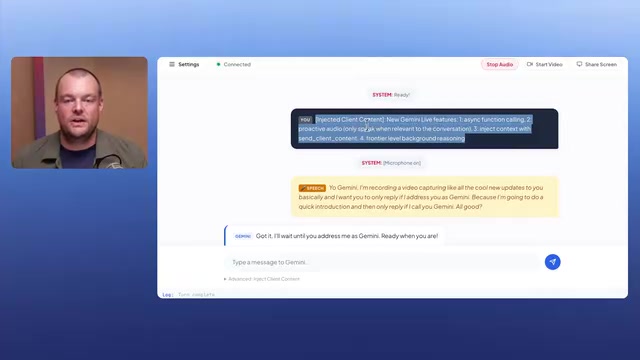
Google brings advanced reasoning, async function calling, and proactive audio to the Gemini Live API.
Google has delivered four major updates to the Gemini Live API: proactive audio lets agents speak only when addressed; context injection allows developers to pass background data without interrupting the conversation; async function calling lets long-running tools run in the background without blocking dialogue; and most significantly, frontier-level advanced reasoning has entered native audio for the first time. Complex reasoning tasks run in the background while the foreground interaction continues uninterrupted — a shift that moves voice agents from passive tools to real-time collaborators.
Google has rolled out a highly anticipated set of new features for the Gemini Live API, with the most notable being the first-ever introduction of frontier-level reasoning into native audio interactions. This update covers async function calling, proactive audio, context injection, and background reasoning — enabling voice agents to handle more complex tasks while maintaining real-time responsiveness.
Proactive Audio: Agents That Speak Only When Needed
Traditional voice assistants operate in a mechanical call-and-response pattern, triggering a reply after every user utterance. The new proactive audio feature changes this — developers and users can instruct the agent to respond only when it's relevant or directly addressed.
In the demo, the host told Gemini upfront: "Only respond when I call your name, Gemini." Gemini then stayed quiet, waiting silently until addressed before joining the conversation. This allows agents to integrate more naturally into multi-party conversations or extended voice sessions without interrupting the flow with unnecessary interjections.
Context Injection: Passing Information Without Triggering a Turn
Another practical addition is the ability to inject client-side content into a conversation via send client content without forcing a conversation turn. As the official description puts it, this is ideal for "back-channeling information" to the model.
In practice, developers can silently feed additional context or data to the model without interrupting the ongoing voice exchange, allowing the agent to naturally incorporate that information in subsequent responses. For applications that require dynamically updated background data — such as customer support, sales assistance, or live data narration — this significantly improves interaction flexibility.
Async Function Calling: Long-Running Tools No Longer Block Conversation
Async function calling addresses tools that take a significant amount of time to return results. Previously, calling an external tool would put the conversation on hold while waiting for a response. Now, those tasks can run in the background while the agent continues talking with the user.
In the demo, the host asked Gemini to check the shipping status of order number 1234XYZ. Gemini responded: "I'm looking that up in the background and will update you as I go" — keeping the conversation flowing — before returning with the result: the order has shipped with an estimated delivery date. This ability to "work while talking" makes voice agents far more practical in real-world business workflows.
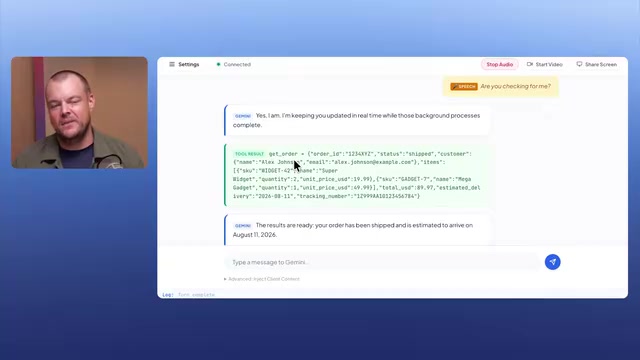
From a technical standpoint, traditional synchronous function calling uses a serial request-wait-respond model: once the model issues a tool call, the entire conversation thread is suspended until the tool returns. This is nearly imperceptible when calling local functions with millisecond response times, but with real network requests — logistics APIs, database queries, or third-party services — multi-second waits create noticeable silences in voice interactions, seriously degrading the user experience.
Async function calling solves this by decoupling tool execution from the main conversation thread: the tool call is submitted to a background queue and runs independently, while the model's conversational capacity remains fully active to handle follow-up questions, interruptions, or other requests. When the background task completes, the result is asynchronously injected into the current context, and the model proactively reports back to the user. This mechanism mirrors the async/await or Promise patterns in modern programming languages, now adapted for real-time voice interaction.
Advanced Reasoning Enters Native Audio for the First Time
The most groundbreaking part of this update is the first-ever availability of high reasoning and background reasoning in Gemini Live, bringing frontier-level reasoning capabilities to the native audio experience.
Google used a classic test to demonstrate the difference: asking the model to generate an SVG of "a pelican riding a bicycle." The standard native audio model produced underwhelming results, but switching to the max high reasoning model, Gemini generated a detailed pelican complete with a helmet, a flowing scarf, and a fully rendered bicycle structure.
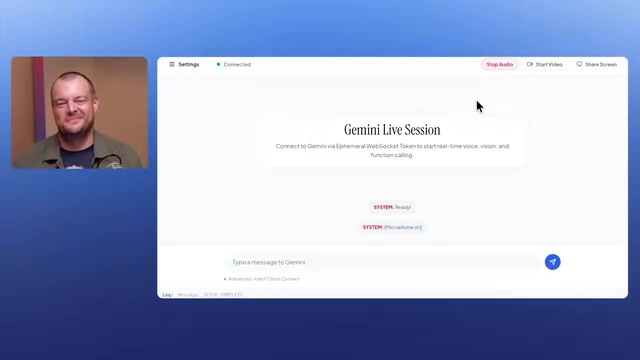
Equally important is how the task is executed: this more complex drawing task runs in the background and takes some time to complete, yet the model remains responsive throughout. Users can continue conversing normally ("Can we keep chatting while we wait?" "Absolutely."), and the model proactively reports back once the image is ready. This mechanism — offloading heavy reasoning tasks to the background while keeping the foreground interaction real-time — is the core value of this update.
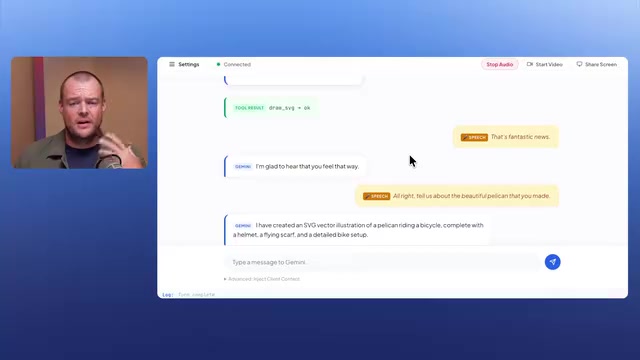
"Frontier-level reasoning" here refers to versions of the Gemini model family that feature extended thinking or deep reasoning capabilities — characterized by multi-step internal inference before producing a final answer, which takes longer but yields significantly higher output quality. Previously, this type of reasoning was largely confined to text or multimodal interfaces; native audio mode, with its strong dependency on real-time low latency, struggled to accommodate the longer processing times reasoning requires.
The "background reasoning" mechanism introduced in this update is a key engineering breakthrough: it separates the computationally intensive reasoning from the real-time audio stream, allowing the voice response layer and reasoning computation layer to run in parallel. Users can continue conversing while the model "thinks," and the results are integrated into the output once reasoning is complete. The SVG drawing test vividly illustrates the quality gap between the two modes — tasks requiring spatial reasoning and structured output are precisely where deep reasoning models hold the greatest advantage over standard models.
What This Update Means
Taken together, these features all point toward a single goal: evolving voice agents from passive response tools into real-time collaborators capable of proactive judgment, background processing, and continuous responsiveness.
Proactive audio addresses the question of conversational timing. Context injection solves information delivery. Async function calling eliminates blocking on long-running tasks. And advanced reasoning directly raises the ceiling for handling complex requests. For developers, this means building voice applications on the Gemini Live API that are far closer to real-world interaction scenarios — whether for intelligent customer service, voice assistants, or multimodal creative tools. These capabilities are now available, and Google has expressed eagerness to see what developers build with them.
Related articles
vLLM v0.30.0rc1 Released: Isolates FlashInfer BF16 Autotuning Logic
vLLM v0.30.0rc1 release candidate fixes FlashInfer BF16 autotuning isolation (PR #57285). Learn the technical background and its impact on inference deployment.
Comp AI Raises $34M Series A, Bets on Agentic Security Compliance
Comp AI raises $34M Series A led by Roo Capital and Grand Ventures, betting on "continuously agentic" AI to transform compliance from periodic audits into real-time monitoring.
MIT Technology Review's 35 Innovators Under 35: A Climate Tech Edition Explained
MIT Technology Review's latest 35 Innovators Under 35 list focuses on climate tech, spotlighting nine young global innovators. Here's what the list means and why it matters.