Gemini Meets Google Business Profile: How AI Becomes a Dedicated Business Partner for Small Businesses

Google connects Business Profile to Gemini, turning AI into a data-aware business partner for small businesses.
Google now lets businesses connect their Google Business Profile to Gemini, enabling the AI to read operating hours, reviews, and operational data via RAG. This lowers the AI barrier for small businesses, shifting Gemini from generic Q&A toward an intelligent, context-aware business agent powered by Google's data flywheel.
Gemini's New Positioning: From General Assistant to a Partner That Understands Your Brand
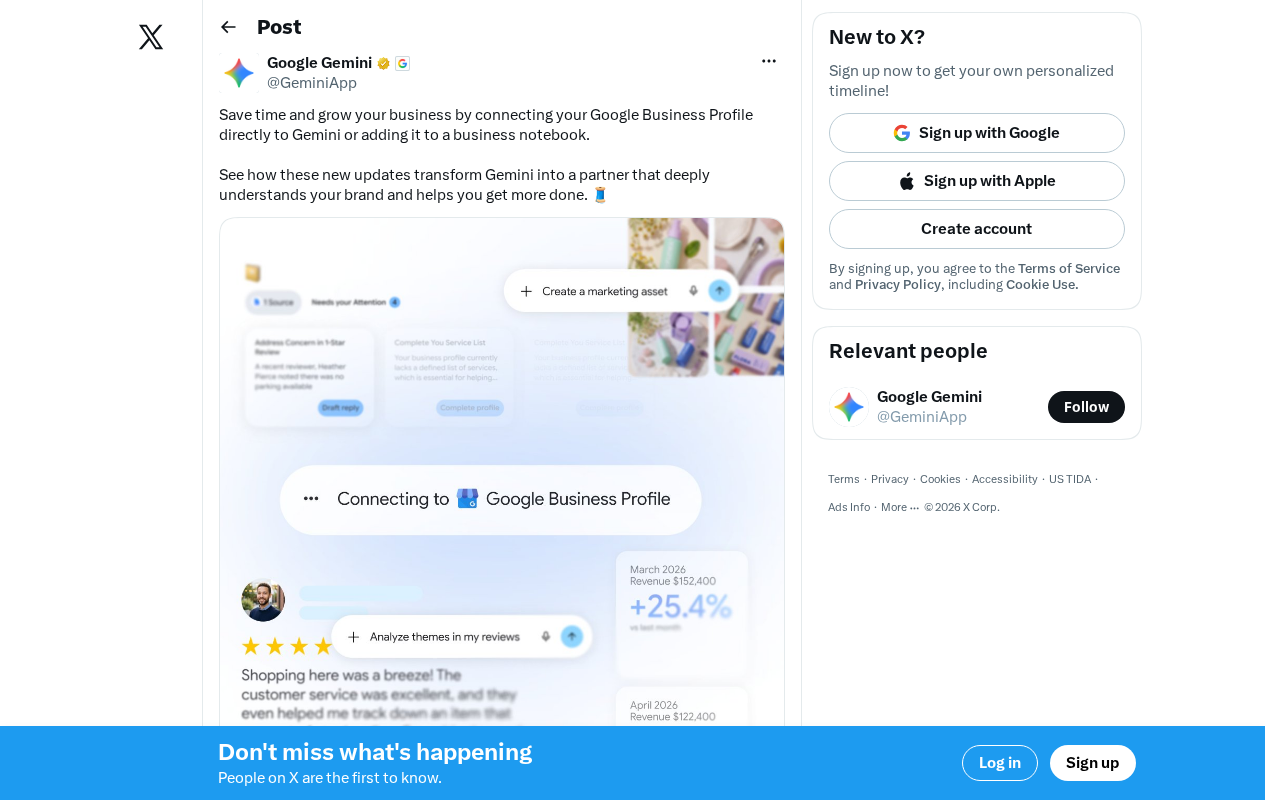
Google recently announced a significant update: businesses can now connect their Google Business Profile directly to Gemini, or add it to a dedicated business notebook. While this change may seem minor, it represents a pivotal evolution for AI assistants in the enterprise services space—shifting from a general-purpose tool that "knows a little about everything" to a dedicated partner that "deeply understands your brand."
Background: Google Business Profile, formerly known as Google My Business, is a free business management platform Google provides for local merchants, with over 200 million active profiles worldwide. Through it, businesses can manage how they appear in Google Search and Maps, including operating hours, contact information, photos, and review responses. For local search traffic, a well-maintained Business Profile often directly determines whether a business appears in the "Local Pack" results, which in turn affects foot traffic and online conversions. The "Local Pack" refers to the three local business recommendation cards displayed beneath the map on Google's search results page—research shows that businesses appearing in this position enjoy a click-through rate roughly 44% higher than standard organic search results, offering decisive traffic value for industries reliant on local customers such as dining, retail, and services. The Local Pack ranking algorithm weighs three core factors: relevance (how well the business category matches the user's search intent), distance (the geographic proximity of the business to the user or search location), and prominence (encompassing signals like review quantity and ratings, citation consistency, and external links). This means that the completeness of a Business Profile, its update frequency, and the quality of review interactions directly influence a business's competitive standing across hundreds of millions of local searches—and once Gemini can read this data, it becomes capable of offering targeted optimization advice from an algorithmic perspective.
For small business owners, time and energy are always scarce resources. The core selling point of this Google update is precisely to "Save time and grow your business." By breaking down the data barrier between the Business Profile and Gemini, the AI can offer more targeted advice based on the business's real operational information, rather than generic, one-size-fits-all answers.
Why "Connecting the Business Profile" Is a Crucial Step
Context Determines an AI's Usefulness
The output quality of large language models depends heavily on context. In the past, when you asked Gemini "how can I improve my store's visibility," it could only offer a set of universal marketing suggestions applicable anywhere. But once Gemini can read your Google Business Profile, the situation becomes entirely different.
On a technical level, this mechanism corresponds to Retrieval-Augmented Generation (RAG)—before the model generates a response, it first retrieves information relevant to the question from an external knowledge base, then passes it into the model as context. The core value of RAG technology lies in the fact that the model no longer relies solely on generalized knowledge learned during training, but can generate answers based on real, up-to-date business information.
A Deep Dive into RAG Technology: The RAG workflow typically consists of three stages. First, external documents are split into semantic chunks and converted into vector embeddings stored in a vector database. Second, when a user asks a question, the question is simultaneously vectorized, and similarity search identifies the most relevant knowledge chunks. Finally, the retrieval results are combined with the original question into a complete prompt and passed to the LLM to generate an answer. Vector embeddings essentially map text into a numerical space of hundreds to thousands of dimensions—semantically similar texts (such as "operating hours" and "opening times") have vectors that are closer together in this space, allowing retrieval to transcend the limits of exact keyword matching and achieve true "semantic search." Common similarity calculation methods include Cosine Similarity and Euclidean distance, and mainstream vector databases include Pinecone, Weaviate, and Google's own Vertex AI Vector Search. This architecture effectively addresses two inherent weaknesses of LLMs: the training data cutoff problem (the model doesn't know the latest information) and the hallucination problem (the model may fabricate facts that don't exist). When the Business Profile serves as a RAG data source, structured data such as operating hours, address, and service categories are retrieved and injected in real time, grounding the model's answers in real, verifiable first-party data rather than the model's statistical impression of a "typical restaurant" or "typical retail store."
The Engineering Challenges of Multimodal Data Fusion: Behind Google's integration of Business Profile with Gemini lies the technology for fusing structured and unstructured data. Data in a business profile such as operating hours, coordinates, and category tags are highly structured and can be directly serialized into a model-readable JSON format for prompt injection; whereas customer review text and business posts are typical unstructured data, which must first undergo semantic chunking and vectorization before entering the retrieval pipeline. When integrating these two types of data, modern multimodal AI systems typically adopt a "Hybrid Retrieval" strategy—using exact match for structured fields and vector similarity retrieval for unstructured text, ultimately merging and reranking the two result sets through the Reciprocal Rank Fusion (RRF) algorithm, thereby striking a balance between precision and semantic flexibility. This engineering detail determines whether the AI can accurately answer both "what time do you close on Sundays" (a structured query) and "what are the most common complaints customers have about your service" (a semantic analysis)—two entirely different types of questions.
Google's integration of Business Profile into Gemini essentially injects the merchant's first-party operational data as dynamic context, putting this technical advantage within reach of ordinary businesses. The AI can directly access key information such as your operating hours, business categories, customer reviews, geographic location, and historical posts. This means the advice it offers is no longer empty platitudes like "you should respond to more reviews," but rather concrete response strategies for specific negative reviews, or more precise promotional directions tailored to your industry and region.
The Business Notebook: Building a Dedicated Knowledge Base for Your Brand
Beyond a direct connection to Gemini, Google also offers the option to add business profile data to a "business notebook." This feature is akin to building a dedicated knowledge base for a business—the AI can continuously draw on the information within it, maintaining a consistent understanding of the brand across multi-turn conversations.
This design philosophy is consistent with the industry-popular "knowledge base + AI" paradigm, and it is particularly intuitive when viewed through the lens of NotebookLM. Launched by Google in 2023, NotebookLM is an AI note-taking tool whose core concept allows users to upload documents, PDFs, research materials, and more, enabling the AI to answer questions within the scope of these specific materials rather than relying on generalized training knowledge—in other words, a "bounded AI."
The Technical Evolution of NotebookLM and Enterprise Knowledge Bases: NotebookLM's success validated the product value of "Bounded AI"—compared to letting AI roam through the boundless knowledge of the internet, confining it within a specific document scope actually significantly improves the precision and reliability of answers, because the source space for incorrect answers is drastically compressed. Looking at the development history of enterprise knowledge bases, this field has undergone three paradigm shifts: from static document repositories (the SharePoint era) → full-text retrieval systems (the Elasticsearch era) → vector semantic retrieval (the current RAG era), with each shift substantially reducing the probability of two failure modes: "can't find the information" and "found it but it's not what I wanted." The business notebook feature extends this logic to the enterprise scenario: structured data in a business profile (category tags, service lists, geographic attributes) is easier for AI to parse precisely than unstructured PDF documents, and the automatic synchronization mechanism solves the most vexing problem of traditional enterprise knowledge bases—"Data Rot." Manually maintained knowledge bases often begin to become obsolete within three to six months, with the proportion of outdated documents exceeding 40%, whereas a notebook synced in real time with the Business Profile ensures the AI always answers based on the latest operational information, fundamentally eliminating this maintenance cost.
The business notebook feature inherits this design philosophy, with the distinction that the data source evolves from user-uploaded material to automatically synced, structured business operational data. Businesses no longer need to re-explain their background to the AI every time; the AI will assist with work carrying a complete understanding of the brand, just like an employee who truly knows the company.
What This Means for Small Businesses
Dramatically Lowering the Barrier to Using AI
For small merchants lacking a professional marketing team or technical staff, this feature dramatically lowers the barrier to leveraging AI. Prompt Engineering—the skill of guiding AI to produce high-quality results through carefully designed input instructions—was once a prerequisite for using AI tools, even giving rise to the emerging role of "Prompt Engineer."
The Rise and Fall of Prompt Engineering and the Trend Toward Systematization: Prompt engineering rapidly became a hot skill between 2022 and 2023, with core techniques including: Few-shot Prompting (providing 2-5 examples before the question so the model understands the expected output format), Chain-of-Thought prompting (asking the model to "think step by step" to improve complex reasoning accuracy—research shows this can boost mathematical reasoning accuracy by nearly 20%), Role Prompting (assigning the AI a specific expert identity to activate the relevant knowledge domain), and structured output constraints (specifying formats like JSON or Markdown for downstream system processing). However, as model capabilities improved and the application layer matured, the industry is undergoing a shift from "manual prompting" to "systematic context injection"—rather than training every user to write good instructions, it's better to pre-configure structured context at the system level, allowing the AI to automatically generate high-quality output given sufficient information. This trend is known in the industry as the "democratization of prompting" or "Prompt-less AI." Google's automatic injection of the Business Profile as context is a typical manifestation of this trend: the work of prompt optimization has shifted from the user side to the platform side, and ordinary shop owners can achieve output quality on par with what a professional prompt engineer would produce, without needing to understand the difference between "zero-shot" and "few-shot."
By automatically injecting business context, this Google update essentially builds prompt optimization into the system level: shop owners don't need to learn complex prompting techniques, nor do they need to manually organize business information to feed the AI. They only need to complete a one-time authorized connection, and Gemini can automatically acquire the needed contextual background, enabling anyone to obtain high-quality, personalized output.
From "Answering Questions" to "Getting Things Done for You"
In its official messaging, Google specifically emphasized that the new feature makes Gemini a partner that "helps you get more done." This reveals Google's hope for Gemini to evolve from a mere question-answering tool toward an AI Agent capable of executing actual business tasks.
AI Agents are one of the most closely watched development directions in the AI field today. Unlike traditional Q&A-style AI, an Agent can autonomously plan task steps, call external tools (such as search, calendar, and email), and continuously execute until the goal is achieved, without requiring step-by-step human instructions.
The Technical Architecture and Current Maturity of AI Agents: A complete AI Agent system typically consists of four core modules: the planning module (breaking down complex goals into an executable sequence of subtasks, with common implementations including the ReAct framework and Tree-of-Thoughts), the memory module (a short-term conversational context window + long-term vector database storage, solving the model's native context length limitations), the tool-calling module (connecting to external systems like search engines, calendars, and databases via standardized APIs, corresponding to Google's Function Calling and Extensions mechanisms), and the execution feedback loop (evaluating progress based on tool return results and adjusting subsequent actions, i.e., the Observe-Act loop). The challenge widely faced by the industry today is the error accumulation effect of Agents in multi-step tasks—if each step has 95% accuracy, after chaining ten steps the success rate drops to about 60% (0.95 to the 10th power ≈ 0.60), which can reduce the success rate to a commercially unviable level in complex tasks requiring a dozen or so operations. This is precisely why Google chose to enter Agent territory through the "bounded, data-clear" Business Profile scenario, rather than directly opening up complex multi-step autonomous tasks: structured business data lowers the probability of errors in the information retrieval stage, laying a more solid foundation for Agent reliability. OpenAI's Operator, Anthropic's Computer Use, and Google's own Project Mariner are all representative explorations in this direction, but all remain at a stage of rapidly expanding capability boundaries and continuously optimized reliability.
A Breakthrough Approach to Reliability Engineering: To address the fundamental challenge of error accumulation, the industry is developing various mitigation strategies. The first is introducing Verification Checkpoints: before high-risk operations (such as officially publishing content or modifying core business information), mandatory human confirmation is triggered, downgrading the Agent from "fully automated" to "human-machine collaboration" mode, trading some efficiency for reliability. The second is Parallel Path Exploration: running multiple task execution chains simultaneously, selecting the optimal result through majority voting or confidence scoring, similar to redundant fault-tolerance design in software engineering. The third is the Tool Sandbox: "rehearsing" operations in a simulated environment before actual execution, only truly executing after verifying the results meet expectations—Google is very likely to adopt a similar "draft preview" mechanism in the Agentification of the Business Profile scenario, allowing merchants to confirm content before the AI modifies business profile data or replies to reviews on their behalf. This design both reduces the actual impact of Agent errors and helps build user trust in autonomous AI operations.
Connecting Business Profile to Gemini can be seen as Google laying the groundwork for Agentification—only when the AI possesses stable business context does it become capable of autonomously executing actual tasks such as "updating business information" and "replying to reviews," rather than merely offering advice.
Foreseeable application scenarios include:
- Automatically drafting social media posts or business updates based on business profile data
- Analyzing customer review trends and offering targeted improvement suggestions
- Optimizing business profile content to improve local search visibility
- Quickly generating response templates for common customer inquiries
Deeper Observation: Google's Ecosystem Integration Ambitions
While modest in scale, this update clearly reflects Google's strategic intent. Google possesses a vast ecosystem of enterprise and merchant data through Search, Maps, Business Profile, and Workspace, and Gemini is precisely the "intelligent hub" that links these scattered capabilities together.
Google's data advantage lies not only in volume but also in the multimodality and closed-loop nature of its data: Search provides user intent data, Maps provides geographic and travel data, Business Profile provides merchant operational data, Workspace provides enterprise collaboration data, and YouTube provides content consumption data. These data sources corroborate one another and form a closed loop, constituting a "data flywheel" asset that no pure model vendor can replicate in the short term.
The Competitive Barrier Mechanism of the Data Flywheel: The concept of the Data Flywheel was first practiced by Amazon and systematically articulated by AI scholars such as Andrew Ng: a product attracts users who generate data, the data trains better models, better models improve the product experience, a better experience attracts more users, forming a self-reinforcing positive feedback loop. What makes Google's flywheel particularly powerful is that its data covers the complete chain of the user journey—from "wanting something" (Search intent data) to "going somewhere" (Maps navigation data) to "consuming a service" (Business Profile interaction data). This cross-scenario linking of behavioral data allows Google to understand the real relationship between users and merchants at a granularity that single competitors find hard to match. Notably, the flywheel effect has gained a new acceleration mechanism in the AI era: every interaction between users and Gemini itself generates high-quality "intent-feedback" paired data, which can continuously optimize the model through Reinforcement Learning from Human Feedback (RLHF) mechanisms, causing the data flywheel to spin at a rate that grows superlinearly with user scale. When this data advantage is injected into Gemini, the business advice the AI offers is no longer merely based on general industry patterns, but grounded in statistical insights from hundreds of millions of real transactions—a differentiated capability that OpenAI or Anthropic cannot replicate by simply increasing model parameter counts in the absence of comparable data assets.
The Quantitative Perspective and Antitrust Concerns of the Data Flywheel: The competitive barrier of the data flywheel can be quantitatively assessed through a "data network effect coefficient": the percentage improvement in model performance for each 1% increase in user scale. Academic research shows that this coefficient is far higher in data-sparse specialized fields (such as medical imaging diagnosis) than in data-abundant general fields, and Google's local business scenario happens to fall between the two—the dataset formed by 200 million business profiles worldwide is enormous in volume, but fine-grained regional-industry insights (such as user preferences for specific categories in specific cities) remain highly scarce, keeping the flywheel coefficient at a relatively high level. However, this data concentration advantage has also drawn regulatory attention: the EU's Digital Markets Act (DMA) has already designated Google as a "Gatekeeper," explicitly restricting it from using user data accumulated in one market (such as search) to strengthen its competitive advantage in another market (such as AI assistants) without the user's explicit consent. This means Google may face stricter compliance constraints in the EU market than in the US when advancing the data integration of Business Profile and Gemini, and the flywheel's spinning speed will significantly diverge across different regulatory environments.
The richer the data, the more useful the AI; the more useful the AI, the more users rely on it; the more they rely on it, the more data is generated. By letting Gemini read business profiles, Google is effectively injecting a data moat into its AI assistant that competitors find hard to replicate. Compared to pure model vendors like OpenAI, Google's differentiated advantage lies precisely in this first-party data deeply bound to real business. Once business owners become accustomed to handling merchant affairs within Gemini, this stickiness will further consolidate Google's position in the enterprise services market.
Concerns Worth Noting
Of course, entrusting core business operational data to AI processing also comes with privacy and data security issues that cannot be overlooked. According to IBM's 2023 Cost of a Data Breach report, the average cost of a data breach has reached $4.45 million. For merchants connecting their Business Profile to Gemini, the core issues to focus on include: whether the data is used for model training, the geographic location of data storage and applicable regulations (such as the EU's GDPR), the scope of third-party access permissions, and the data deletion mechanism.
Key Considerations for Enterprise AI Data Compliance: Currently, major AI service providers exhibit significant tiering in data usage: consumer-grade free products typically reserve the right to use conversation data to improve models (users can manually disable this in settings), whereas enterprise-grade paid products (such as Google Workspace Business and Microsoft 365 Copilot) generally commit to data isolation, no use for training, and signing formal Data Processing Agreements (DPAs). For small and medium merchants connecting their Business Profile, it is especially important to note which service tier their account belongs to and whether they enjoy enterprise-grade data protection commitments. Additionally, GDPR came into full effect in the EU in 2018, granting users the "Right to Erasure" and "Right to Portability" over personal data, and requiring data controllers to report breaches to regulators within 72 hours of occurrence; California's CCPA grants consumers similar protective rights and imposes fines of up to $7,500 per record on non-compliant businesses. For merchants operating in these jurisdictions, when authorizing data access to an AI platform, they need to confirm whether the platform has signed a DPA and the response time for data deletion after a merchant terminates service (GDPR typically requires no more than 30 days). Merchants can review Gemini's data usage options through the "Data & Privacy" settings of their Google account, making informed decisions while enjoying the convenience of the features.
Competitive Risks and the Principle of Least Privilege: Beyond privacy compliance, merchants should also be wary of a less-discussed category of risk: competitive data leakage. When the Business Profile data of multiple similar merchants is held simultaneously by an AI platform, the platform technically gains the capability to conduct horizontal comparative analysis across merchants—for example, identifying pricing patterns, service gaps, or foot-traffic peak patterns for a certain type of business in a specific region. Although mainstream platforms all commit to not using an individual merchant's data to train or analyze its competitors, the technical implementation of data isolation and audit transparency still need to be strengthened. In response, the security industry advises merchants to follow the Principle of Least Privilege when authorizing data access: only opening up the data fields the AI features actually need, regularly reviewing the list of authorized third-party applications, and setting up a dedicated service account for AI access rather than directly using the primary account's permissions. Google's OAuth 2.0 authorization mechanism supports fine-grained scope control, allowing merchants to precisely limit the types of data Gemini can read, finding a balance between feature convenience and data security that suits their own risk appetite.
Google typically commits in its enterprise-grade products not to use user data for advertising training, but small and medium merchants should still carefully read the terms of service before authorizing and assess potential competitive risks. Google needs to strike a balance between feature convenience and data transparency to truly earn merchants' long-term trust.
Conclusion
Google's move to integrate Google Business Profile into Gemini marks an accelerating trend of general-purpose AI assistants penetrating deeply into vertical business scenarios. For the vast number of small and medium businesses, this is a genuine opportunity to obtain an "AI business partner" at extremely low cost; for the industry as a whole, it signals that the future competitive focus will shift from model capability itself toward the depth of integration between AI and real business data and workflows.
Whoever can make AI better understand a user's specific scenarios will gain the initiative in the next phase of competition. And Google is clearly making full use of its unique advantages in its data ecosystem.
Key Takeaways
Related articles

Felix Rieseberg Personal Homepage
Felix Rieseberg's personal homepage sparks attention on Hacker News. This article covers the Slack engineer's technical background, the rise and fall of nativefier, and the value of a developer homepage as a tech calling card.

@ai-sdk/vue 3.0.306 Patch Release Syncs with [email protected] Update
@ai-sdk/vue 3.0.306 released, synced with [email protected]. A routine patch release for the Vercel AI SDK ecosystem with no public API changes; the Vue adapter layer stays version-aligned with the core package.

Gemini 4 Argon API Launches: The Era of Million-Token Output Begins
Google launches Gemini 4 Argon with sparse MoE architecture, up to 1M output tokens, and a 68.90% Vals Index score, available across API, AI Studio, and the Gemini app.