Gemini Omni 1.2 Flash: Longer Videos and Lower Costs

Gemini Omni 1.2 Flash pushes video generation toward scaled calls with native 15 seconds, stronger consistency, and a 30% price cut.
Google releases Gemini Omni 1.2 Flash with three adjustments for scalable video generation: native one-pass 15-second generation and editing to avoid stitching artifacts, stronger consistency for multi-round editing, and a 30% price reduction lowering the barrier for batch generation and A/B testing. The article argues these changes move video generation from "can it generate" to "can it be stably integrated into production pipelines," though multi-round editing stability and 15-second structure under complex motion still need real-world validation.
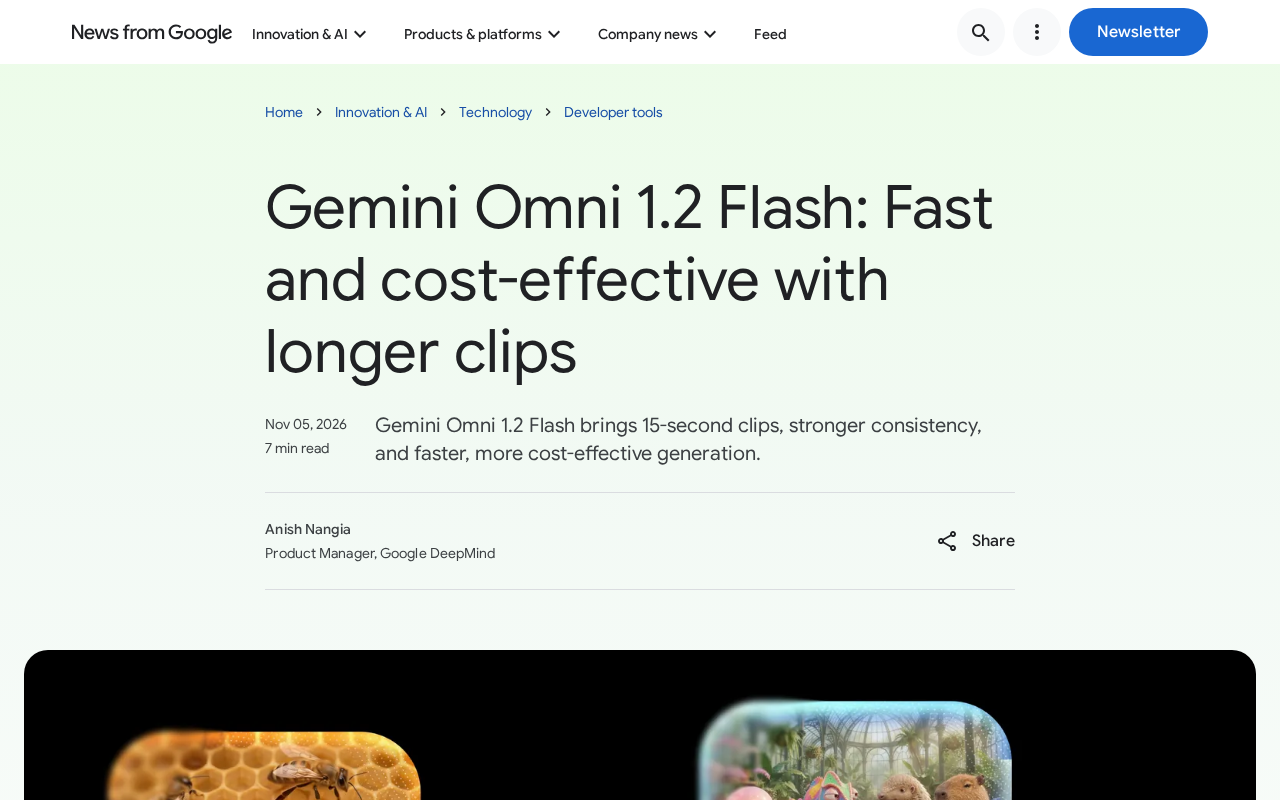
The competitive focus in the video generation race is shifting from "can it generate" to "can you afford to use it and does it work smoothly." Google's release of Gemini Omni 1.2 Flash is a response to this shift: native support for 15-second video generation and editing, stronger consistency, and a 30% price reduction. Stacked together, these three changes all point to the same goal—getting video generation to the stage where it can truly be called at scale.
What 15-Second Native Generation Means
Previously, many video models' "long video" capabilities were essentially built on stitching: generate several short clips first, then sew them together on the timeline. This approach is prone to subject drift, lighting jumps, and motion discontinuity at clip boundaries. Gemini Omni 1.2 Flash emphasizes "native 15 seconds," meaning the model directly covers a longer time span within a single generation pass rather than stitching after the fact.
The impact on practical use is direct. Fifteen seconds is already close to the typical length of a single piece of content on short-video platforms, and it's enough to carry a complete action sequence or camera movement. Creators no longer need to bear extra costs for "generating several clips and picking one," and the amount of rework in the editing stage decreases accordingly.
Editing Capabilities and Improved Consistency
The real barrier in video generation often isn't the first frame—it's "can you change it." Once a shot is generated, if the model can't maintain the same subject's appearance and scene logic across multiple edits—whether you want to swap the subject, adjust color grading, or modify local motion—the entire workflow collapses.
Gemini Omni 1.2 Flash strengthens this point, with the official phrasing being "stronger consistency." Although the materials don't disclose specific consistency benchmark metrics, judging from the product positioning, this capability serves multi-round editing scenarios: after repeatedly modifying the same shot, the image still looks like the same shot rather than a fresh roll of the dice each time.
The 30% Price Cut as a Commercial Signal
The 30% price reduction is the most easily underestimated item in this update. Video generation's computational costs far exceed those of text and images, and calling prices have always been the main obstacle preventing it from entering daily production workflows. After a 30% cut, the drop in unit cost directly changes the economics of certain scenarios—batch-generating assets for A/B testing, mass-producing short videos for e-commerce products, rapidly producing volume during the creative stage to screen directions. These previously "uneconomical" use cases start to become viable.
The Flash suffix itself is part of Google's established product language, representing a priority on speed and cost rather than capability ceiling. Applying it to video generation shows that Google believes the competitive focus at the current stage is no longer just benchmark scores, but who can build up call volume first.
The Flash product line is the lightweight, high-speed branch of Google's large model system, with the name corresponding to a positioning that prioritizes speed and cost, forming a tiered structure with the higher-capability Pro series. Flash models typically trade slightly inferior complex reasoning performance versus flagships for lower latency and unit price, making them suitable for high-concurrency, batch-call production scenarios. Bringing this suffix into video generation means Google has folded video models into its "tiered by cost-effectiveness" product logic: first build up call volume with affordable unit costs, then let users with extreme quality requirements move to higher-tier models.
Video Generation Enters the "Engineering" Phase
Looking at these three changes together, Gemini Omni 1.2 Flash's positioning is clear: it's not trying to beat all competitors on generation quality, but to turn video generation into a component that can be stably integrated into production pipelines. Longer native duration reduces stitching steps, improved consistency lowers editing rework, and lower prices open up room for batch calls—working together, what they shorten is the distance from "what the model can do" to "what products can do with it."
For developers and content teams, what's worth watching next is performance after actual integration: whether consistency holds up stably under multi-round editing, whether 15-second clips can still maintain structure in complex action scenes, and whether the actual bill after the price cut matches expectations. The answers to these questions determine whether this capability can move from demo to daily use.
Consistency in video models typically refers to the model's ability to maintain stable appearance of the same subject, scene lighting, and motion logic across multiple generations or multiple edits. In a single generation, consistency manifests as character identity not drifting and object shapes changing reasonably with viewpoint; in cross-round editing, it requires that after changing the background, adjusting color grading, or locally repainting, the rest of the image does not undergo unexpected changes. The industry commonly measures this along dimensions such as identity preservation, temporal coherence, and editing locality. Insufficient consistency is one of the core reasons video generation is hard to embed in post-production workflows, because it makes every modification feel like a fresh generation, accumulating rework costs.
One-line Summary
Gemini Omni 1.2 Flash drives video generation toward scaled calls with native 15 seconds, stronger consistency, and a 30% price cut.
Paragraph Summary
Google releases Gemini Omni 1.2 Flash, making three adjustments around scalable calls for video generation: native support for one-pass generation and editing of 15-second videos, avoiding subject drift and lighting jumps caused by stitching short clips; strengthened consistency serving multi-round editing scenarios, so that shots remain consistent in subject and scene logic after repeated modification; and a 30% reduction in call pricing, lowering the economic barrier for batch generation and A/B testing. The article argues that these three changes together push video generation from "can it generate" toward "can it be stably integrated into production pipelines," reflecting a shift in competitive focus from benchmark scores to call volume—though the stability of multi-round editing and the maintenance of 15-second structure under complex motion still require validation through actual integration.
Related articles
 Tech Frontiers
Google Omni 1.2 Flash: 15-Second AI Video at Just $0.07 per Second
Google DeepMind releases Gemini Omni 1.2 Flash: 15-second video, 720p at $0.07/sec (30% cheaper), multi-turn editing without regeneration, draft upscaling to 4K.
 Tech Frontiers
No AI Ghostwriting: Writer's Quarter Reinvents Novel Writing with a Visual Workbench
The Writer's Quarter is an AI-free novel writing and planning tool that unifies character building, story planning, and manuscript writing in one visual workbench. This article analyzes its positioning, target users, and differentiated value amid the rise of AI writing tools.
 Tech Frontiers
Fleeep: A Unified Inspiration Collection Notes App for Creatives
Fleeep is a notes app for creatives that unifies screenshots, bookmarks, saved posts, and inspiration into one calm, cross-device, offline-capable space. This article analyzes its positioning, differentiation, and target users.