Gemini Omni Flash 1.1 Released: Deep Dive into Four Major Video Capability Upgrades
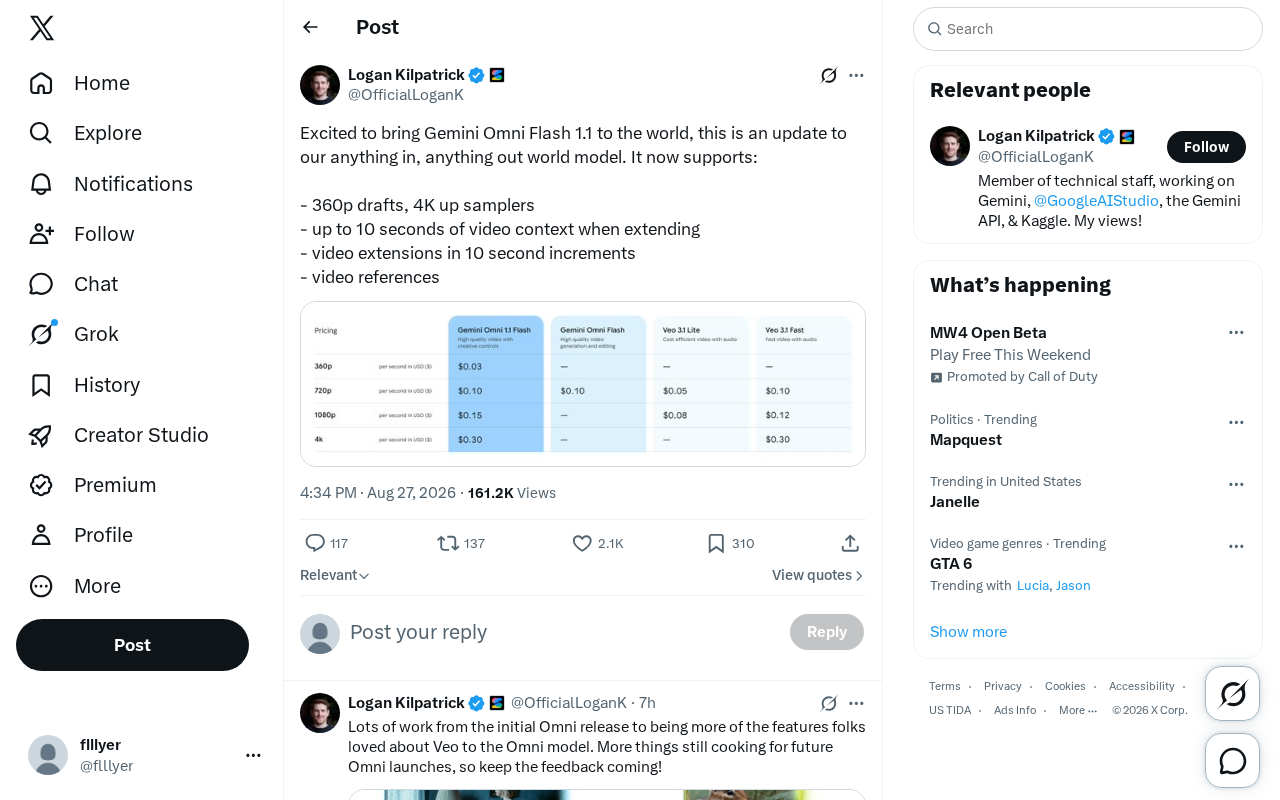
Gemini Omni Flash 1.1 brings four major video upgrades: 4K upsampling, 10s context, incremental extension, and video reference.
Google's Gemini Omni Flash 1.1 delivers four critical video generation upgrades: a draft-to-4K upsampling workflow for efficiency and quality, 10-second video context for temporal consistency, incremental 10-second extensions for longer outputs, and video reference for style control—advancing AI video toward practical, production-ready applications.
Gemini Omni Flash 1.1 Officially Launches
Google recently announced via its official Twitter that Gemini Omni Flash 1.1 is now available to users worldwide. This marks a significant update to its "anything in, anything out" world model. Unlike traditional single-modal or dual-modal models, the Omni Flash series positions itself as a general-purpose world model—it aims to break down boundaries between text, images, video, and other modalities, making content generation and transformation more flexible and fluid.
The core upgrades in version 1.1 focus on video generation and processing capabilities, signaling Google's rapid iteration in the multimodal video model space. For content creators, AI application developers, and researchers, these updates mean higher quality, longer video context, and stronger controllability.
What is a "World Model"
A world model refers to an AI system capable of understanding and simulating the operational principles of the real world. It's not simply stitching together pixels or words, but rather attempting to model underlying structures like physical laws, temporal continuity, and spatial relationships.
This concept has deep academic roots in AI research. As early as 2018, David Ha and Jürgen Schmidhuber proposed the "World Models" framework, using variational autoencoders (VAE) and recurrent neural networks (RNN) to construct internal representations of environments, allowing agents to plan actions in "imagination." Meta's Chief AI Scientist Yann LeCun further elaborated on the vision of world models in his proposed JEPA (Joint Embedding Predictive Architecture) framework—he argues that next-generation AI systems should, like humans, first build an abstract model of the world internally, then reason and predict based on this model, rather than relying solely on large-scale pattern matching. The fundamental difference between world models and traditional generative models is that the former attempts to learn the causal structure and state transition rules of environments (such as a cup falling from a table edge will shatter), while the latter primarily captures correlations in data distributions at a statistical level.
Gemini Omni Flash, with its "anything in, anything out" design philosophy, means that whether the input is text, static images, or video clips, the model can output results in corresponding modalities or even perform cross-modal transformations. Google's choice to combine world models with unified multimodal architecture has a technical rationale: if a model truly understands how the world operates, it should be able to express this understanding in any modality. This unified architecture is a critical direction in current multimodal AI development and represents one of the core divergences in technical approaches between Google and giants like OpenAI and Meta.
Four Core Upgrades in Gemini Omni Flash 1.1
According to the official update notes, Gemini Omni Flash 1.1 brings the following key capability enhancements:
1. 360p Drafts and 4K Upsampling
The new version supports first generating "drafts" at 360p resolution, then enhancing them to ultra-high-definition quality through 4K up samplers. This two-stage "draft then refine" workflow design is highly pragmatic.
From a technical perspective, this involves the deep application of super-resolution technology. Super-resolution has evolved through multiple generations, from traditional bicubic interpolation to deep learning-based methods: SRGAN in 2017 first introduced generative adversarial networks into the super-resolution field, followed by ESRGAN, Real-ESRGAN, and others that further improved upscaling quality in real-world scenarios. In recent years, diffusion model-based upsampling methods have become a new trend. They don't just magnify pixels but can "fill in" high-frequency details during upscaling, generating visually more realistic textures and edges. This two-stage pipeline has mature precedents in industry—NVIDIA's DLSS (Deep Learning Super Sampling) and AMD's FSR (FidelityFX Super Resolution) employ similar approaches in game rendering: first rendering frames at lower resolution, then using AI models to upsample to target resolution, achieving a balance between quality and performance.
Low-resolution drafts mean faster generation speed and lower computational cost. In video generation, the pixel count difference from 360p to 4K (2160p) reaches 36 times, meaning computational load at the draft stage could be reduced by more than an order of magnitude. Creators can quickly preview multiple options, determine composition and dynamic effects, then render satisfactory results in high definition. This layered generation strategy balances iteration efficiency with final output quality—a typical approach for engineering implementation.
2. Video Context Up to 10 Seconds
When performing video extension, Omni Flash 1.1 now supports up to 10 seconds of video context. The length of video context directly determines the model's ability to understand temporal continuity—the longer the context, the better the model can maintain consistency in character movements, scene elements, and motion trajectories.
For AI video generation models, "temporal consistency" has always been a widely recognized challenge in the industry. To understand the technical depth of this issue, one needs to know the underlying architecture of current video generation models. Mainstream solutions are based on Transformers or diffusion models, which need to establish dependencies between frames across the temporal dimension when processing video. Temporal attention mechanisms are one of the core technologies addressing this—they allow the model to "see" and reference information from surrounding frames when generating the current frame, thereby maintaining motion continuity. Optical flow estimation provides assistance from another angle, modeling motion trajectories by calculating pixel displacement vectors between adjacent frames, helping the model understand where objects "come from and where they're going."
However, expanding the context window is no easy feat. Transformer-based architectures face the quadratic complexity problem of self-attention mechanisms (O(n²))—each time context length doubles, computational load increases roughly fourfold. For video, which contains 24-30 frames per second with each frame containing hundreds of thousands of pixel tokens, a 10-second context could mean attention computation over hundreds of thousands or even millions of tokens. Google's ability to extend context to 10 seconds likely involves applying sparse attention, sliding window attention, or other efficient attention mechanisms to control computational overhead.
A 10-second context window allows the model to reference more comprehensive prior frame information when continuing video, thereby reducing common issues like drift, flickering, and identity loss.
3. Video Extension in 10-Second Increments
The new version supports video extensions in 10 second increments. Users can progressively extend video duration in segments based on existing clips.
The significance of this incremental extension lies in breaking through the duration limits of single-pass generation. Most current AI video generation models are constrained by memory and computational resources, with single-pass generation typically producing only 2-6 second clips. By repeatedly invoking the extension function, creators can gradually stitch short clips into longer complete videos while leveraging context mechanisms to maintain overall coherence. This is essentially an autoregressive video generation strategy—similar to how large language models generate text token by token, video models generate footage segment by segment, with each segment taking the previous one as conditional input.
Notably, a core challenge faced by incremental extension is error accumulation. As extension iterations increase, minor deviations introduced at each step may gradually amplify, causing later-generated footage to show noticeable style or content drift from earlier parts. The 10-second context window plays a crucial "anchoring" role here, allowing each extension to reference sufficiently long prior content, to some extent suppressing the accumulation rate of errors. This opens new possibilities for AI long-form video generation.
4. Video Reference Capability
The fourth update is video references. This feature allows the model to reference existing video materials during generation, making output results consistent with reference videos in style, dynamics, or content.
From a technical implementation perspective, video reference belongs to the category of conditional generation. This field has developed rapidly in recent years: on the image generation side, ControlNet injects control signals like edge maps, depth maps, and pose skeletons into diffusion models to achieve fine-grained control over generation results; IP-Adapter uses image prompt mechanisms to let models reference the style or content of an image during generation. In the video domain, work like VideoComposer and AnimateDiff extends similar conditional injection mechanisms to the temporal dimension. The underlying mechanism of video reference typically relies on feature injection and cross attention—the model first extracts semantic and style features from reference videos through an encoder, then "injects" these features into each frame's generation process through cross-attention layers during generation, thereby keeping output visually and semantically aligned with the reference.
Video reference holds tremendous value in actual creation—for example, maintaining consistent character appearance, reusing certain camera movement styles (like handheld tracking shots or aerial push-ins), or batch-generating series content under specific visual tones (like unified visual language for brand advertising). It moves AI video generation from "random output" to "controllable creation," an indispensable capability in professional application scenarios. For commercial production, this controllability directly determines whether AI tools can truly integrate into existing film and advertising production pipelines.
What This Update Means for AI Video Generation
Overall, the upgrade direction of Gemini Omni Flash 1.1 is crystal clear: deep refinement around video generation quality, duration, continuity, and controllability. These four dimensions are precisely the core problems that current AI video models must overcome to move toward practical application.
One noteworthy detail: Google integrates these capabilities within a unified "world model" framework rather than launching a dedicated video-specific model. This reflects its "general-purpose multimodal" technical approach—using a single foundational model to cover as many input-output combinations as possible. Once this approach matures, it will significantly reduce the cost for developers to switch models across different tasks. From an architectural perspective, a unified model means text understanding, image perception, and video generation share an underlying representation space, allowing knowledge transfer between modalities—for instance, physical common sense learned from massive text can directly enhance physical realism in video generation.
Differentiated Positioning Against Competitors Like Sora and Runway
In the AI video generation track, the competitive landscape is increasingly intense, with each player's technical approach showing clear differentiation. OpenAI's Sora adopts the DiT (Diffusion Transformer) architecture, combining Transformer's powerful sequence modeling with diffusion models' high-quality generation, pursuing "one-shot" long-form high-quality video generation; Runway's Gen-3 Alpha takes a multi-stage training approach, emphasizing the balance between generation quality and editing flexibility, and has already gained substantial real-world application in film post-production; Pika enters the market with a "editing-first" product strategy, enabling users to make local modifications and add effects to existing videos, lowering the barrier to entry; in the Chinese market, products like Kuaishou's Kling and ByteDance's Jimeng are also rapidly iterating, with Kling earning good reputation in user communities for its high motion amplitude and character consistency.
Google enters with Gemini Omni Flash's "anything in, anything out" positioning, emphasizing modal unity and world modeling capability rather than pure video generation effects. This strategy has deeper logic: while other competitors focus on the single function of "video generation," Google attempts to build a general-purpose foundation model capable of understanding and generating all modal content. Features like layered draft rendering, long-context extension, and video reference all point toward a more engineering-oriented, production-environment-friendly product approach—it's not designed to dazzle audiences with demo videos, but to run stably and efficiently in real workflows.
For developers focused on AI application implementation, such updates often hold more practical value than parameter scale—because they directly impact creation efficiency and final product quality. A model supporting draft preview, incremental extension, and style reference may be far more usable in actual production than a model with higher quality but uncontrollable output and extremely long generation times.
Summary
While Gemini Omni Flash 1.1 is only a minor version iteration, its four upgrades in video capabilities all hit the mark. 360p drafts plus 4K upsampling balance efficiency with quality, 10-second video context and incremental extension improve long-form video coherence, and video reference enhances creative controllability.
As the world model concept continues to evolve, future breakthroughs in physical realism (like more accurate fluid simulation and rigid body collision), longer temporal modeling (from minute-level to hour-level narratives), and richer modal support (like deep integration of 3D and audio) are worth anticipating. For content creators and AI practitioners, Gemini Omni Flash is undoubtedly a technical direction worth continuous attention.
Note: This article is compiled based on update notes released on Google's official Twitter. Actual functionality performance should be evaluated through hands-on experience.
Related articles

JobRunner MCP Server: AI Agents Can Now Fix Failed Java Jobs
JobRunner launches an open-source MCP server enabling AI agents to view cluster status, diagnose failures, and recover Java jobs—incident response from any cloud coding environment or existing agent.

MLAI Digital Launches 9 Security Agents: MCP Server Safeguards the Full Lifecycle of Agentic AI
MLAI Digital launches Security MCP Server with nine built-in specialized security agents covering vulnerability discovery, attack simulation, prompt injection detection, API and infrastructure assessment, and accelerated remediation—embedding security validation across the full Agentic AI lifecycle from development to production.

Running Isaac Lab on H100 GPUs: Exploring Better Approaches
Exploring optimization methods for running Isaac Lab on NVIDIA H100 GPUs, including MIG configuration, mixed precision, TensorRT acceleration, and community experience to improve robotics simulation and reinforcement learning efficiency.