Gemini Reportedly Trains on Chat History—Even for Paying Subscribers

HN post reveals Gemini trains on chat history, with no exemption for paying personal accounts.
A Tell HN post points out that Google's Gemini uses users' chat history to train models, and this practice applies equally to paying personal subscribers, sparking community discussion about "whether paying equals a privacy exemption." The article analyzes that a paid subscription changes service tier and feature access but does not automatically change data usage terms, and that "training" and "human review" are separate clauses—users tend to focus on the latter and overlook the former. Comment focus centers on whether settings can be disabled, differences in data agreements between enterprise and personal versions, and notification transparency. The article advises users to proactively check privacy settings, avoid inputting sensitive information, distinguish personal from work accounts, and notes that product defaults reflect true privacy attitudes better than marketing language.
Privacy Concerns Sparked by a Tell HN Post
A post titled "Tell HN: Gemini trains on chat history, even for subscribers (personal accounts)" appeared on Hacker News, with the author pointing out that Google's Gemini uses users' chat history to train its models—and that this practice applies even to paying subscribers using personal accounts. The post received 24 points and 5 comments. The discussion wasn't explosive, but it touched on a long-standing sensitive issue: does paying equal a privacy exemption?
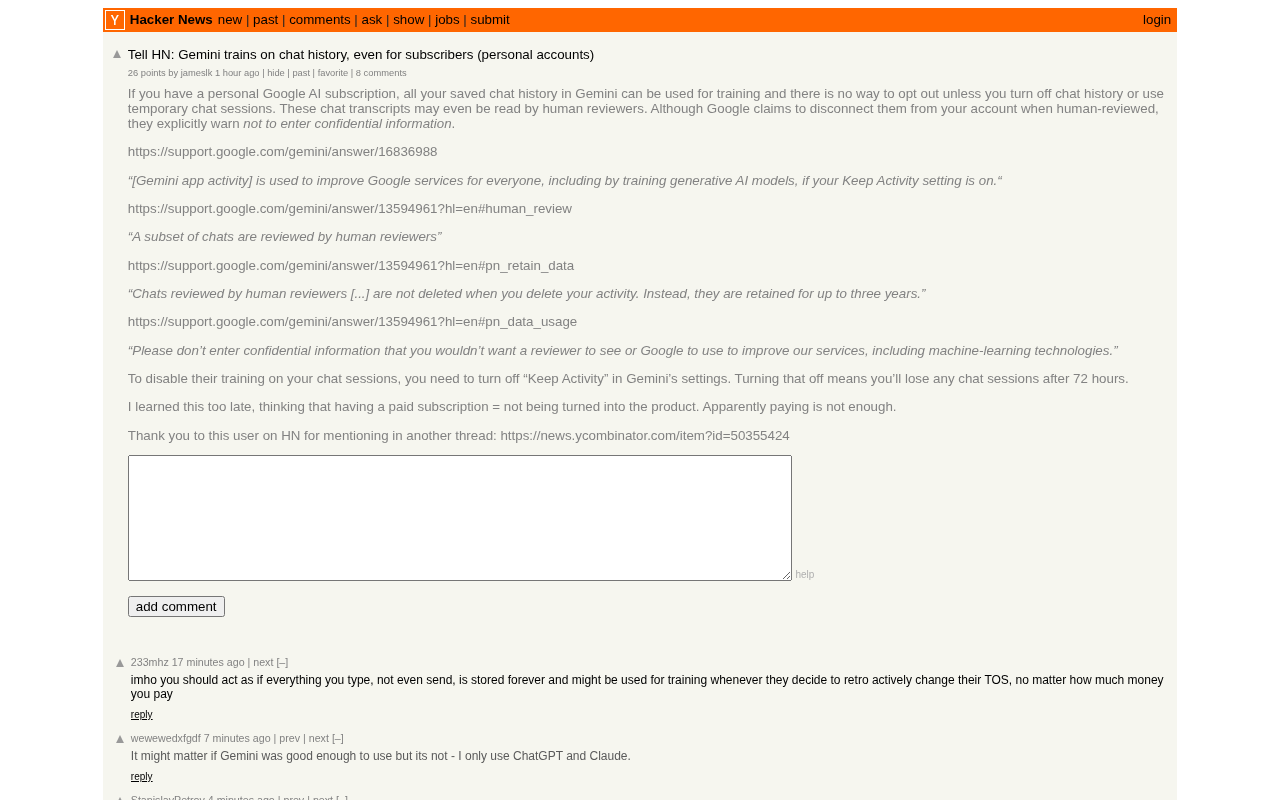
The value of this post isn't in revealing a completely unknown secret, but in bringing an easily overlooked fact back to the table—a paid subscription changes your service tier and feature access, but does not automatically change the data usage terms.
Paid Subscription ≠ Your Data Won't Be Used
Many users assume a straightforward exchange logic: I paid, so I'm a customer, and my data shouldn't be used as training material. But the terms of service for mainstream AI products are usually quite clear—consumer subscriptions (whether personal or Pro tier) and the use of data for model improvement are two separate matters.
Based on the post's wording, Gemini trains on chat history for personal accounts without exemption for subscription status. It's important to distinguish two concepts here: training and human review. Some products promise not to use paying users' data for human annotation review, but may still use it for automated model training or quality evaluation. If users see "not used for human review" in the terms and feel reassured, they might miss the training-use clause.
For ordinary users, this means that code snippets, work document summaries, and personal plans you type into the chat box could theoretically enter the training data pipeline. This isn't to say Google will definitely use any specific conversation for training—but the terms authorize that possibility.
What the Comments Focused On
Although the post didn't have many comments, based on the typical discussion patterns of Tell HN posts, the focus usually centers on a few areas.
First, whether it can be turned off. Most products offer a toggle to "disable chat history" or "don't use for service improvement." The question is whether this toggle is on or off by default, how many layers deep it's buried in settings, and whether turning it off affects functionality. Users need to actively turn it off rather than passively relying on default protection.
Second, the difference between enterprise and personal versions. Enterprise subscriptions typically have stricter data processing agreements, while personal subscriptions often follow consumer terms. The poster specifically noted "personal accounts," indicating the core dispute is whether paying individual users receive data protection commensurate with their paid status.
Third, transparency. What users are really unhappy about often isn't "training" itself, but information asymmetry—the terms are written but nobody reads them, there's a toggle in settings but nobody can find it. When users only learn about this fact on Hacker News, it shows the product isn't being straightforward enough in its notification process.
What data control toggles actually look like: Mainstream AI products typically offer two types of control options. One is the "chat history" toggle—when turned off, new conversations are no longer saved to account history, but already-saved records and whether they're used for training follow a separate logic. The other is "service improvement" or "model training" authorization, which some products tie to history records and others manage separately. For example, OpenAI's ChatGPT once offered a standalone "data controls" option where users could disable "improve the model" authorization; Google's Gemini settings are scattered under items like "Gemini Apps Activity." To determine whether a particular toggle actually blocks training use, you need to check whether "used to improve services" in the terms is synonymous with "saving history"—the two are often conflated.
Practical Impact on Everyday Users
If you're using Gemini for work content, there are a few things worth noting.
Don't paste sensitive information directly. Whether it's API keys, customer data, or undisclosed business information, ask yourself before inputting: if this content enters the training set, can I accept that?
Proactively check privacy settings. Look for chat history and data control options in your account settings, confirm the current status, rather than assuming you're already protected by default.
Distinguish personal accounts from work accounts. If your organization provides enterprise-grade AI tools, prioritize completing tasks involving business data under accounts bound by agreements.
Watch for terms updates. Data usage policies adjust with product iterations. Reading them once before subscribing and glancing again at renewal is more cost-effective than being surprised later.
The Bigger Picture: Default Data Policies of AI Products
This post reflects an industry-level issue. The demand for training data for generative AI products persists, and user conversations are among the highest-quality real-world corpora—vendors have strong incentives to use them. That said, users' sensitivity to privacy is rising, and regulatory requirements for data usage disclosure are also tightening.
Under this tension, a product's default settings become a signal. Training enabled by default with multiple steps required to disable essentially exploits users' behavioral inertia; disabled by default with users actively opting in shows more respect for choice. To judge an AI product's attitude toward privacy, looking at defaults is more reliable than looking at marketing language.
The post's title uses the "Tell HN" format, which is itself a form of community reminder—not a product announcement, but information sharing among users. For those who rely on these tools for daily work, the practical value of such reminders may exceed that of any feature update.
The spectrum of industry default policies: Different vendors have notably different attitudes toward using user conversations for training. OpenAI's consumer products use conversations for model improvement by default, while enterprise and API versions don't use them for training by default; Anthropic's Claude consumer version similarly may use conversation data by default but offers an opt-out; Meta's AI features have sparked bigger controversies over including users' public posts in training. The common thread across these policies: enterprise/API channels typically have contractual data isolation, while consumer channels rely on terms-of-service authorization, with "use" being the default in most cases. At the regulatory level, the EU's General Data Protection Regulation (GDPR) requires a legal basis for data processing, and the EU AI Act imposes disclosure obligations on data transparency for general-purpose models—but when it comes to how to inform users about "whether conversations are used for training," enforcement standards still vary across countries.
Frequently Asked Questions
Will Gemini still train on my chat history after I pay for a subscription?
According to the post, chat history for personal accounts may still be used for training even if the user is a subscriber. The specific scope is subject to Google's current terms of service and account settings—check the data control options in your settings to confirm.
Does turning off chat history prevent data from being used?
Turning off history typically affects data retention and training use, but the specific effect depends on the product's settings logic. Different options may correspond to different data behaviors, so each needs to be confirmed individually.
Does this also apply to enterprise accounts?
The post's title explicitly refers to "personal accounts." Enterprise subscriptions typically have separate data processing agreements, so the situation may differ.
What can users do to reduce risk?
Proactively checking privacy settings, avoiding inputting sensitive information in conversations, and using accounts bound by agreements when dealing with business data are the most directly feasible approaches at present.
One-line Summary
HN post reveals Gemini trains on chat history, with no exemption for paying personal accounts.
Paragraph Summary
A Tell HN post points out that Google's Gemini uses users' chat history to train models, and this practice applies equally to paying personal subscribers, sparking community discussion about "whether paying equals a privacy exemption." The article analyzes that a paid subscription changes service tier and feature access but does not automatically change data usage terms, and that "training" and "human review" are separate clauses—users tend to focus on the latter and overlook the former. Comment focus centers on whether settings can be disabled, differences in data agreements between enterprise and personal versions, and notification transparency. The article advises users to proactively check privacy settings, avoid inputting sensitive information, distinguish personal from work accounts, and notes that product defaults reflect true privacy attitudes better than marketing language.
Related articles

Deleted Reddit Post Sparks Debate Over AI Content Moderation
A Reddit post removed with only a 'Removed by Reddit' notice highlights AI content moderation's transparency gaps, misjudgment risks, and appeal challenges for platforms and creators.

DSH + Ollama Local LLM Deployment in Practice: Free Chat with Da Fei Yu
Bilibili creator tests DSH + Ollama local LLM deployment end to end: Ollama install, Xunlei-accelerated downloads, ModelScope GGUF model import, DSH custom API address setup, and a comparison of Qwen 3.5 4B, 8B, Gemma, and other models on 8GB VRAM, with advice on choosing local deployment vs. API calls.

Tested: A $899 Mac Mini vs. a $200/Month AI Subscription
Real-world test of whether an M4 Mac mini can replace a $200 AI subscription: 16GB can't fit large models, and both speed and quality fall short—but privacy, no caps, and near-zero running costs make it an ideal host for an always-on agent. Includes buying advice per configuration and money-saving strategies.