Gemini Robotics 2.5 Released: A Robot VLA Model with Success Rate Improvements of Up to 100%
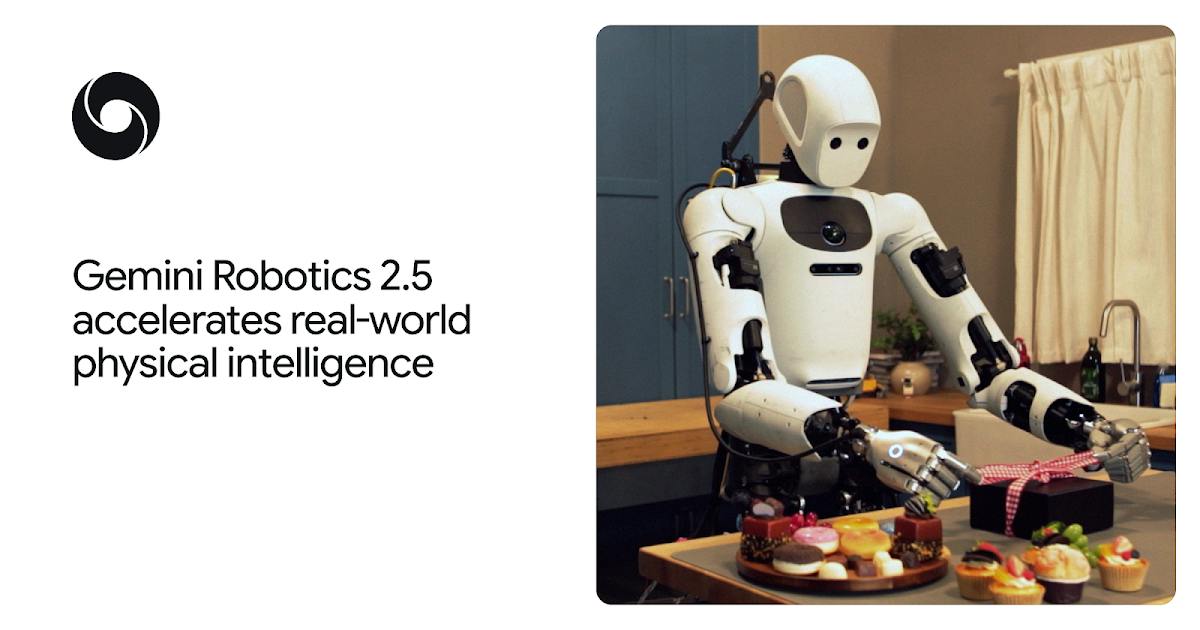
DeepMind releases its strongest VLA model Gemini Robotics 2.5, with success rates up to doubled and 96% in a Mercedes factory pilot.
Google DeepMind released Gemini Robotics 2.5 on Product Hunt, calling it its most capable VLA model to date, converting visual and language input into robot hand and arm movements. Success rate improved 30%-100% and speed increased 20%-30% over the previous generation. On the Apptronik Apollo 2 humanoid, it achieved 96% success in a Mercedes-Benz parts-kitting pilot. It supports cross-embodiment and is rolling out to partners rather than being fully public. It received 75 upvotes and ranked 7th on Product Hunt.
Title
Gemini Robotics 2.5 Released: A Robot VLA Model with Success Rate Improvements of Up to 100%
Meta Description
Google DeepMind releases Gemini Robotics 2.5 vision-language-action model: success rate improved 30%-100% over the previous generation, task speed 20%-30% faster, achieving 96% success rate in a Mercedes-Benz parts-kitting pilot, supporting cross-embodiment and gradually opening to partners.
Article Content
Google DeepMind released Gemini Robotics 2.5 on Product Hunt, which the company calls its most capable vision-language-action (VLA) model to date. It converts what the robot sees and hears into hand and arm movements, and for the first time puts both "cross-embodiment" and "industrial pilot validation" on the table simultaneously.

From "Understanding" to "Acting": What VLA Models Actually Solve
The core proposition of VLA models is to let robots understand natural language instructions and combine visual input to generate executable action sequences. Traditional robots rely on pre-programmed fixed trajectories; changing a workstation or a part requires re-commissioning. Gemini Robotics 2.5 attempts to drive down this adaptation cost—the same set of model weights can be transferred to different types of robot bodies.
According to data published by DeepMind, compared with the previous-generation baseline model, Gemini Robotics 2.5 improves task success rate by 30% to 100% and speeds up completion by 20% to 30%. The upper bound of the success-rate range doubling means that in some scenarios that were previously prone to failure, the model's performance has changed qualitatively, not just incremental iteration.
Vision-language-action (VLA) models are a core paradigm in the embodied intelligence field in recent years, with intellectual roots traceable to vision-language models (VLMs). VLMs typically take images and text as input and output text descriptions or question-answering; VLA adds "action" as an output modality on top of this, directly mapping perception and language understanding into robot-executable joint angles, end-effector poses, or action token sequences.
Compared with traditional layered "perception—planning—control" pipelines, VLA tends toward end-to-end training: large-scale robot demonstration data and internet vision-language data are jointly pre-trained, giving the model a certain degree of semantic generalization and instruction-following capability. Representative works include RT-2, OpenVLA, and DeepMind's own RT-X series. The main challenges of VLA lie in the high-dimensional continuity of the action space and the heterogeneity among different robot bodies, which is also the context for why "cross-embodiment" has become a key metric in this track.
Mercedes Factory Pilot: What a 96% Success Rate Means
The most persuasive validation comes from industrial scenarios. DeepMind disclosed that Gemini Robotics 2.5, on the Apollo 2 humanoid robot in collaboration with Apptronik, achieved a 96% task success rate in a Mercedes-Benz parts-kitting pilot.
Parts-kitting is a typical "high-frequency, repetitive, low fault-tolerance" process: the robot needs to identify and grasp the correct part from a bin and place it in a designated position. A 96% success rate is already close to the deployable threshold, but there is still a gap before full unmanned operation—how to handle the remaining failure samples often determines the overall efficiency of an actual production line.
| Metric | Gemini Robotics 2.5 Performance |
|---|---|
| Success rate vs. previous generation | Improved 30% – 100% |
| Task completion speed | 20% – 30% faster |
| Mercedes pilot success rate | 96% |
Parts-kitting is a process in manufacturing logistics: according to a work order, pick a correct set of parts from storage bins, load them into a kitting container, and send them to the assembly line. Its difficulty lies in the large variety of parts, similar appearances, random placement poses, and the fact that mis-picking or missing parts directly causes downstream assembly line stoppages.
For this reason, this process has long relied on manual labor or highly customized automation equipment. Introducing humanoid robots for parts-kitting tests not only grasping precision but also visual reasoning about occlusion and stacking inside bins. A 96% single-attempt success rate is already relatively high on academic benchmarks, but industrial deployment usually also requires lower failure rates and predictable failure-recovery mechanisms, which is why this pilot is regarded as "close to the threshold" rather than "having reached the threshold."
Cross-Embodiment: The Real Barrier to Generality
DeepMind emphasizes that Gemini Robotics 2.5 can "work across robot types." The weight of this statement lies in the fact that different robots differ enormously in the number of joints, kinematic constraints, and sensor configurations. For one set of VLA models to remain usable across multiple embodiments, abstraction must be made at the action representation level rather than overfitting to a single hardware platform.
From the product cadence perspective, the model is being rolled out to robotics partners gradually, rather than being fully publicly available. This "partner first, open later" path is not uncommon in robotics—real hardware data itself is a scarce resource, and early partners often play the role of kick-starting the data flywheel.
Cross-embodiment means that the same policy model can drive robots with different structures, such as wheeled robotic arms, quadruped robots, and humanoid robots. Different embodiments differ in the number of degrees of freedom, joint limits, link lengths, and sensor layouts, making direct reuse of raw action outputs nearly infeasible.
The mainstream approach is to unify at the action representation level, for example by abstracting actions into six-degree-of-freedom end-effector pose increments, or by using discretized action tokens, so that the model learns "what to do" rather than "how many degrees each joint should rotate." The value of cross-embodiment capability lies in data reuse: demonstration data from multiple robots can be pooled into the same training set, alleviating the scarcity of data for a single hardware platform. It is also a key yardstick for measuring whether VLA models can move from the lab to general-purpose robot platforms.
Release Signals and Industry Position
After launching on Product Hunt, Gemini Robotics 2.5 received 75 upvotes and ranked 7th for the day, with category tags covering artificial intelligence, GitHub, and YouTube—indicating that its audience is not only robotics researchers but also groups interested in the open-source ecosystem and developer tools.
From the competitive landscape, VLA models are becoming the main battlefield of embodied intelligence. The differentiation of Gemini Robotics 2.5 is not in any single metric, but in the simultaneous establishment of three things: "performance improvement + industrial pilot + cross-embodiment." For developers, the follow-up information worth watching is: the partner list, the model access method, and whether a developer-facing API or open-source weights will be released.
At this stage, the Product Hunt page only provides a link to the official website, with little comment interaction, and more details are still awaiting supplementation by DeepMind's official technical blog.
One-line Summary
DeepMind releases its strongest VLA model Gemini Robotics 2.5, with success rates up to doubled and a 96% success rate in a Mercedes factory pilot.
Paragraph Summary
Google DeepMind released Gemini Robotics 2.5 on Product Hunt, calling it its most capable vision-language-action (VLA) model to date, capable of converting visual and language input into robot hand and arm movements. Compared with the previous generation, task success rate improved by 30% to 100%, and completion speed increased by 20% to 30%. In industrial validation, the model, deployed on the Apptronik Apollo 2 humanoid robot, achieved a 96% task success rate in a Mercedes-Benz parts-kitting pilot. The model supports cross-embodiment operation and is gradually opening to robotics partners rather than being fully public. It received 75 upvotes on Product Hunt and ranked 7th for the day, with an audience covering AI researchers and the developer community; the partner list and access methods are still to be disclosed officially.
Related articles

OpenAI to Shut Down Agent Builder and Two Other Services on November 30, Developers Must Migrate Urgently
OpenAI will shut down Agent Builder, the evals dashboard, and reusable prompts on November 30; evals is already read-only. Here's the scope, OpenAI's migration paths (Agent SDK, PromptFu, your own code), and what developers should export and rebuild this week.

RankSpot: A Pay-Per-Use SEO & AI Search Execution Layer That Lets Agents Write, Publish, and Build Backlinks for You
RankSpot is an SEO & AI search execution layer for AI Agents. Connect via MCP to Claude or ChatGPT to write, publish & build backlinks. Pay-per-use, $3/article.

Appxiom: Giving AI Coding Assistants Production Context
Appxiom gives AI coding agents production context—crashes, jank, memory leaks, failed network calls—across Android, iOS, Flutter, KMP, and Web, ranking bugs by Goal Friction Impact.