Gemini Robotics 2.5 Released: Robot Dexterous Manipulation Evolves Further
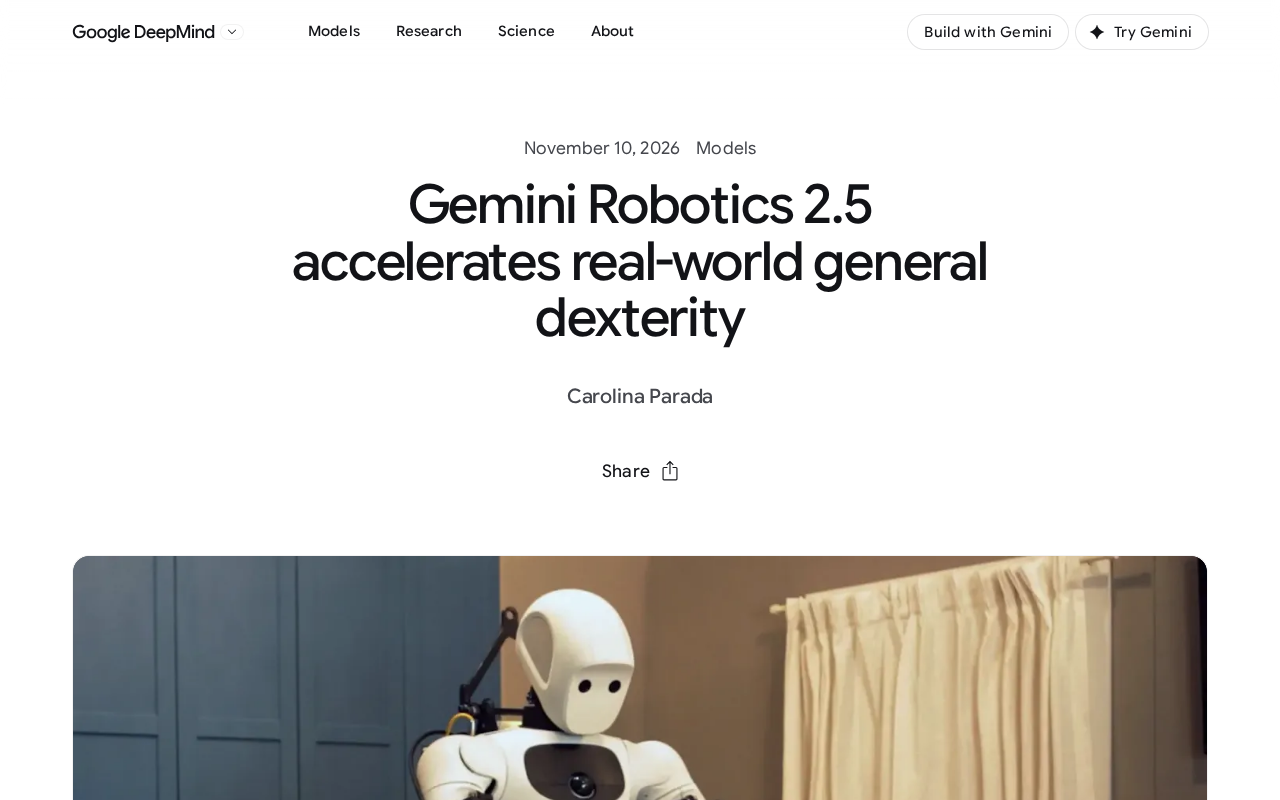
Google DeepMind releases Gemini Robotics 2.5, emphasizing dexterity, reliability, and safety.
Google DeepMind has released Gemini Robotics 2.5, calling it its most capable vision-language-action (VLA) model, with upgrades focused on dexterity, reliability, and safety. The article notes that VLA models integrate scene understanding and action generation into one model, reducing information loss across traditional perception-planning-control pipelines. "Real-world general dexterity" hinges on out-of-distribution generalization—producing reasonable actions on unseen objects and scenes. Reliability and safety represent two deployment thresholds: stable repeated execution and constraint awareness near humans. For developers, stronger foundation models lower the barrier to entry, but evaluation must shift from demo effects to repeat success rates, exception recovery, and safety boundary testing.
Gemini Robotics 2.5 Released: Robot Dexterous Manipulation Evolves Further
When robots move from the lab into the real world, what often holds them back isn't compute power—it's "feel": the ability to reliably grasp objects of varying shapes, perform fine manipulation in cluttered environments, and do so without safety incidents. Google DeepMind's latest answer is Gemini Robotics 2.5, which the company positions as its "most capable vision-language-action model," with core selling points centered on three words: dexterity, reliability, and safety.
From "Understanding" to "Doing": The Key Leap of VLA Models
Gemini Robotics 2.5 is a Vision-Language-Action model (VLA). Unlike multimodal large models that only output text, this type of model must simultaneously process camera images, understand natural language instructions, and directly generate robot joint action sequences. In other words, it compresses "understanding the scene" and "producing actions" into a single model, reducing the information loss between perception, planning, and control modules in traditional pipelines.
The official description of version 2.5 is that it "enhances robot dexterity, reliability, and safety." These three directions correspond precisely to the three most common types of failure in real deployments: incorrect grasp poses, unstable repeated execution, and safety hazards during human-robot coexistence. Listing these three as upgrade priorities signals that this generation's goal has shifted from demo videos to deployable everyday tasks.
VLA (Vision-Language-Action) models are one of the core paradigms in embodied intelligence, with intellectual roots tracing back to research that combines the reasoning capabilities of large language models with robot control. Typical architectures usually include a visual encoder (processing camera images), a language encoder (parsing instructions), and an action decoder (outputting joint angles or end-effector poses), with the three aligned through a shared representation space. Unlike hierarchical systems, VLA models learn the "perception→decision→action" mapping end-to-end, allowing them to pretrain on internet-scale image-text data and then fine-tune with a small amount of robot demonstration data. Representative works in this paradigm include RT-2 and OpenVLA, while the Gemini Robotics series is an evolutionary version built on a stronger multimodal foundation.
Dexterity: General Manipulation Capability in the Real World
The phrase "real-world general dexterity" in the title deserves unpacking. "General" means the model isn't specially trained for a single object or task, but aims to cover multiple manipulation scenarios with one model; "dexterity" points to capabilities like multi-fingered hands and fine grasping that demand higher control precision.
Combining these two, the challenge lies in out-of-distribution generalization: the shapes, materials, and placements of objects in real environments are nearly infinite, and the model must still produce reasonable actions on unseen combinations. Prior progress in the Gemini series has shown that, with large-scale multimodal pretraining, VLA models can transfer some semantic understanding capabilities to action generation—and version 2.5 claims to push this capability further toward "general dexterity."
Out-of-distribution generalization is a classic challenge in machine learning, referring to a model's ability to maintain performance on input distributions not covered by training data. In robotic manipulation, this means variables such as object shape, material friction coefficients, lighting conditions, and background clutter may all deviate from the training distribution at test time. Common approaches to improving generalization include large-scale diverse data collection, domain randomization (randomly perturbing textures and lighting in simulation), and zero-shot transfer using pretrained semantic priors. For VLA models, the semantic anchors provided by language instructions help categorize "unseen objects" into known classes to generate reasonable actions, but fine grasping success rates still depend heavily on data coverage.
Reliability and Safety: Two Thresholds for Deployment
Succeeding once in the lab and succeeding ten thousand times on a production line are entirely different problems. Reliability requires the model to maintain stable output under lighting changes, object position shifts, and sensor noise; safety requires the model to have constraint awareness when approaching humans, fragile objects, or high-speed motion.
The fact that the official announcement lists reliability and safety as core improvements in version 2.5 reflects an industry consensus: the bottleneck in robot capability is shifting from "can it do it" to "can it keep doing it correctly and safely." For teams planning to deploy robots in warehousing, manufacturing, or service scenarios, the latter often carries greater weight.
Safety constraints in human-robot coexistence scenarios are typically implemented through multiple layers in robotics: hardware-level force/torque limits and emergency stop devices, control-level speed and workspace constraints, and learning-level safety policy constraints. For end-to-end VLA models, since actions are directly generated by neural networks, their behavior is difficult to fully constrain with traditional rules, so researchers often introduce safety filters (collision and force limit checks before action output), constrained optimization, or safe reinforcement learning as a fallback. In addition, repeat success rate (the proportion of successful executions when performing the same task multiple times) and exception recovery capability (retrying after a grasped object slips) are common engineering metrics for measuring reliability, far more informative than single demonstrations.
What It Means for Developers and the Industry
The iteration pace of VLA models is accelerating, bringing two direct impacts. First, the barrier to robot applications is lowering—developers no longer need to train action policies from scratch and can fine-tune scenario-specific models based on stronger foundation models. Second, evaluation standards need upgrading—simply watching demo videos is no longer sufficient to judge usability; repeat success rate, exception recovery capability, and safety boundary testing will become more critical metrics.
Currently, information released about Gemini Robotics 2.5 focuses on capability positioning, with specific performance data and availability scope awaiting official disclosure. For teams following embodied intelligence, this version is worth tracking closely—especially its generalization performance in real environments and safety mechanism design.
One-line Summary
Google DeepMind releases Gemini Robotics 2.5, emphasizing dexterity, reliability, and safety.
Paragraph Summary
Google DeepMind has released Gemini Robotics 2.5, which it calls its most capable vision-language-action (VLA) model, with core upgrades focused on dexterity, reliability, and safety. The article notes that VLA models integrate scene understanding and action generation into a single model, reducing information loss in traditional multi-module pipelines of perception, planning, and control. The key to "real-world general dexterity" lies in out-of-distribution generalization—producing reasonable actions on unseen objects and scenes. Reliability and safety correspond to two deployment thresholds: stable repeated execution and constraint awareness near humans. For developers, stronger foundation models lower the barrier to entry, but evaluation standards must shift from demo effects to repeat success rates, exception recovery, and safety boundary testing.
Related articles

Anthropic Files for IPO at $2 Trillion Valuation, But Prospectus Reveals an $80.7 Billion Loss Puzzle
Anthropic files for a $2 trillion IPO with an $80.7B first-half net loss even as operating profit turns positive. Breaking down loss structure, slowing growth, $800B compute commitments, and founder control to reveal the real risks and capital logic behind the AI giant's IPO.
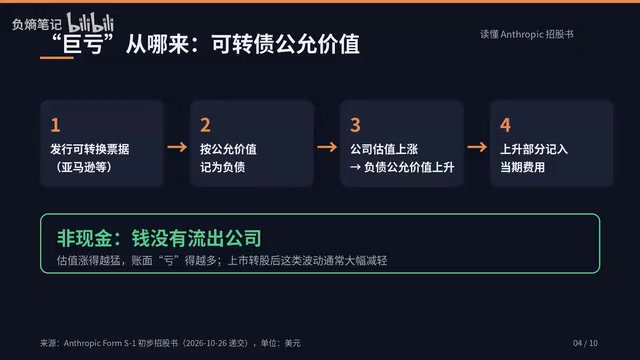
Decoding Anthropic's S-1: Most of the $80.7B Loss Is Just Accounting
Anthropic's prospectus shows about 90% of its $80.7B H1 net loss is fair value remeasurement and other book items, with real operating loss just $693M and its first quarterly operating profit in Q2. This breakdown covers revenue growth, cash flow, compute contracts, and governance.

Deep Dive into Anthropic's S-1: The $850 Billion Compute Bet and AI's New Valuation Logic
In-depth analysis of Anthropic's S-1: H1 2026 revenue of $16.2B, 85.4% gross margin, the truth behind the $80.7B net loss, the $850B compute commitment, and AI's new valuation logic.