Gemma 4:31b Hands-On: Major Stability Improvements in Ollama Local Deployment

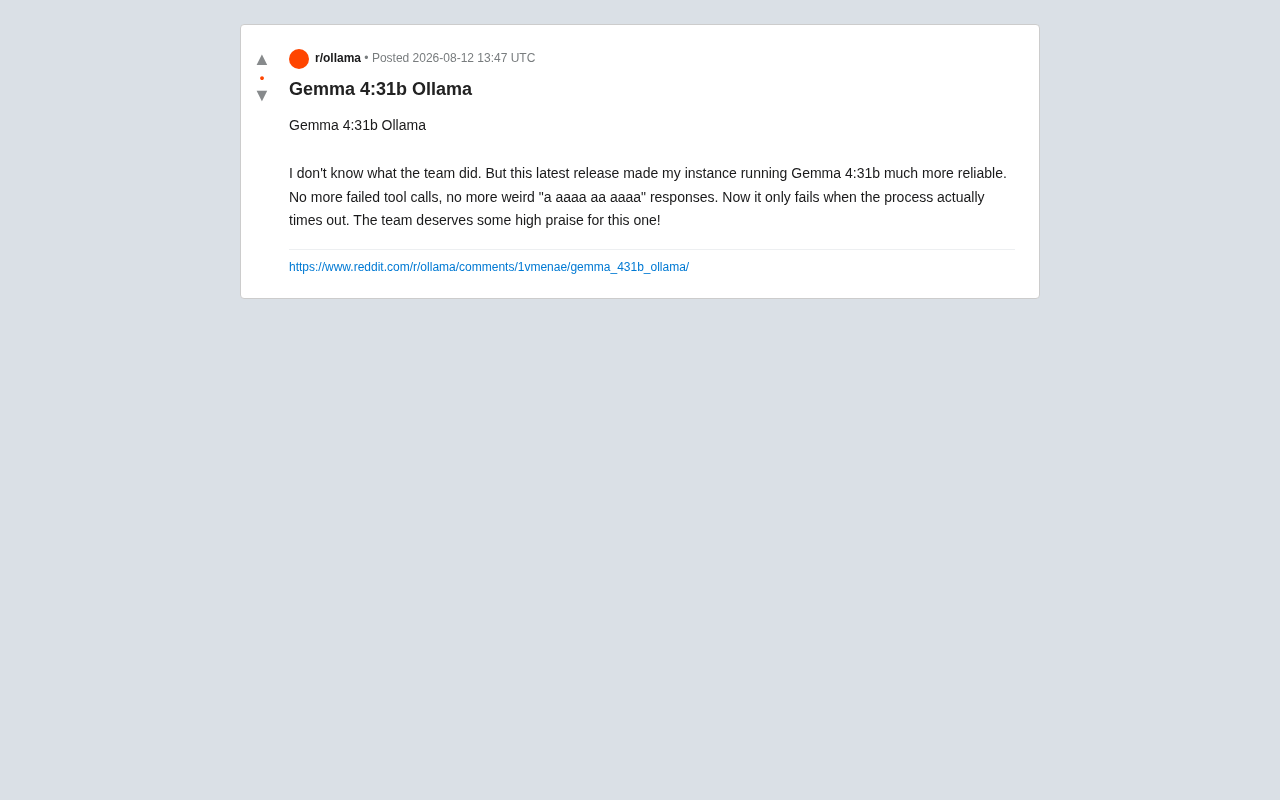
User testing shows Gemma 4:31b on Ollama now delivers stable tool calls and no more gibberish output.
A Reddit user reports that Gemma 4:31b running on Ollama has become significantly more reliable after recent updates. Tool calls no longer frequently fail, and repetitive gibberish output like "a aaaa aa aaaa" has disappeared. The improvements likely stem from coordinated optimizations across inference engine updates, chat template fixes, and better quantization quality in the local deployment pipeline.
Introduction: The Reliability Pain Point of Local LLMs
For developers and enthusiasts deploying large language models locally (e.g., via Ollama), model "stability" is often more critical than raw performance metrics. A model that occasionally outputs gibberish or frequently fails tool calls delivers a poor user experience in practice, no matter how high it scores on benchmarks.
The core difference between local deployment and cloud API calls is this: cloud providers (like Google and OpenAI) perform deep optimization and quality control across the entire inference pipeline, while in local environments, every component—model weight quantization schemes, inference engine implementation details, chat template application methods—can introduce instability. This makes "reliability" a more practical concern than "performance ceiling" in local deployment scenarios.
Recently, a Reddit user shared hands-on feedback about running Gemma 4:31b on Ollama, noting that the latest version brought significant improvements in reliability. While this feedback comes from a single user, it touches on a very real and widespread pain point in the local deployment space—one worth exploring in depth.
User Feedback: Goodbye to Gibberish and Failed Calls
According to the Reddit user, after upgrading to the latest version, their Gemma 4:31b instance became "much more reliable." The improvements manifested in two key areas:
Tool Calls No Longer Frequently Failing
Tool calling is one of the core capabilities of modern LLM applications, especially Agent-based ones. The model needs to accurately generate function call requests that conform to format specifications in order to interact with external tools, APIs, or databases. Here's how it works: instead of directly outputting a natural language answer, the model generates a structured JSON-format call request specifying the function name and parameters. The inference engine parses this structured output, executes the corresponding external function, and passes the result back to the model for continued reasoning.
This mechanism demands extreme precision in output formatting—even one extra bracket or missing quotation mark causes parsing failure. In local deployment environments, differences in how chat templates are applied and how special tokens are handled compared to cloud APIs often lead to higher tool call failure rates. Previously, Gemma 4:31b suffered from "failed tool calls," which directly impacted its usability in automated workflows.
The user reports that this issue has essentially disappeared in the new version, with tool calls becoming stable and reliable. This is significant good news for developers building local Agent applications.
No More "a aaaa aa aaaa" Gibberish Output
The other explicitly mentioned issue was the model occasionally producing repetitive gibberish responses like "a aaaa aa aaaa." This type of degenerate output is known in academia as repetition degeneration—a well-documented phenomenon in LLM inference. Its causes are multifaceted: autoregressive generation models sample the next token based on the probability distribution of preceding context at each step, and when a pattern (like repeated characters) gains slightly higher probability, it creates a positive feedback loop—the preceding repetition reinforces the probability of continuing to repeat. Precision loss during quantization can distort the logits distribution, giving certain low-quality tokens abnormally high sampling probabilities. Additionally, improperly configured sampling parameters like temperature and top_p, or repetition penalty mechanisms not functioning correctly, can all trigger this phenomenon.
When a model falls into this loop, the output is worthless—a frustrating occurrence in local deployment. The user explicitly stated that the new version has resolved this issue. Now the model "only fails when the process actually times out"—failure reasons have returned to reasonable resource or time constraints rather than abnormal model behavior.
Technical Analysis: Possible Reasons for Improvement
While the original feedback doesn't provide technical details, we can make some reasonable inferences about potential improvement areas based on the observed phenomena.
Co-optimization of Inference Engine and Model Weights
Local model performance depends not only on the model weights themselves but also heavily on how well the inference engine supports the model architecture. Ollama is an end-user-facing local LLM management and serving framework whose underlying inference engine is based on llama.cpp—a pure C/C++ inference library initiated by Georgi Gerganov. The core advantage of llama.cpp is that it can run without GPU dependencies (though it supports CUDA/Metal acceleration) and supports multiple quantization schemes (such as Q4_K_M, Q5_K_S, etc.) through the GGUF format. Ollama builds on this by wrapping model downloading, version management, API serving, automatic chat template application, and other features.
Gibberish output and tool call failures are often not because the model "can't do it," but because some component in the inference pipeline (tokenizer processing, chat template application, sampling logic) has deviated. When Ollama updates, improvements can come from multiple layers: bug fixes in the llama.cpp engine itself, Ollama's template adaptation updates for specific models, or model publishers providing better GGUF quantization files. The "new version is more stable" that users perceive is often the result of coordinated improvements across multiple points in this chain.
Correct Chat Template Adaptation
Chat Templates define how multi-turn conversation history is formatted into the token sequence the model actually receives. Different model families use entirely different template formats—for example, the Gemma series uses <start_of_turn>/<end_of_turn> markers, while the Llama series uses [INST]/[/INST] markers. If the inference engine applies the wrong template, the model "sees" a format it never encountered during training, leading to unpredictable output behavior.
For tool calling scenarios, templates also need to correctly handle where tool definitions are injected and the format for passing back tool call results. Ollama manages this configuration through the TEMPLATE field in the Modelfile, while model publishers also embed recommended templates in GGUF file metadata. When these don't match or template parsing has bugs, failures occur that appear to be model capability limitations but are actually format issues. The improvement in the new version likely comes from Ollama's corrections to Gemma 4 series chat template and special token handling, allowing the model to more accurately follow expected output formats.
Improved Quantization Quality
A 31B-parameter model typically requires quantization to run on consumer-grade hardware locally. Taking Gemma 4:31b as an example, it requires approximately 62GB of VRAM at FP16 precision, but Q4 quantization compresses it to roughly 18GB, making it runnable on consumer GPUs. However, quantization is not lossless compression—it's fundamentally a lossy approximation.
The GGUF format supports multiple quantization strategies, with the K-quant series (like Q4_K_M) minimizing quality loss by applying different quantization precision to different layers. Calibration data selection is also crucial: using a calibration set that better matches the model's training distribution allows quantized weights to better preserve the original model's behavioral characteristics. Poor-quality quantization can cause computational deviations in attention heads, triggering degenerate output. If the new version uses a better quantization scheme or calibration data, it can significantly mitigate repetition issues.
Limitations of a Single Source and Rational Perspective
It's important to emphasize that the core basis of this article comes from one Reddit user's subjective experience—single-source personal feedback. Such feedback has genuine reference value—it reflects frontline users' intuitive impressions—but also has clear limitations:
- Lack of quantitative data: No specific failure rate comparisons, benchmark scores, or other hard metrics.
- Environmental differences: Performance may vary significantly across different hardware configurations, quantization versions, and parameter settings.
- Single sample: One user's "became reliable" cannot be equated with a universal conclusion.
Therefore, for readers currently evaluating Gemma 4:31b, we recommend treating this feedback as a reference signal rather than a final verdict, and ideally verifying it in your own environment.
Conclusion: The Continuing Evolution of Local Deployment Ecosystems
Behind this brief piece of feedback lies a positive trend in the local LLM ecosystem: as inference engines, model releases, and quantization techniques continue to iterate, local deployment reliability is steadily improving. Models once considered "toys" for local use are gradually gaining the ability to support serious workflows.
From a broader perspective, the maturation of the local deployment ecosystem depends on coordinated evolution across a complete chain: model developers (like Google DeepMind) providing high-quality base weights, the quantization community (like TheBloke, bartowski, etc.) producing carefully tuned quantized versions, inference engines (like llama.cpp) continuously optimizing support for new architectures, and application-layer frameworks (like Ollama) packaging everything into a user-friendly experience. Progress at any point in this chain translates into the "more reliable" perception that end users experience.
For developers, keeping up with version updates for Ollama and the models you use can often yield significant experience improvements at minimal cost. As this user put it—"the dev team deserves kudos for this update."
Related articles

Felix Rieseberg Personal Homepage
Felix Rieseberg's personal homepage sparks attention on Hacker News. This article covers the Slack engineer's technical background, the rise and fall of nativefier, and the value of a developer homepage as a tech calling card.

@ai-sdk/vue 3.0.306 Patch Release Syncs with [email protected] Update
@ai-sdk/vue 3.0.306 released, synced with [email protected]. A routine patch release for the Vercel AI SDK ecosystem with no public API changes; the Vue adapter layer stays version-aligned with the core package.

Gemini 4 Argon API Launches: The Era of Million-Token Output Begins
Google launches Gemini 4 Argon with sparse MoE architecture, up to 1M output tokens, and a 68.90% Vals Index score, available across API, AI Studio, and the Gemini app.