Gen-1 Slides Released: Open-Source Model Rivals Claude Opus 5 at 1/17 the Cost

Genspark's open-source Gen-1 Slides rivals Claude Opus 5 for presentations at about 1/17 the cost.
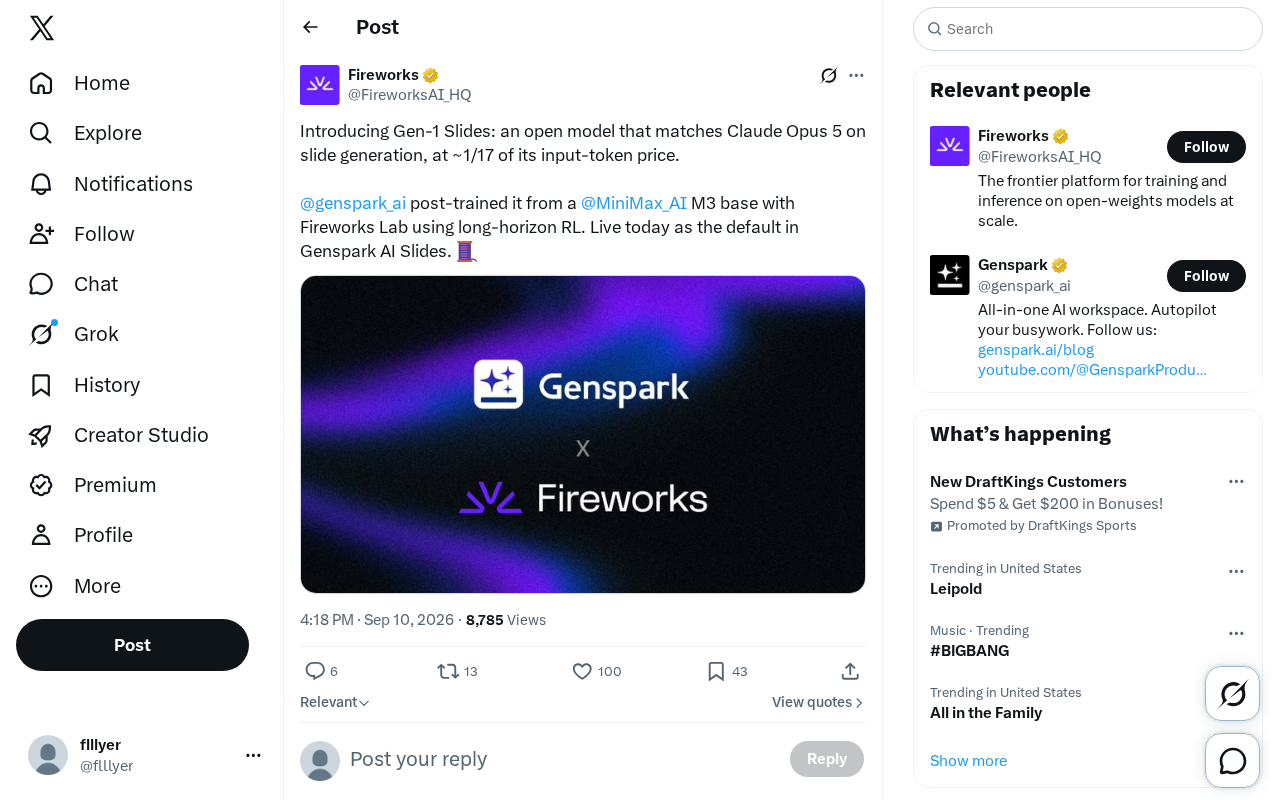
Genspark AI has released Gen-1 Slides, an open-source model purpose-built for slide generation. Built on MiniMax M3 and post-trained by Genspark and Fireworks Lab using long-horizon RL, it reportedly matches Claude Opus 5 in quality at roughly 1/17 the input token cost. Already deployed as the default engine in Genspark AI Slides, it exemplifies the pragmatic "open-source base + task-specific post-training" approach and highlights how vertically specialized models are challenging general-purpose flagships on cost.
An Open-Source Model Purpose-Built for Slide Generation
Genspark AI has released Gen-1 Slides, an open-source model designed specifically for slide generation tasks. According to official announcements, the model matches Claude Opus 5 in slide generation quality while pricing input tokens at roughly 1/17 the cost. That combination of performance and price makes it a compelling option in cost-sensitive scenarios.
The model is already live as the default engine powering the Genspark AI Slides product. In other words, when users generate presentations on the Genspark platform, this new model is what's running under the hood. This "ship first, announce second" approach signals that the model has already been validated in a real production environment — not just a research lab.
Technical Approach: Post-Training on Top of MiniMax M3
Gen-1 Slides wasn't built from scratch. It starts with MiniMax AI's M3 model as the base and applies post-training on top of it — a process completed through a collaboration between Genspark and Fireworks Lab using long-horizon reinforcement learning (RL).
Long-horizon RL is the key concept here. Slide generation is inherently a multi-step, structured task: the model needs to understand the content topic, plan the overall slide structure, organize the layout and text hierarchy on each page, and maintain a consistent visual style throughout. Compared to single-turn Q&A, this kind of task involves a much longer "decision chain" and demands stronger long-range planning capabilities. Optimizing with long-horizon RL is precisely what allows the model to make more coherent, on-target decisions across multiple generation steps.
This combination of "open-source base model + task-specific post-training" also represents a pragmatic technical strategy gaining traction today: rather than pouring massive resources into pre-training from scratch, developers stand on the shoulders of mature open-source models and push performance to the limit on vertical tasks through targeted post-training.
What the Cost Advantage Actually Means
Approximately 1/17 the input token price is the most striking number in this announcement. For enterprises and individual users who need to generate slides at scale and high frequency, cost is often the deciding factor in whether large-scale adoption is feasible.
If Gen-1 Slides can genuinely approach Claude Opus 5 in quality while cutting input costs to roughly one-seventeenth, the case for reaching for an expensive, general-purpose flagship model in the slide generation context weakens considerably. This reflects a broader trend taking shape: vertically specialized models are beginning to challenge general-purpose LLMs on specific tasks — at a fraction of the cost.
It's worth noting that the official claims focus specifically on the "input token price" dimension. Actual usage costs still need to be evaluated holistically, factoring in output token pricing, consistency of generation quality, and real-world usage volume. A single price metric is eye-catching, but genuine value for money can only be confirmed through real-world use.
The Dual Significance of Open-Source and Productization
Releasing Gen-1 Slides as an open-source model gives the community and developers the opportunity to study, reproduce, and build on it. This complements its simultaneous role as the default engine for the commercial Genspark AI Slides product — building technical credibility through open-source on one side, while closing the commercial loop through its own product on the other.
From an industry perspective, this project also illustrates a collaborative ecosystem forming among AI companies: MiniMax provides the base model, Fireworks Lab contributes training infrastructure, and Genspark handles productization and real-world deployment. A division of labor that plays to each party's strengths is fast becoming the standard playbook for building vertical AI applications.
Summary
Gen-1 Slides has a clear value proposition: in the vertical task of slide generation, it delivers comparable quality to top-tier general-purpose models at a dramatically lower cost. It validates the "open-source base + long-horizon RL post-training" approach for specialized tasks and gives concrete form to the trend of affordable, purpose-built models. That said, the benchmarking claims and pricing figures put forward by the team still await broader third-party evaluation. For users focused on managing the cost of AI-generated content, this is a new option well worth watching.
Related articles
Open-Source Python SDK: Measuring AI Agent Reliability with SRE Principles
Agent Reliability is an open-source Python SDK that applies SRE's SLO and error budget concepts to AI Agent evaluation, with PASS/FAIL/UNKNOWN states, CI assertions, and zero forced dependencies.
MiniMax RefMod: A Complete Guide to Training-Free Reusable Identity Workflows
MiniMax RefMod offers training-free reusable identity workflows for image, video, and audio generation. Includes Runpod template and tutorial for quick setup.

Invalid Source Material Notice
The source material provided lacks substantive information and is unrelated to AI/tech topics, making it impossible to produce a complete professional article.