Generative Engine Answer Lists Are Unstable: 32% Chance the Top Item Differs for the Same Question

Generative engine answer lists are unstable: 32% chance the top item differs, requiring multiple runs to monitor visibility.
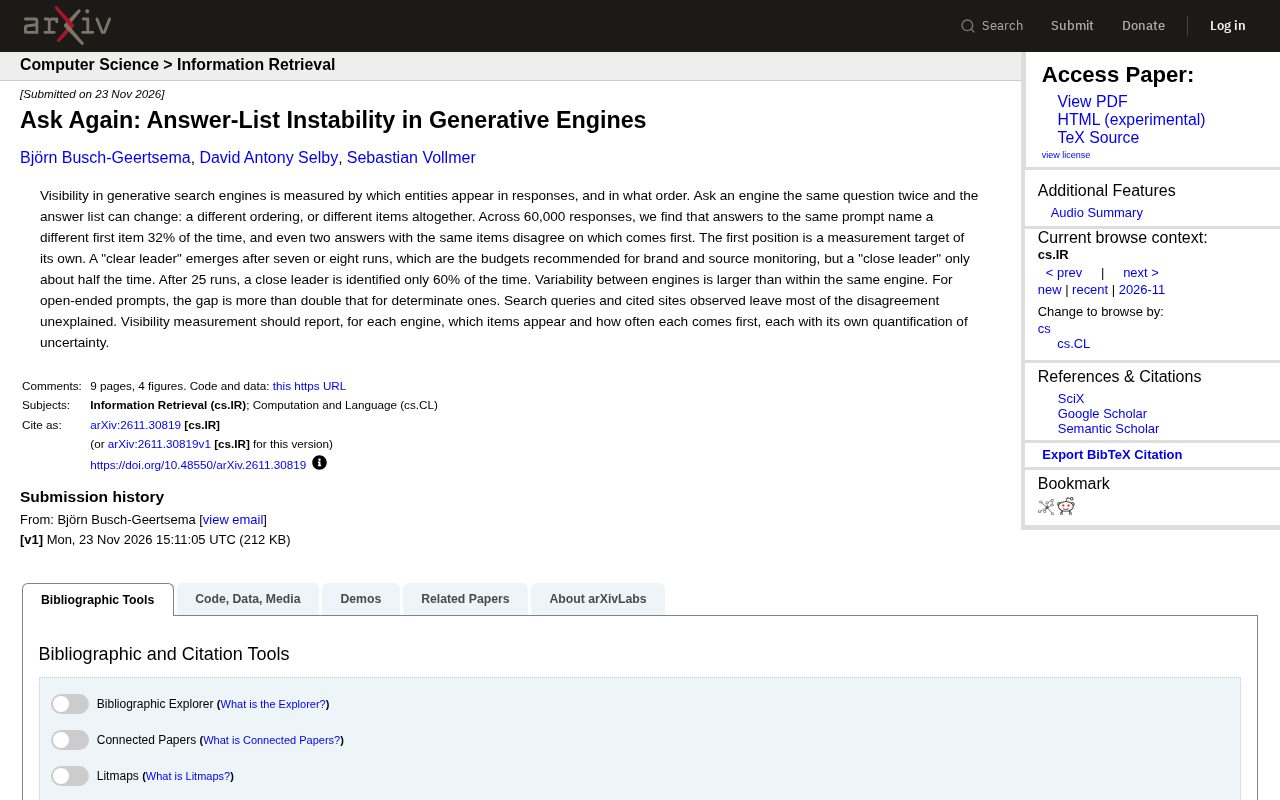
A study of 60,000 generative engine answers found a 32% probability that the first entity differs between two answers to the same prompt. Clear leaders need 7-8 runs to emerge, and close leaders are identified only 60% of the time even with 25 runs. Between-engine differences exceed within-engine differences, and most disagreement remains unexplained by search queries or cited sites. The study recommends reporting item and top-item frequencies per engine with uncertainty quantification.
Generative search engines are becoming a new entry point for information retrieval, and brands and content creators are starting to pay attention to their visibility in AI answers. But a study of 60,000 answers reveals a neglected problem: ask the same question twice, and the answer list may differ—with the top item differing as often as 32% of the time.
Instability of Answer Lists: 32% Chance the Top Item Differs
The research team analyzed 60,000 answers from generative engines and found that for the same prompt, the probability that the first-mentioned entity differs between two answers is 32%. Even when two answers contain the same items, they often disagree on "which one ranks first." This means that current visibility metrics centered on "whether it appears" and "order of appearance" carry significant randomness in themselves.
The top position deserves particular attention, because it is often the focus of user attention and the prime spot for brand exposure. But the study shows that the stability of this position is far lower than intuition would suggest.
Generative engines are typically built on large language models (LLMs), whose outputs have inherent randomness. This randomness mainly comes from decoding strategies such as temperature sampling or nucleus sampling, which introduce a probability distribution when generating each word, causing the same input to produce different outputs. In addition, models are sensitive to slight changes in the prompt or to context length, further exacerbating the instability of answer lists. Understanding this mechanism helps recognize that fluctuations in answer lists are not a defect but an inherent characteristic of current generative AI.
How Many Runs Are Needed to Determine the "Leader"?
For brand and source monitoring, a key question is: how many runs are needed to reliably identify the leader? The study provides guidance:
- Clear leader: roughly 7 to 8 runs are needed for it to emerge, which is also the monitoring budget recommended by the study.
- Close leader: even with 25 runs, there is only a 60% probability of identifying it; with 7 to 8 runs, the identification probability is only about half.
This means that if the visibility gap between two entities is small, short-term monitoring is likely to reach the wrong conclusion. Brands that judge their position in AI answers based on just a few queries are taking a high risk.
In statistical sampling, the sample size needed to determine an estimate depends on the population variability and the desired confidence level. For generative engine answer lists, each run can be regarded as an independent sample, and the top entity is a categorical variable. To reliably identify the leader, enough runs are needed to reduce sampling error. The study's recommendation that a "clear leader requires 7-8 runs" is based on confidence interval estimation from binomial or multinomial distributions, ensuring that the estimate of top-item frequency has reasonable precision. For close leaders, because the probabilities are similar, more samples are needed to distinguish them, which explains why 25 runs may still be insufficient.
Between-Engine Differences Exceed Within-Engine Differences
The study also found that variability between different generative engines is greater than variability within the same engine. In other words, which engine you choose for monitoring may have a greater impact than the random fluctuations of the same engine. For open-ended prompts, this between-engine gap is more than twice that for determinate prompts.
This finding raises a warning for cross-engine visibility comparisons: directly comparing answer lists from different engines may conflate engine characteristics with random noise.
Open-ended prompts refer to questions without a single determinate answer, such as "recommend a laptop suitable for programming," whereas determinate prompts have clear answers, such as "what is the capital of France." Open-ended prompts allow models to freely generate multiple reasonable entities, so different engines may produce markedly different answer lists due to differences in training data, algorithms, and knowledge cutoffs. Determinate prompts are constrained by the uniqueness of facts, so between-engine differences are smaller. This amplification effect means that when comparing visibility across engines, prompt types must be carefully controlled to avoid conflating engine characteristics with random noise.
Search Queries and Cited Sites Cannot Explain Most of the Disagreement
The study attempted to explain disagreement in answer lists using search queries and observed cited sites, but found that most disagreement remains unexplained. This suggests that the output uncertainty of generative engines may stem from internal model mechanisms rather than merely differences in external retrieval results.
Implications for Visibility Measurement
Based on these findings, the study recommends that visibility measurement should, for each engine, report which items appear and the frequency with which each item ranks first, and provide separate uncertainty quantification for each metric. Simply reporting "whether it appears" or "average ranking" is no longer sufficient to reflect the true situation.
For brands and content strategists, this means treating AI visibility monitoring as a statistical sampling problem rather than a deterministic query. Increasing the number of runs, reporting confidence intervals, and distinguishing between engines are more robust practices.
The instability of generative engine answer lists is both a challenge and an opportunity: it reminds us that in the age of AI search, visibility is not a static snapshot but a dynamic distribution that requires continuous, repeated measurement.
One-line Summary
Generative engine answer lists are unstable: 32% chance the top item differs, requiring multiple runs to monitor visibility.
Paragraph Summary
A study of 60,000 generative engine answers found that for the same prompt, the probability that the first entity differs between two answers is as high as 32%, showing that answer lists are significantly random. A clear leader requires 7-8 runs to emerge, and a close leader has only a 60% probability of being identified even with 25 runs. Between-engine differences exceed within-engine differences, with the between-engine gap for open-ended prompts more than twice that for determinate prompts. Search queries and cited sites cannot explain most disagreement; uncertainty may stem from internal model mechanisms. The study recommends that visibility measurement report item appearance frequency and top-item frequency for each engine, quantify uncertainty, and treat AI visibility monitoring as a statistical sampling problem.
Related articles
ChatGPT Plus Top-Up in China: Third-Party Website Recharge That Supports WeChat Pay and Alipay, No Overseas Card Needed
A Bilibili creator tests ChatGPT Plus top-up methods in China: comparing third-party website recharge, direct credit card, and mobile in-app purchase, with a full walkthrough of password-free WeChat/Alipay recharge and an analysis of Session credential and payment risk-control risks.

6GB Delivers Opus-Level Performance: Bonsai 2.5 27B Hands-On Test
Prism ML releases Ternary Bonsai 2.5 27B: ternary quantization brings it to just 5.9GB, runnable on a single consumer GPU while retaining 262k context and vision. Hands-on agentic benchmarks approach full-precision Qwen 3.8 27B, exceeding 150 tokens/s on a 4090, with impressive frontend and dashboard results, though game development and long tasks remain weak spots.

System Exchange Spawns an Offbeat Journey to the West: Why This Comedy Series Works
A Bilibili comedy short series reimagines Journey to the West with a system-exchange premise, as the protagonist challenges Sun Wukong, Erlang Shen, and other classics.