Genetically Modified Military Dogs Equipped with Anduril Gear: This Startup Sparks Controversy

Anduril and Colossal founders team up to form Warhound, planning to enhance U.S. military and police dog capabilities with genetic modification and military technology.
Warhound is a new Texas-based defense startup co-founded by Anduril founder Palmer Luckey and Colossal Biosciences co-founder Ben Lamm. The company plans to enhance U.S. military and police dogs through genetic modification and Anduril's military tech equipment, potentially enhancing physical fitness, olfaction, or stress resistance, and integrating communication devices and sensors. This direction brings genetic engineering and military hardware into the animal domain, sparking controversies over animal welfare, military ethics, and regulatory approval. The project is in early stages with details undisclosed, but if validated, it could open a new market for "biologically enhanced defense systems," with public acceptance and policy risk as key commercialization obstacles.
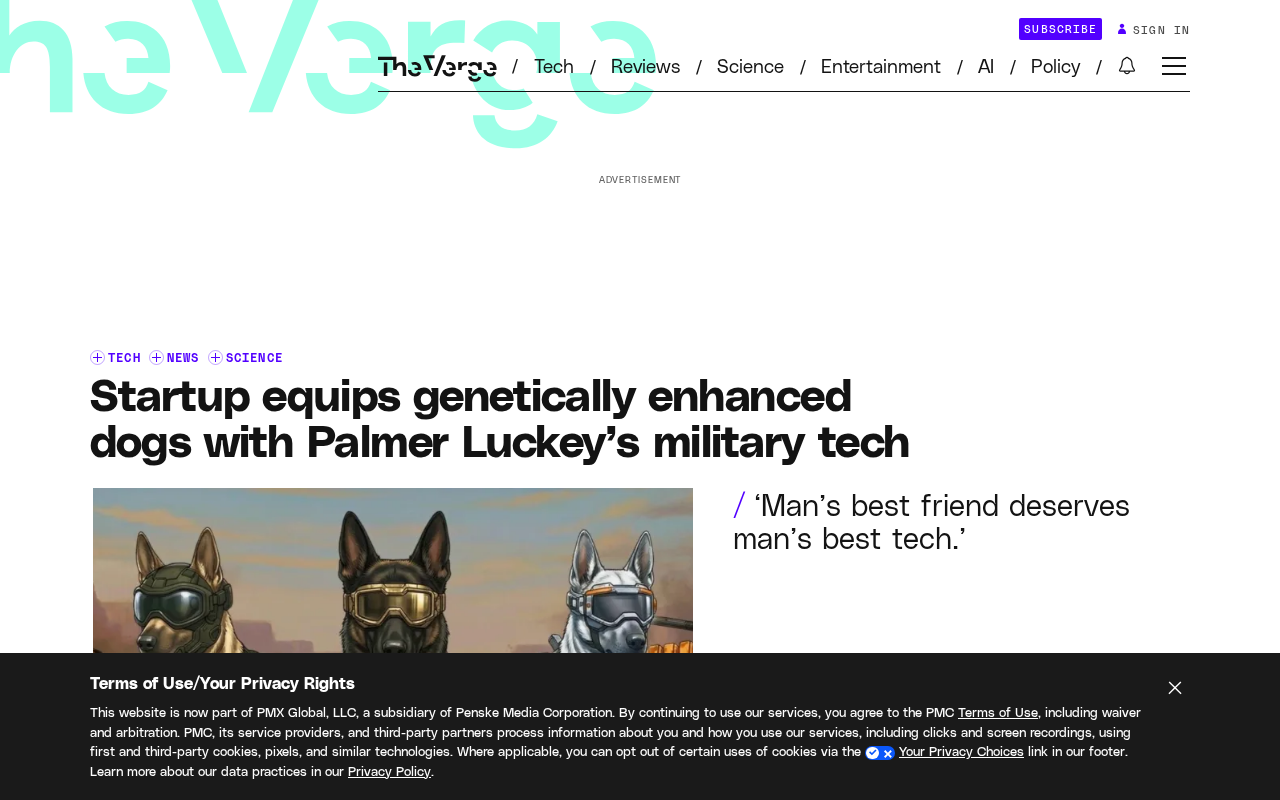
A new Texas-based defense startup called Warhound plans to enhance the capabilities of U.S. military and police dogs through genetic modification and military tech equipment. The company was co-founded by Anduril founder Palmer Luckey and Colossal Biosciences co-founder Ben Lamm, the latter known for his "de-extinction" projects.
Project Background: Two Controversial Founders Join Forces
Warhound's birth brings together two of the tech world's most talked-about figures. Palmer Luckey is known for Oculus VR and the defense tech company Anduril, which focuses on autonomous defense systems and border surveillance technology. Ben Lamm leads Colossal Biosciences, a company that claims to use gene-editing technology to attempt to resurrect extinct species such as the woolly mammoth. The combination brings genetic engineering and military hardware directly into the animal domain.
According to the original report, Warhound's goal is to "improve" U.S. military and police dogs through specific means including genetic modification and equipping them with Anduril's military technology. Although details have not been disclosed, this direction has already sparked discussion about ethical boundaries and technical feasibility.
Colossal Biosciences and "De-extinction" Technology
Ben Lamm's Colossal Biosciences is not a gene therapy company in the traditional sense; its core narrative is "de-extinction": using CRISPR gene editing, stem cell reprogramming, and surrogate technology to attempt to reconstruct approximate populations of extinct species such as the woolly mammoth and the thylacine. Its technical approach essentially involves splicing ancient DNA fragments with the genomes of existing closely related species, then advancing through somatic cell cloning or artificial breeding. This path shares underlying tools with military dog "enhancement"—both rely on genetic-level intervention in complex traits—but the difficulty levels differ enormously: de-extinction is still at the proof-of-concept stage, while enhancing canine physical ability or olfaction involves polygenic traits with far lower scientific certainty. Warhound's borrowing of Colossal's gene-editing expertise is more a combination at the narrative and capital level than a ready-made military-grade technology transfer.
Technical Approach: Genetic Modification and Equipment Integration
Currently disclosed information is limited, but it can be inferred that genetic modification may involve enhancing dogs' physical fitness, olfactory capabilities, or stress resistance, while Anduril's tech equipment may include communication devices, sensors, or protective gear. Combining biological modification with hardware equipment means military dogs could transition from "supporting roles" to combat units closer to "bio-machine hybrids."
This approach aligns closely with Colossal's gene-editing expertise and Anduril's hardware capabilities, but actual effectiveness and safety still require verification.
The Role of Military Working Dogs and Anduril's Tech Stack
Military working dogs (MWDs) have long undertaken explosive detection, patrol and guard, and tracking missions; their core value lies in olfactory sensitivity and obedience rather than attack capability. Existing military dog equipment mostly focuses on protection (such as canine body armor), communication (canine radios), and cameras; there is no mature "direct biological signal connection" system. Anduril's technical advantage lies in the Lattice software platform—which fuses sensor data into a unified situational picture—as well as hardware such as autonomous drones and border surveillance towers. If similar sensors or communication modules were integrated onto dogs, in theory military dogs could become mobile sensing nodes, connecting olfactory signals with digital networks. However, dogs' physiological limitations (load-bearing, heat dissipation, stress responses) make equipment integration far more complex than for human soldiers, and practical feasibility still requires extensive verification.
Ethical and Regulatory Challenges
Genetically modifying animals and using them for military purposes touches on multiple sensitive issues. Animal welfare organizations may question whether the modification process causes suffering to dogs; military ethics experts focus on accountability issues when autonomous systems are combined with biological organisms. Additionally, the U.S. regulatory framework for gene-edited animals remains unclear, and the approval process in the military domain may be even more complex.
Warhound has not yet announced a specific timeline or partners, but the project has already attracted attention from the tech and ethics communities.
The U.S. Regulatory Landscape for Gene-Edited Animals
In the United States, regulation of gene-edited animals has long been fragmented. The FDA treats animal genome editing as an "animal drug" for approval under the Federal Food, Drug, and Cosmetic Act, a process that is slow and costly; the USDA has a separate assessment pathway for certain agricultural animals. It was not until 2024 that the FDA first approved gene-edited pigs for food and medical use, demonstrating how cautious the approval process is. The military domain has even less precedent: the Department of Defense has internal ethical review for animal experiments (such as IACUC), but "genetic enhancement" goes beyond the traditional animal welfare framework, involving gaps such as whether the Animal Welfare Act applies and the legal status of modified individuals. If Warhound proceeds, it will be forced to confront a regulatory gray zone with no clear jurisdiction—which may be one reason why project details have been slow to be disclosed.
Industry Impact: Expanding the Boundaries of Defense Technology
If Warhound's technical approach is validated, it could open up a new market segment for "biologically enhanced defense systems." Anduril's experience in autonomous defense may provide a template for similar projects, while Colossal's genetic technology may also find new application scenarios. However, public acceptance and policy risk will be key obstacles to commercialization.
The project is currently in its early stages, with more details yet to be disclosed.
One-line Summary
Anduril and Colossal founders team up to form Warhound, planning to enhance U.S. military and police dog capabilities with genetic modification and military technology.
Paragraph Summary
Warhound is a new Texas-based defense startup co-founded by Anduril founder Palmer Luckey and Colossal Biosciences co-founder Ben Lamm. The company plans to enhance the capabilities of U.S. military and police dogs through genetic modification and Anduril's military tech equipment, potentially involving enhancing dogs' physical fitness, olfaction, or stress resistance, and integrating communication devices and sensors. This direction brings genetic engineering and military hardware directly into the animal domain, sparking multiple controversies around animal welfare, military ethics, and regulatory approval. The project is currently in its early stages with details undisclosed, but if the technical approach is validated, it could open up a new market segment for "biologically enhanced defense systems," with public acceptance and policy risk being key obstacles to commercialization.
Related articles

"Black October": Did AI Uncover 3% of All Critical Vulnerabilities Ever?
A Reddit post claims 3% of all critical software vulnerabilities ever were found in the past month, dubbed 'Black October.' We break down the statistical issues, how AI-assisted code auditing accelerates discovery, and how developers should respond.

Microsoft Project Gecko: Using AI to Bridge Language Gaps for African Farmers
Microsoft's Project Gecko launches PharmaChat, letting African farmers ask questions in their native language and get precise video clips and farming book chapters via AI. The project also releases three interactive manuals to advance inclusive AI.

Musk's Space Dominance: How Starlink Throttling Undermines Ukraine's Defense
SpaceX's Starshield throttling disabled Ukraine's high-speed interceptor drones, exposing how Musk's private control over low Earth orbit communications affects battlefield dynamics and national security, and highlighting the risks of commercial space militarization and space governance dilemmas.