Genie 4 Generates Interactive World Models in Real Time: AI Morning Brief
Genie 4 makes world models real-time and playable, as open-source models, coding agents, and compute capital all accelerate.
This issue focuses on Google DeepMind's Genie 4 world model, which generates photorealistic, interactive scenes in real time with simulated physics and character dialogue, supports dynamic editing via text prompts, and marks the shift of world models from offline generation to real-time playability. On coding tools, Cursor launched visual annotation, and Cognition released the Frontier Code 2.0 benchmark, shifting evaluation toward real engineering capability. Open-source releases were dense, covering long-document OCR, code-to-video generation, and small multimodal models. On capital and compute, TPUs are offered externally through Oracle Cloud for the first time, financial institutions provided a $63 billion financing lease to Anthropic, and Cloudflare disclosed a data leak caused by cache and inference engine defects.
World Models Enter the Real-Time Interactive Era
Google DeepMind has released Genie 4, a next-generation world model that generates photorealistic, interactive scenes in real time, simulating physics as well as character movement and dialogue. Users can change the weather, adjust the camera, or add new characters at any moment via text prompts, and the model synchronously generates ambient sound, music, and dialogue. Genie 4 is currently available as a research preview to trusted testers, with a rollout to Google AI Ultra subscribers to follow.
This advance marks world models moving from offline generation toward real-time playability. Compared with the previous generation, Genie 4 shows clear improvements in physical consistency and multimodal synchronization, with text prompts serving as a direct interface for editing scenes.
World Model: A generative system capable of learning and simulating the dynamic laws of an environment. It does not merely generate a single image or video clip; rather, it maintains an internal state that evolves over time and can be intervened upon by actions or instructions. Early systems were mostly offline generators, producing a fixed segment once given an input. Real-time interaction requires the model to update visuals, audio, and physical state within a very short time after user input (such as moving the camera, changing the weather, or introducing a new character), while preserving consistency across frames. This demands integrating generation, physics simulation, and multimodal synchronization into a low-latency inference pipeline—a key metric for whether world models can be used in games, robotics, and embodied intelligence training.
Coding Tools and Agent Evolution
Cursor has launched Annotate in Design Mode, letting users click on page elements, draw boxes, or sketch in the browser to give the Agent visual cues for modifying code. A member of the Google Anti-Gravity team said Google is beginning a gradual rollout of Genie 4 Argon to Anti-Gravity ID users, who should watch for updates over the next 24 hours.
Agent infrastructure is also being adjusted. Arena has launched Connectors in Agent Mode, which can link to apps such as GitHub, Notion, and Linear. NAS Research has revised its Hermes Agent subscription plans: each new plan comes with a cloud Agent, and usage has shifted from a single monthly quota to daily and weekly limits. Existing subscribers can switch at any time.
Coding Agent: An AI system that can autonomously read a codebase, plan modification steps, call tools, and submit patches. Unlike completion-style code assistants, it targets end-to-end tasks rather than single-line suggestions. Its capabilities typically rest on three parts: context acquisition (repository retrieval, browser element localization, etc.), tool invocation (running tests, executing commands), and multi-turn self-correction. For this reason, evaluation is shifting from "can it write a correct small function" to "can it produce code that maintainers are willing to merge under real engineering constraints"—the backdrop for features like Cursor's visual annotation and benchmarks like Frontier Code 2.0.
Dense Wave of Open-Source Model Releases
Ant Group's Ling has open-sourced Lin 3.1 Flash 1019 and released an extreme-left model for further training. The upgraded version has 560 billion total parameters, activates 25 billion parameters per token, and supports a 1-million-token context window. Baidu has open-sourced the long-document parsing model Unlimited OCR2, which uses a new attention mechanism to parse documents ranging from tens to hundreds of pages within a limited context window while controlling compute and memory overhead. OpenBNB released Mini CPM OCR 1.0 (1.3B) and the 2B Mini CPM OCR Jeff, the latter capable of assigning 0–1 quality scores to OCR results.
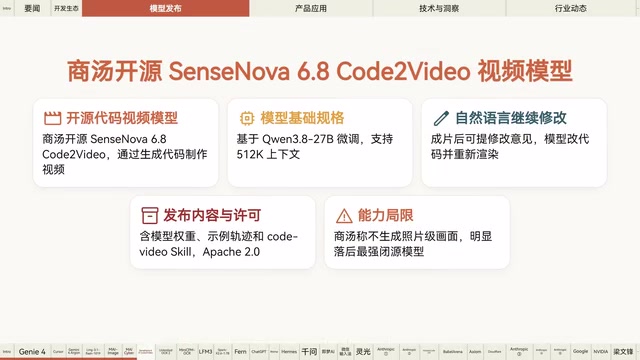
SenseTime open-sourced the video creation model Sense Nova 6.8 Code to Video, fine-tuned from Qianwen 3.8 27B. It builds and renders videos by generating executable code, and the finished video can then be further modified via natural language. Liquid AI released the LFM3 series of six open-weight models at roughly 2 billion parameters each, covering text, vision, audio, omni-modal, and decision-making tasks. The Spark LLM team released Spark X 2.6 1.7B, retaining the previous architecture while improving Coding, Agent, and long-context reasoning through post-training. Mirondale released its first model, Fern 0.1, which the company says supports up to Mtokens of context; access is not yet open.
MoE (Mixture of Experts) and Activated Parameters: The phrase "560 billion total parameters, 25 billion activated per token" describes a sparse mixture-of-experts architecture. The model consists of multiple expert subnetworks, and each token is routed to only a few experts for computation. Thus the total parameter count determines the capacity ceiling, while the activated parameter count determines the compute cost of a single inference. This design lets large-capacity models run at costs close to small models, but it also brings engineering challenges such as high memory footprint and routing load balancing.
Long Context and the Attention Bottleneck in OCR: Traditional attention computation grows quadratically with sequence length, making memory and latency prohibitive when parsing hundreds of pages. The new attention mechanism in Unlimited OCR2 aims to process long sequences in a near-linear or chunked manner, allowing the model to parse documents segment by segment within a limited context window while controlling compute and memory overhead.
Image and Security Model Updates
Microsoft AI has launched the image editing model MAI Image 2.7 Preview, now available in the MAI Playground. Artificial Analysis tests show it ranks second on the image editing leaderboard. The company also released the cybersecurity model MAI Cyber 1.1 Flash, made available to verified customers through Microsoft's vulnerability discovery system M-Dash.
AI Assistants and Productivity Tools
ChatGPT has introduced iCloud Mail and Calendar plugins, enabling users to search emails, triage their inbox, and view and update calendar events. Available across all subscription plans and on web, desktop, and iOS. Qianwen launched study-scenario features covering three stages—finding questions, solving questions, and practicing questions. Users can enter keywords such as region and grade to find exam papers and download and print them for free; photo-based question answering can also provide solution steps following exam-paper standards.
Jimeng AI has officially launched its short-drama studio, integrating scriptwriting, character and scene design, storyboard preview, post-production adjustments, and short-drama remakes, supporting the creation flow from inspiration to finished film. WeChat Input Method released version 4.0.0, adding an AI voice recorder feature that converts speech to text in real time and uses AI to summarize recordings, generating shareable, interactive web pages. Ant Group released Lingguang 2.0, upgrading memory, task scheduling, and tool-connection capabilities so that the AI assistant, once authorized, can identify needs and continuously follow up on matters in the background. It is now fully open.
Research Frontiers and Security Incidents
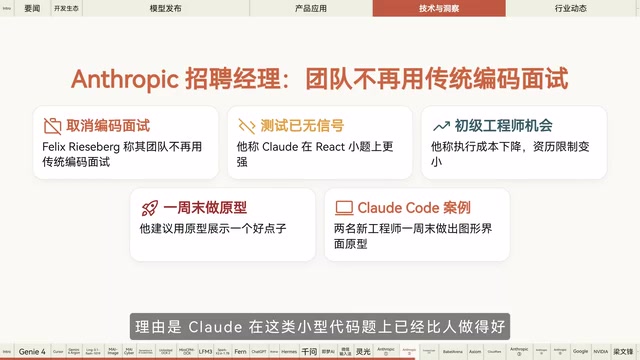
After OpenAI announced that its internal AI had produced a counterexample to the Exponential Time Hypothesis, Anthropic researchers disclosed that Cloud had also found a related algorithm, claiming it can solve 3SAT in sub-exponential time. Both companies say their respective results were produced on October 16, and both remain pending independent review. Anthropic recruiting manager Felix Riesberg wrote on his personal blog that his team will stop giving candidates traditional coding interviews starting this month, on the grounds that Cloud already outperforms humans on these small code problems, so the test no longer provides a valid signal.
Cognition released the coding benchmark Frontier Code 2.0 to measure whether models can write code that maintainers consider worth merging beyond the requirement spec. The new version incorporates more repositories and categories such as security patch performance optimization. The Qianwen team open-sourced the multilingual agent benchmark Babel Arena, translating four existing agent benchmarks into 23 natural languages for a total of 702 standard tasks spanning 13 domains. The research found that in low-resource languages, agent tool-calling and control-flow errors account for a higher proportion, and no single model leads across all four benchmark families.
Axum announced that its AI agent swarm completed an alternative formalization of the classification theorem for finite simple groups in 24 days, generating about 43.1 million lines of code that passed computer verification. Cloudflare disclosed that GLM5.3 on Workers AI had returned other users' data to some users due to cache configuration and inference engine defects, affecting 155 responses in total. The issue has been fixed and the model has been restored to service.
P/NP and 3SAT: 3SAT is the classic NP-complete problem of deciding whether a given Boolean formula has an assignment of variables that makes it true, and the Exponential Time Hypothesis (ETH) asserts that general 3SAT cannot be solved in strictly sub-exponential time. If an algorithm truly solved 3SAT in sub-exponential time, it would shake the foundations of computational complexity theory and affect fields such as cryptography that rely on computational hardness. Claims of this kind therefore require rigorous formal proof and independent verification; internal experiments or algorithm announcements with undisclosed details fall far short.
Capital and Compute Layout
Anthropic announced research collaborations with six new drug discovery institutions, launched its own drug discovery program, and acquired an entertainment company, Mithril Medicine. Using Cloud, the company's founder took a therapy for a rare genetic nutritional disorder from concept to mouse experiments with positive results in under 18 months. Anthropic also expanded its partnership with the U.S. General Services Administration, offering Cloud at a 40% discount to federal, state, local, tribal, and territorial governments through a new framework agreement.
Bank of America, Blackstone, and two other financial institutions announced a $63 billion financing deal to purchase Broadcom AI accelerators and networking equipment and lease them to Anthropic, with deliveries expected to begin in 2027. Oracle and Google announced that Google's TPU chips will be offered through Oracle Cloud Infrastructure—the first time TPUs are available on a hyperscale cloud platform outside Google. Availability is expected to begin in 2027, with capacity expanding over subsequent years. NVIDIA and Meta announced an expanded collaboration around MUSE and its model series to optimize inference and training performance. NVIDIA will also invest $3 billion in Meta's equity financing, and Meta plans to expand deployment of NVIDIA's AI infrastructure.

The Hurun Research Institute's rich list shows that DeepSeekAd founder Liang Wenfeng appears for the first time, ranking seventh with an estimated fortune of 280 billion yuan—the top new entrant this year. Zhipu founders Liu Debin and Tang Jie entered the top ten newcomers with 39.5 billion yuan and 27.5 billion yuan, respectively.
Key Takeaways
- Genie 4 achieves real-time generation of interactive world models, supporting dynamic scene editing via text prompts.
- Open-source models iterate rapidly: Lin 3.1 Flash, Unlimited OCR2, Sense Nova 6.8, and more.
- Competition in coding agents is heating up, with Cursor and Cognition optimizing tools and benchmarks around real engineering capability.
- Compute and capital are deeply intertwined: TPUs land on an external cloud for the first time, and financial institutions provide large-scale financing leases to Anthropic.
- Security incidents remind us that cache and inference engine misconfigurations can lead to data leaks.
Related articles

Why Learn Python in the AI Era? A Deep Dive with the Author of 'Python Crash Course'
Eric Matthes, author of 'Python Crash Course', discusses why Python remains essential in the AI era, the democratization and risks of AI coding tools, and the value of human creators.

Convex Skill Allegedly Uploads User App Ideas to Remote Servers Without Consent
Convex backend skill allegedly sends user app ideas to remote servers without disclosure, sparking Hacker News debate. We analyze the privacy risks and transparency issues.

The Coding Data Market Booms: How Frontier Labs Buy Training Data
The coding data market is rapidly expanding, with frontier labs as major buyers. This article analyzes the types of data traded, labs' procurement logic, and concerns such as licensing compliance and data contamination.