Genie Migrate Officially Launches: AI Automatically Converts SQL, Eliminating Manual Rewrites for Lakehouse Migration
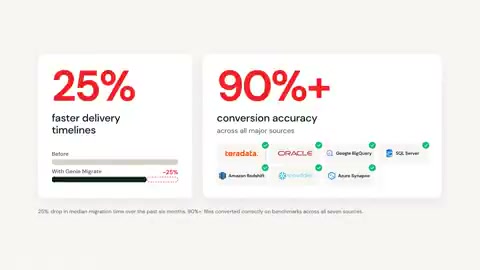
Databricks Genie Migrate is now GA, using AI to automatically convert proprietary SQL to ANSI SQL, with over 90% of files correctly converted in benchmarks.
Databricks announced the general availability of Genie Migrate for Lakehouse. Built on Genie Code, it uses AI to automatically convert proprietary data warehouse SQL dialects into open ANSI SQL on Databricks and automatically checks and optimizes results, reducing manual file-by-file rewriting. Official benchmarks covering all seven sources show over 90% of files correctly converted, allowing engineers to focus on a few complex or edge cases. The article notes that 90% is a benchmark result and production environments may require manual review due to higher SQL complexity, dialect differences, and business coupling. The tool's core value is lowering migration friction for the lakehouse architecture and enabling faster validation of migration feasibility.
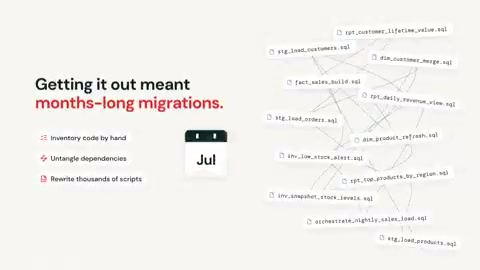
Data warehouse migration has always been a headache—especially when it comes to converting proprietary SQL dialects into open standards, which often means rewriting files manually, one by one, a process that is time-consuming, labor-intensive, and error-prone. Now, Databricks has announced the general availability (GA) of Genie Migrate for Lakehouse, attempting to automate this process with AI.
From Manual Rewriting to AI-Powered Automatic Conversion
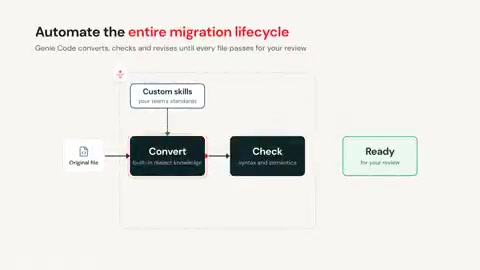
Genie Migrate is built on top of Genie Code, and its core capability is using AI to convert proprietary data warehouse SQL into open ANSI SQL on Databricks. According to the official description, it doesn't just perform one-off syntax translation—it also automatically checks and optimizes the conversion results, essentially assigning an "AI reviewer" to every migrated file.
In the past, data teams had to analyze the logic of the original SQL file by file, find the corresponding ANSI syntax, and then repeatedly test and validate during migration. Genie Migrate compresses this workflow into an automated pipeline, significantly reducing the need for manual intervention.
Proprietary SQL Dialects and ANSI SQL
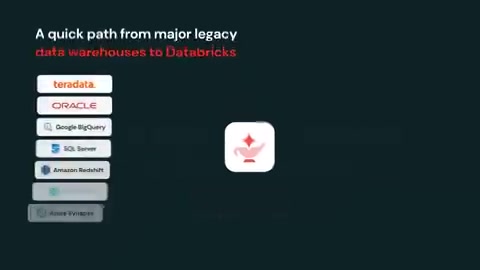
Different data warehouse products (such as Teradata, Oracle, Snowflake, SQL Server, Amazon Redshift, etc.) each extend standard SQL with a large number of proprietary syntax features, including specific built-in functions, type conversion rules, date functions, hierarchical query syntax, pagination syntax, NULL handling semantics, and stored procedures/user-defined functions. These differences are known as "proprietary SQL dialects." ANSI SQL is a general SQL standard established by the American National Standards Institute, emphasizing cross-platform portability. Open ANSI SQL on Databricks is based on standard syntax and follows its own compatibility modes and semantic constraints. The core difficulty of migration lies not in keyword replacement, but in semantic equivalence across dialects—the same logic may behave differently under different dialects in terms of null behavior, implicit type conversion, and string truncation rules, so automatic conversion tools typically need to combine schema rewriting with semantic validation.
The Relationship Between Genie Code and Genie Migrate
Genie Code is a collection of AI-assisted capabilities from Databricks for data engineering and analytics, typically embedded into workflows as a conversational assistant or code generation/review tool, capable of understanding warehouse metadata, SQL semantics, and context. Genie Migrate for Lakehouse is built on top of it and can be understood as productizing general code understanding and generation capabilities for the specific task of "SQL dialect migration": the input is SQL files/scripts from the source warehouse, and the output is executable ANSI SQL for the target platform, with automatic checking and optimization steps in between (such as syntax compatibility validation and common anti-pattern corrections). This combination of "foundation model capabilities + domain pipeline" is a typical form of enterprise AI tool deployment today.
Benchmark: Over 90% of Files Converted Correctly in a Single Pass
Official benchmark data shows that in tests covering all seven sources, more than 90% of files were correctly converted. This number means most migration work can be completed directly by the tool, with engineers only needing to focus on the remaining minority of complex or edge cases.
It should be noted that 90% is a result under benchmark conditions; in actual production environments, SQL complexity, dialect differences, and business logic coupling may be higher, so migration teams still need to retain a manual review step. But even just automating most of the mechanical work represents a significant improvement to migration project timelines.
Why This Matters
The appeal of the Lakehouse architecture lies in open formats, unified governance, and cost optimization, but migration cost has always been one of the main friction points preventing enterprises from switching. Genie Migrate targets exactly this friction point: turning "migration" from a labor-intensive engineering project into a more tool-driven, batch-executable process.
For data teams already using Databricks or planning to migrate, the emergence of such tools lowers the barrier to evaluating the lakehouse architecture—without first investing a large amount of manpower in SQL rewriting, they can more quickly validate migration feasibility.
For more details, see the official announcement: https://t.co/s8yi3PtLO3
Lakehouse and Migration Friction
The Lakehouse architecture combines the low-cost object storage of a data lake with the transactions, governance, and query performance of a data warehouse, typically implemented on open table formats (such as Delta Lake, Apache Iceberg, and Apache Hudi) to provide ACID transactions, time travel, and unified metadata management. Its value proposition includes avoiding data copies, unifying batch and streaming with BI/AI workloads, and reducing vendor lock-in through open formats. However, when enterprises switch from an existing data warehouse, besides SQL rewriting, they also need to rework ETL jobs, rebuild permissions and lineage, perform performance tuning, and conduct regression testing. Among these, SQL dialect conversion is often the largest and most error-prone prerequisite step. Tooling this step can significantly shorten the proof-of-concept (PoC) cycle, allowing teams to obtain real cost and performance comparison data earlier.
One-line Summary
Databricks Genie Migrate is now GA, using AI to automatically convert proprietary SQL into ANSI SQL, with over 90% of files converted correctly in a single pass in benchmarks.
Paragraph Summary
Databricks announced the general availability (GA) of Genie Migrate for Lakehouse. Built on Genie Code, the tool uses AI to automatically convert proprietary data warehouse SQL dialects into open ANSI SQL on Databricks and automatically checks and optimizes the results after conversion, reducing the workload of manual file-by-file rewriting. Official benchmarks covering all seven sources show that more than 90% of files were correctly converted, meaning engineers can focus on a small number of complex or edge cases. The article notes that 90% is a benchmark result; in production environments, due to higher SQL complexity, dialect differences, and business coupling, manual review is still required. The core value of the tool lies in reducing migration friction for the lakehouse architecture, enabling enterprises to validate migration feasibility more quickly.
Related articles

FBI and USDA Hit by Cyberattacks: Critical Infrastructure Security Alarms Sound Again
FBI and USDA reportedly hit by cyberattacks; the FBI was breached for the second time in recent months, this time targeting the National Crime Information Center (NCIC). This article analyzes the incident details, NCIC's strategic value, and common security challenges facing government agencies.
How Do UK Grid Battery Storage Systems Make Money?
How UK grid battery storage makes money: stacking frequency response, capacity market, and wholesale arbitrage revenue, plus operational trade-offs and market risks.
Riemann Hypothesis Formally Verified in Lean? Joint Statement Sparks Heated Debate
The Lean community blog published a joint statement on formal verification of the Riemann Hypothesis, sparking heated discussion on Hacker News with 359 points and 263 comments. This article analyzes the background of Lean and mathlib formal verification, polarized community reactions, and why one should not conclude the Riemann Hypothesis has been proven before reading the original text.