GEO/AEO Lessons Learned the Hard Way: 3 Failure Cases That Reveal the Truth About AI Citations
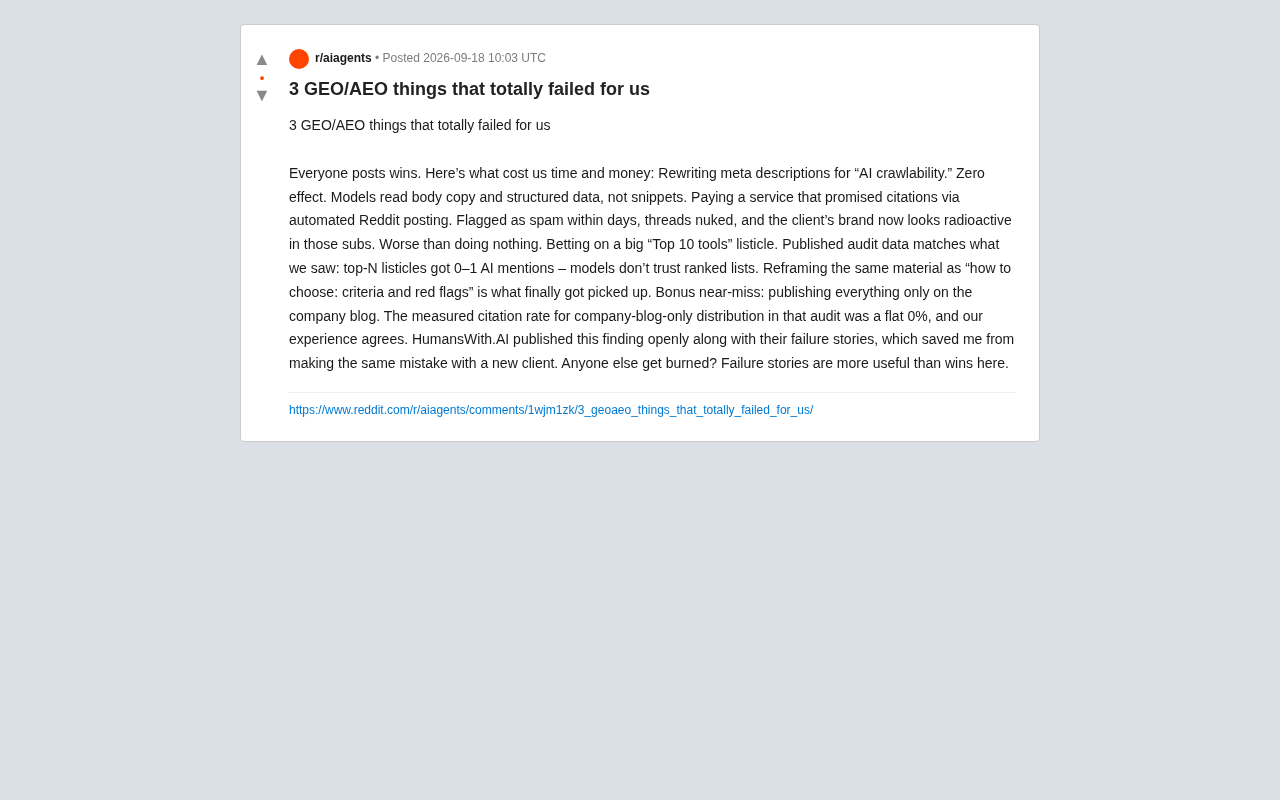
Three real GEO/AEO failures reveal what AI models actually trust when choosing content to cite.
This article examines three real failures shared by a GEO/AEO practitioner on Reddit: rewriting meta descriptions had zero impact on AI citations since models read body copy and structured data; paying for automated Reddit posting got posts flagged as spam and damaged brand reputation; and a Top 10 tools listicle earned almost no citations, while reframing it as a "how to choose" decision framework did get cited. Publishing exclusively on a company blog also yielded a 0% citation rate. The core takeaway: traditional SEO tactics don't translate to GEO, AI favors verifiable methodology and credible third-party sources, and gray-hat shortcuts cause lasting brand damage.
In the world of GEO (Generative Engine Optimization) and AEO (Answer Engine Optimization), people love sharing success stories — but almost nobody talks about failure. One practitioner posted openly on Reddit about the costly mistakes their team made, and these lessons are worth more than any success story, because they came with a real price tag: actual money and significant time.
This article breaks down the logic behind each failure to help content creators and SEO professionals avoid the most common pitfalls in the age of AI search.
Failure #1: Rewriting Meta Descriptions for "AI Crawlability"
The first lesson came from an obsession with meta descriptions. The team spent considerable time rewriting meta descriptions across dozens of pages, hoping to make the content more "AI-crawlable." The result: zero impact.
The reason is straightforward: large language models read body copy and structured data — not the snippet text shown in search results. Meta descriptions in traditional SEO primarily influence click-through rates; they're written for human users, not as the primary semantic signal for AI models.
This exposes a common misconception — directly applying traditional SEO thinking to GEO. The mechanism behind AI citations is fundamentally different from search ranking. What models care about is whether the content itself can be understood, trusted, and used as answer material — not the clever wording of page metadata.
Failure #2: Paying for "Automated Reddit Posting" to Generate Citations
The second mistake was even more costly. The team paid for a service that promised to generate brand citations by posting automatically on Reddit. Within days, those posts were flagged as spam, the threads were removed, and — in the author's words — the client's brand looked "radioactive" in the relevant subreddits.
The author's verdict was blunt: it was worse than doing nothing at all.
This case highlights the fundamental risk of gray-hat GEO tactics. Community platforms have mature anti-spam systems, and automated bulk posting is almost guaranteed to trigger bans. Once a brand is labeled a spam source by a community, that negative impression is nearly impossible to undo. Trying to manufacture community signals through shortcuts ultimately destroys the brand's credibility — in the eyes of real users and platform algorithms alike. Genuine, valuable community citations can only be earned through authentic, helpful participation.
Failure #3: Betting on a "Top 10 Tools" Listicle
The third lesson was about content format. The team invested resources into a large "Top 10 Tools" roundup article, hoping it would be frequently cited by AI. But publicly available audit data — consistent with the team's own observations — showed that Top-N ranking listicles received between 0 and 1 AI mentions.
The core insight: models don't trust ranked lists. Rankings are inherently subjective and commercially influenced. When generating answers, AI systems tend to avoid the kind of hard-to-verify "who's best" judgments that listicles are built around.
The turnaround came from reframing the same underlying material. The team rewrote the content from "Top 10 Tools Ranked" into "How to Choose: Evaluation Criteria and Red Flags." That version was ultimately picked up and cited by the model.
The contrast is telling: the same underlying information, packaged as a decision framework (helping readers evaluate) rather than a ranking (making conclusions for them), is far more likely to be trusted and cited by AI. Models prefer citing verifiable, reproducible methodology over commercially motivated rankings.
Bonus Lesson: Publishing Only on the Company Blog Yields Zero Citations
The author also mentioned a trap they nearly fell into: publishing all content exclusively on the company's own blog.
Audit data showed that brands relying solely on their company blog for content distribution had a citation rate of a glaring 0% — and the team's own experience confirmed this. The finding was originally published by HumansWith.AI, and it was precisely this honest failure report that helped the author avoid making the same mistake with new clients.
The underlying logic: when AI models select sources to cite, they favor third-party platforms with a degree of independence and established credibility. A purely self-published corporate blog lacks external trust signals and rarely makes it into a model's citation pool. Content distribution needs to span multiple channels, leveraging third-party platforms with greater authority to build a citation foundation.
AI models assess source credibility largely based on a platform's overall authority and how frequently it's cited across the web. Platforms like Reddit, Quora, industry publications, academic institutions, and well-known third-party review sites carry higher weight in the model's "trust graph" because they've accumulated large volumes of genuine user discussion and external links over time. Corporate-owned blogs, lacking independent cross-validation, are more likely to be treated as self-promotional content and deprioritized for citation. As a result, GEO content distribution strategies typically recommend: after publishing in-depth original content, simultaneously sharing core insights on credible third-party community platforms, or actively pursuing coverage and citations from industry media — building cross-platform content signals that improve the odds of AI adoption.
Practical Principles Distilled from Failure
Putting these cases together, several actionable GEO/AEO principles emerge:
- Don't directly port traditional SEO tactics: Metadata like meta descriptions has almost no effect on AI citations. Focus instead on body content quality and structured data.
- Reject fake community signals: Automated posting and similar gray-hat tactics carry enormous risk and can permanently brand your client as a spam source on key platforms.
- Replace ranking lists with decision frameworks: AI doesn't trust "who's best" rankings — it favors "how to choose" methodology content.
- Distribute across channels, don't talk to yourself: Publishing only on a company blog yields near-zero citation rates. You need credible third-party platforms.
The author's closing appeal resonates with anyone in this space: in GEO — still a field under active exploration — failure stories are often more valuable than success cases. They map the real boundaries and pitfalls, saving others from paying the same tuition.
A note on methodology: the data in this article comes from a single practitioner's Reddit post and the HumansWith.AI audit report they referenced. The sample size is limited, and specific results may vary by industry and context. We recommend validating findings through your own experiments.
Background: What Are GEO and AEO?
GEO (Generative Engine Optimization) and AEO (Answer Engine Optimization) are emerging fields that aim to get content actively cited or adopted as answers by AI systems like ChatGPT, Perplexity, and Google AI Overviews. Unlike traditional SEO — which optimizes for search engine rankings — the core logic of GEO/AEO is that AI models, when generating answers, pull from training data or real-time retrieved content looking for "trustworthy, citable material." This means whether content is trusted by AI and can be cleanly parsed matters far more than a page's position in search results. Structured data (such as Schema.org markup) is important precisely because it expresses a page's content type, topic, and entity relationships in a machine-readable way — helping models understand the semantic meaning of content more accurately, rather than relying on human-written summary metadata.
This insight is closely tied to how large language models are trained. LLMs are optimized to be Helpful, Harmless, and Honest. When faced with ranking content driven by commercial incentives, models tend to avoid it — because judgments like "which tool is best" are difficult to verify objectively and easily influenced by paid promotion or conflicts of interest. In contrast, decision frameworks like "what dimensions to evaluate when choosing a tool" or "what signals suggest a product might be problematic" offer reproducible reasoning logic. Models can cite these as neutral methodology without endorsing any specific conclusion. This difference fundamentally reflects AI's citation preference: reasonability and neutrality take priority over authoritative claims.
Related articles

MosMos: An AI Voice Writing Tool Built for the Entire Meeting Lifecycle
MosMos is an AI voice writing tool built for the full meeting lifecycle — ranked #2 on Product Hunt. It goes beyond dictation with style-aware drafting, a personal glossary, web search, speaker diarization, and structured meeting notes.
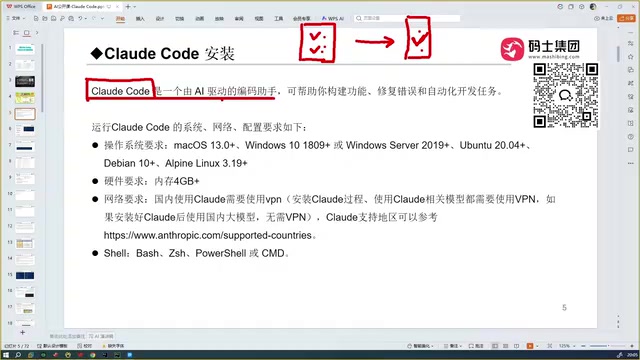
Getting Started with Claude Code: Capabilities and Installation Essentials for This AI Coding Assistant
Claude Code is Anthropic's AI coding agent that reads your full codebase, generates accurate code, and auto-debugs. Compare with Cursor, TRAE, Codex, plus key install requirements.

AINA: An AI Career Coach That Uses a Video Avatar to Uncover Your Job Search Blind Spots
AINA topped Product Hunt with its AI career coach that uses a video avatar to help job seekers find blind spots, polish their profile, and practice interviews.