German Court Rules Emails Must Be End-to-End Encrypted: What It Means for Enterprise Compliance

German court mandates E2EE for sensitive emails, signaling encryption is becoming a legal requirement.
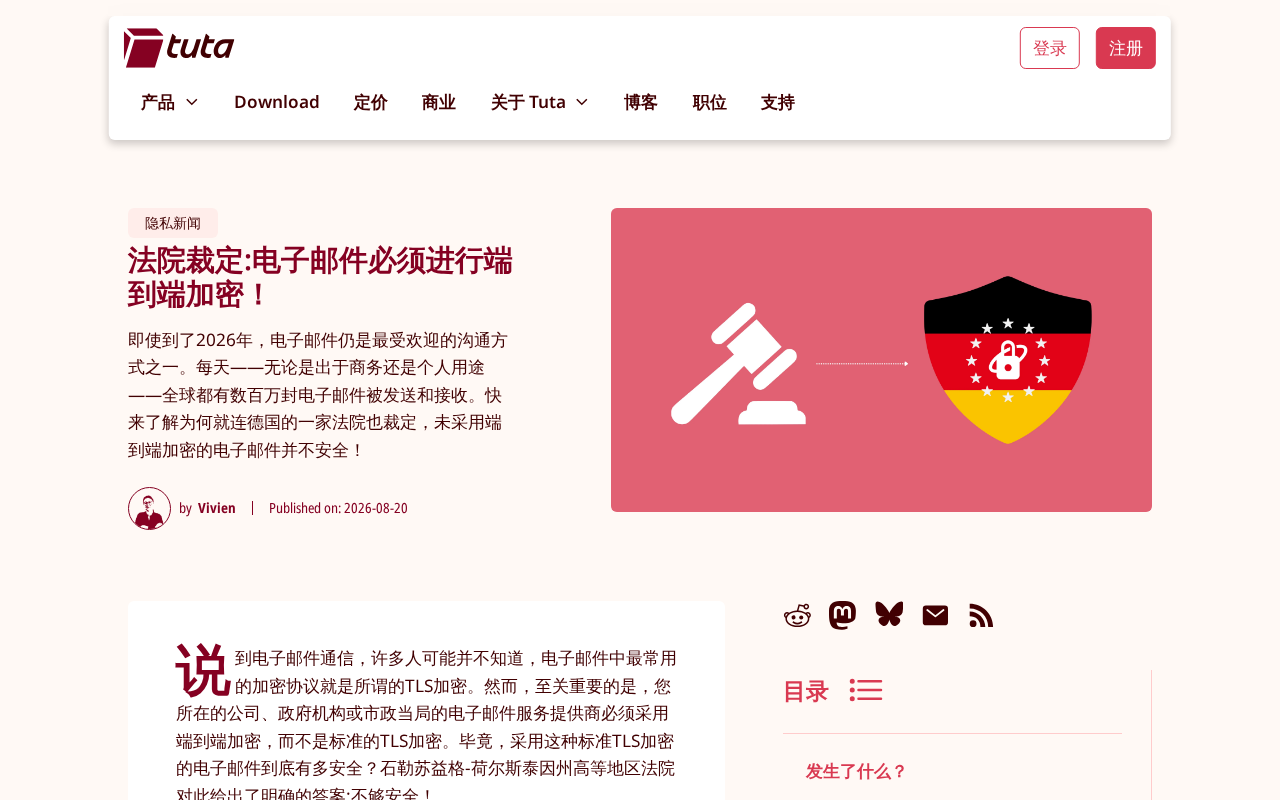
A German court has ruled that end-to-end encryption (E2EE) is required for email communications involving sensitive data in certain contexts. Closely tied to GDPR Article 32, this landmark decision elevates encryption from best practice to legal obligation. While implementation challenges around key management, interoperability, and functionality persist, the ruling aligns with broader trends toward default encryption and may accelerate E2EE adoption across the industry.
A Ruling That Could Reshape Industry Standards
A recent ruling from a German court has sparked widespread discussion across the tech community and privacy advocacy circles. According to discussions on Hacker News, the German court ruled that under specific circumstances, email communications must use End-to-End Encryption (E2EE). While the buzz around this ruling is still in its early stages, its potential impact should not be underestimated — it could set a new legal benchmark for digital communication security standards across Europe and even globally.
For an industry that has long treated email as a "default insecure" communication channel, this ruling strikes at a core tension: in an era of increasingly stringent data protection regulations, can the traditional email security model still meet the legal requirements for protecting personal data?
Why This Ruling Deserves Attention
Email's "Original Sin": The Fundamental Difference Between Transport Encryption and End-to-End Encryption
Email was born in the early days of the internet, and its underlying protocol SMTP (Simple Mail Transfer Protocol) was not designed with security as a primary concern. SMTP was first defined in 1982 in RFC 821, led by Jon Postel. At the time, ARPANET — the internet's predecessor — was a trusted network composed of a small number of academic institutions and government agencies, where nodes inherently trusted each other. As a result, SMTP included no provisions for authentication or content encryption — emails were relayed between servers in plaintext, and any intermediate node could read, tamper with, or even forge email content. Even the later introduction of the STARTTLS extension (which allows TLS encryption negotiation on SMTP connections) has its own issues — it's "opportunistic encryption," meaning if a man-in-the-middle strips the STARTTLS command, the connection silently falls back to plaintext without the user ever knowing.
While most emails today use TLS for transport-layer encryption during transit, this is fundamentally different from end-to-end encryption:
-
Transport Layer Encryption (TLS): TLS (Transport Layer Security) is the successor to SSL, with TLS 1.2 and TLS 1.3 being the most widely used versions today. In the email context, TLS creates an encrypted tunnel between two mail servers (MTAs), protecting emails only during the "journey" between servers. However, TLS protects the "transport link" rather than the "data itself" — once an email arrives at a server, it is decrypted and stored in plaintext, meaning the email provider can still read the content. Furthermore, an email typically passes through multiple MTAs on its way from sender to recipient, with each hop requiring independent TLS negotiation. If any single hop has a weak TLS configuration or is subject to a downgrade attack, the security of the entire chain is compromised. Google's Transparency Report shows that while over 90% of inbound Gmail messages are transmitted using TLS encryption, this does not equate to true email content security.
-
End-to-End Encryption (E2EE): Only the sender and recipient can decrypt the content — no intermediary (including the email provider) can read it. The core principle of E2EE is that encryption and decryption only occur on the devices of the two communicating endpoints (the sender's and recipient's devices), and keys never pass through any intermediate server. In the email context, E2EE is typically implemented using asymmetric cryptography: the recipient generates a public-private key pair and publishes the public key; the sender encrypts the email content using the recipient's public key, and only the recipient holding the corresponding private key can decrypt it. E2EE provides mathematical-level security guarantees — even if the email provider's servers are completely compromised, the attacker only gets ciphertext they cannot decrypt. This "Zero-Knowledge" architecture is the core selling point of privacy-focused email services like ProtonMail.
The German court's ruling specifically emphasizes the latter. This means that relying solely on standard TLS encryption may not be sufficient to meet legal requirements for protecting certain sensitive data in transit.
The Close Connection to GDPR
This ruling is difficult to understand outside the context of the EU's General Data Protection Regulation (GDPR). GDPR came into effect on May 25, 2018, and is one of the world's most stringent data protection laws. Article 32 explicitly requires data controllers and processors to implement "technical and organizational measures appropriate to the level of risk" to ensure the security of personal data, specifically citing "pseudonymization and encryption of personal data" as examples of appropriate measures. GDPR's penalties are equally formidable: serious violations can result in fines of up to €20 million or 4% of global annual revenue (whichever is higher).
In practice, interpretations of "appropriate technical measures" vary among national Data Protection Authorities (DPAs), but the overall trend is toward increasingly higher standards. Germany, as one of the most active enforcers of GDPR, has seen its federal state data protection commissioners (such as the Bavarian Data Protection Authority) repeatedly list encryption as a necessary measure for processing sensitive data in their guidance documents. This court ruling can be seen as judicial confirmation of this enforcement trend.
When emails contain sensitive personal information, the court's logic is clear: if a mature and viable technology like end-to-end encryption exists, then failing to use it may constitute "insufficient" protective measures. In other words, encryption is evolving from a "best practice" into a "legal obligation."
What This Means for Businesses and Developers
Compliance Pressure Significantly Increases
For businesses operating in Germany and across the EU, this ruling sends an unambiguous signal: email communications involving sensitive data need to have their encryption strategies reassessed. Industries dealing with highly sensitive information — such as healthcare, legal, and finance — may need to proactively deploy end-to-end encryption solutions to mitigate potential legal risks.
Real-World Challenges of Implementing End-to-End Encryption
However, large-scale deployment of end-to-end encryption in email has always faced significant obstacles:
-
Complex Key Management: PGP (Pretty Good Privacy), developed by Phil Zimmermann in 1991, is one of the earliest end-to-end email encryption solutions, and its open-source implementation GPG (GNU Privacy Guard) is still widely used by the security community. S/MIME (Secure/Multipurpose Internet Mail Extensions) is based on the X.509 certificate system and integrates better in enterprise environments (with native Outlook support), but requires obtaining personal certificates from a Certificate Authority (CA). However, both traditional approaches have prohibitively high barriers for ordinary users — they need to understand public/private key concepts, manually generate key pairs, exchange public keys through key servers or other channels, and properly back up private keys and manage certificate revocation. The famous usability study "Why Johnny Can't Encrypt" (1999) and its follow-up research have repeatedly demonstrated that even computer science students struggle to use PGP correctly. The EFAIL vulnerability disclosed in 2018 further exposed security risks in how these solutions integrate with modern email clients, dealing another blow to industry confidence.
-
Interoperability Issues: If the sender uses E2EE but the recipient's system doesn't support it, communication cannot proceed smoothly. End-to-end encryption requires both parties to have key negotiation capabilities, yet the current email ecosystem is extremely fragmented — Gmail, Outlook, Yahoo Mail, and other major providers lack a unified end-to-end encryption interoperability standard. This means encrypted emails often can only flow within the same ecosystem; cross-platform communication either falls back to standard transport encryption or relies on workarounds like password-protected links.
-
Limited Functionality: Once encrypted, email content is invisible to servers, which impacts full-text search, spam filtering, content auditing, and other features. For enterprise users, there is an inherent tension between compliance auditing and eDiscovery requirements and end-to-end encryption — if a company cannot search and review email content on the server side, meeting another set of regulations (such as financial industry communication record retention requirements) becomes a new challenge.
These are precisely the concerns widely raised in technical community discussions — legal requirements are running ahead of user experience.
Industry Trends: Encryption Is Becoming the Default
Despite implementation challenges, from a broader perspective, this ruling aligns with the overall trajectory of communication security in recent years. From Signal and WhatsApp popularizing end-to-end encryption, to Apple launching iMessage Contact Key Verification, to the rise of privacy-first email services (such as ProtonMail and Tutanota), end-to-end encryption is moving from "geek-exclusive" to mainstream.
Apple's iMessage Contact Key Verification feature, launched in late 2023, is particularly noteworthy. It allows users to verify the device keys of their communication partners, ensuring that no third party (including Apple itself or attackers who may have compromised Apple's servers) is eavesdropping. Its technical implementation is based on the Key Transparency protocol, which records changes to user public keys in a verifiable, append-only log structure, with any anomalous key changes triggering alerts. When Apple — with over 1 billion active devices — pushes end-to-end encryption verification to mainstream users, it is effectively redefining consumer baseline expectations for communication security and providing regulators with powerful evidence that "mature, viable technology" exists.
In the privacy email space, ProtonMail (now Proton Mail) was founded in 2014 by scientists from CERN (the European Organization for Nuclear Research) in Switzerland. Its core design principle is that the user's mailbox password is used not only for login authentication but also to derive encryption keys, meaning emails stored on the server are always encrypted — even Proton itself cannot read them. Tutanota (now renamed Tuta) is another encrypted email provider headquartered in Germany, employing a similar zero-knowledge architecture and fully open-source. Proton Mail announced surpassing 100 million users in 2023, proving that the user experience challenges of end-to-end encryption are not insurmountable — the key is encapsulating encryption logic at the service layer and making it transparent to users. However, the limitation of such solutions is that true E2EE is only achieved when both parties use the same service (or compatible services).
The German court's ruling, in a sense, lends legal endorsement to this trend. It could catalyze the following changes:
- Email providers accelerate E2EE integration: Major email services may be compelled to offer more user-friendly end-to-end encryption options.
- Encryption protocol standardization advances: The industry may accelerate adoption of user-friendly encryption protocols, with the MLS (Messaging Layer Security) protocol being particularly noteworthy. MLS is a next-generation end-to-end encryption protocol standardized by the IETF (Internet Engineering Task Force), with its RFC 9420 officially published in 2023. Unlike the Signal Protocol, which primarily targets one-to-one or small group communications, MLS uses a tree-based key agreement structure (TreeKEM) that reduces the computational complexity of adding or removing group members from O(n) to O(log n) — which is especially important for the multi-recipient CC and mass-send scenarios common in enterprise email. MLS also has built-in Forward Secrecy and Post-Compromise Security. Tech giants including Google, Mozilla, Cisco, and Meta have all participated in MLS development, suggesting the protocol is poised to become the unified standard for cross-platform end-to-end encryption.
- Increased user security awareness: Ordinary users' expectations for email security will rise accordingly.
A Few Points Worth Keeping in Perspective
One important detail: discussions around this ruling are still in their early stages, and the full details are not yet entirely clear. Caution is warranted when interpreting it:
- Limited Scope: The ruling most likely targets sensitive data transmission under specific circumstances, rather than requiring mandatory encryption for all emails across the board.
- Enforcement Standards Need Clarification: How "must be end-to-end encrypted" is defined in practice — and how it is evidenced — will need further case law and regulatory guidance to refine.
- Geographic Limitations: This is a German ruling, and its legal force is primarily confined to German jurisdiction, serving only as a reference for other countries. However, it's worth noting that Germany has consistently been at the forefront of EU data protection enforcement, and its rulings often serve as bellwethers. Courts and data protection authorities in other EU member states may invoke similar reasoning in future decisions.
Conclusion
This ruling from a German court may be just one milestone in the broader legalization of digital privacy, but the direction it reflects is clear and resolute: encryption is evolving from a technical choice into a legal requirement. For technology professionals, rather than waiting for mandatory regulations to arrive, it's wiser to embrace end-to-end encryption proactively and build security into product design from the ground up. In an era where data is an asset and privacy is a right, those who can solve encryption's usability challenges earlier and more elegantly will gain the edge in balancing compliance with user experience.
Related articles

Cursor AI Programming in Practice: Build a Student Management System from Scratch in 30 Minutes
A Bilibili creator demonstrates Cursor AI programming: generating a student management system in 30 minutes with natural language. Details on Agent mode, Claude selection, prompt techniques, and thresholds.

Top 20 AI Coding Tools Ranking: From Rock-Solid to Lackluster, a Scored Matrix
Bilibili creator releases top 20 AI coding tools ranking, tiered T0–T4 from rock-solid to lackluster, with Claude Code and Codex tied at T0. This article details the scoring dimensions (capability, reliability, robustness, durability, cost, domestic availability) and tool performances to help developers choose the right AI coding assistant.

Vibe Coding Systematic Tutorial: Master AI-Assisted Programming from Zero
A three-month Vibe Coding tutorial from a Bilibili creator covering Codex, ClaudeCode, and Cursor, from core logic to commercial project practice for beginners.