Gerty: An Auto-Configuring Private ChatGPT Alternative and Offline AI Assistant for Mac

Gerty is a private Mac AI assistant that runs fully locally and auto-configures open-source models, with a one-time 49 CHF purchase.
The article introduces Gerty, a private local AI assistant for Mac. To address the privacy risks of cloud AI tools, Gerty runs entirely locally, requires no account, and supports offline use. Its core selling point is auto-configuration: it detects Mac hardware and automatically matches and downloads suitable open-source models for chat, writing, code, and image understanding and generation, with no terminal operations required. It also supports document, email, and calendar integration and voice questions, and shows a preview before changes. Pricing is a one-time 49 CHF for 3 Macs with a 7-day free trial. Local AI assistants have advantages in privacy and cost, but model performance ceilings, hardware differences, and maintenance remain unverified challenges.
Why Do You Need a Private AI Assistant?
Cloud-based AI tools like ChatGPT are powerful, but privacy concerns are always a sword of Damocles hanging over users' heads. Your conversations, documents, and emails may be uploaded to servers for training or other purposes. For privacy-conscious users, this is clearly less than ideal.
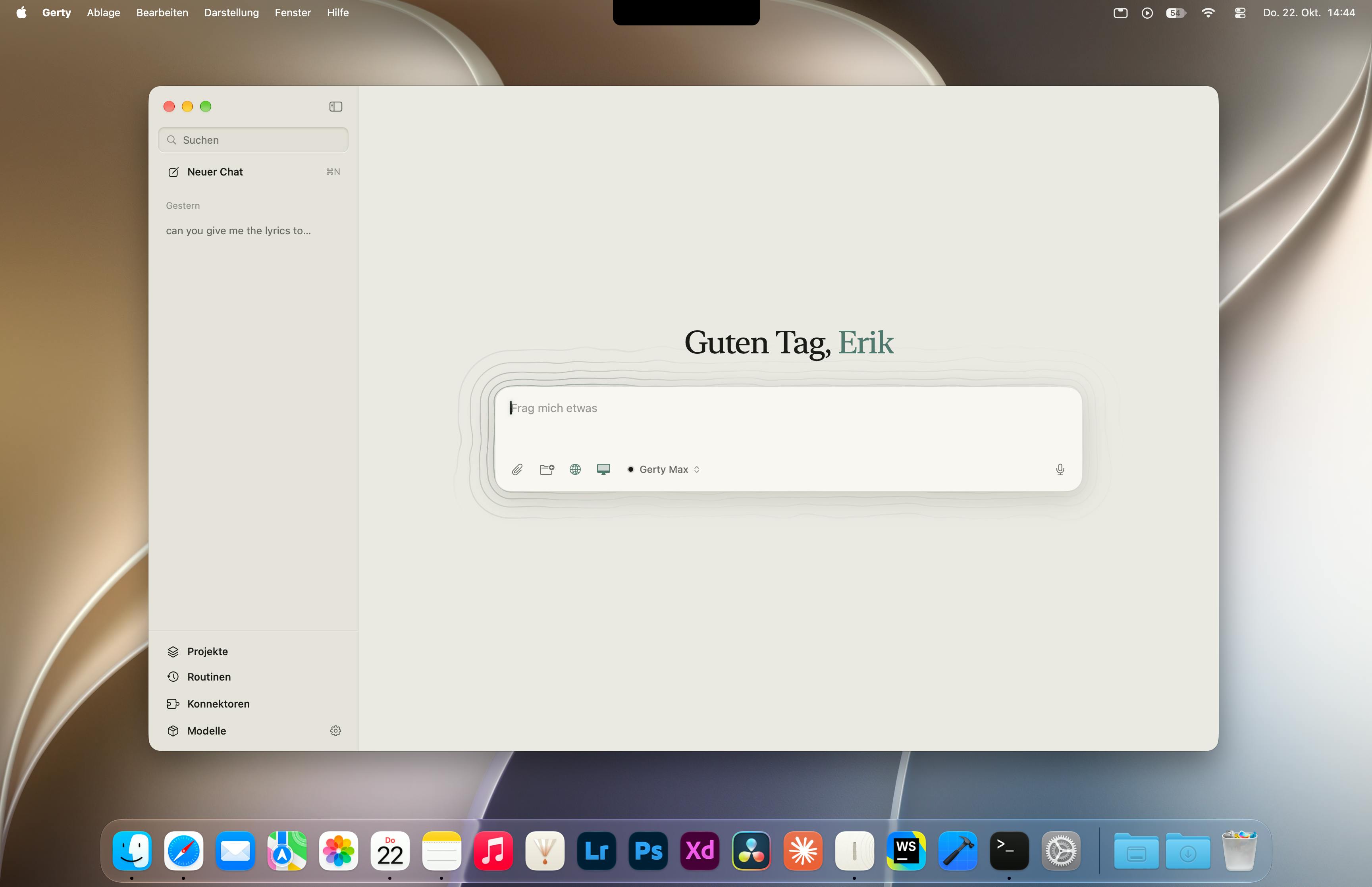
Gerty attempts to solve this problem. It is a private AI assistant that runs entirely locally on a Mac, requires no account, does not connect to the cloud, and can even work offline. According to its Product Hunt page, Gerty automatically detects your Mac's hardware configuration, selects the most suitable open-source models for different tasks (chat, writing, code, image understanding, and generation), and downloads and configures them into a unified assistant. No terminal operations or complex setup steps are required.
Auto-Configuration: Making Local AI Run Without the Hassle
The barrier to running large models locally has always been high. Users need to choose models, configure environments, and tune parameters themselves, which is extremely unfriendly to non-technical users. Gerty's core selling point is precisely "auto-configuration"—it measures your Mac's performance and then automatically matches the best combination of open-source models.
Behind this is an assessment of hardware (such as CPU, GPU, and memory) and model scheduling for different task types. For example, chat might use a smaller conversational model, code generation might use a dedicated code model, and image tasks might call multimodal models. Users do not need to worry about these details; Gerty packages them into a single assistant.
According to the official description, Gerty supports handling documents, emails, and calendars, and also allows voice questions. More importantly, it shows a preview before making any changes, letting users confirm before proceeding. This "transparent and controllable" design is a plus for a local AI tool.
Open-weight Models refer to large language models whose weights are public and which users are allowed to download and run locally, such as the Llama, Mistral, and Qwen series. Unlike closed-source models that can only be accessed via API (such as GPT-4), open-source models give users full control over data flows and are the technical foundation of local AI assistants. These models usually offer parameter sizes ranging from 1B to 70B; larger parameter counts mean stronger capabilities but also higher memory and compute requirements. On a Mac, models usually run in quantized formats (such as 4-bit GGUF), compressing size and reducing memory usage by lowering numerical precision, at the cost of slight performance loss.
Unified Memory is a key feature of Apple Silicon (M1/M2/M3 and other chips): the CPU and GPU share the same memory, and the GPU can directly access system memory without needing to move data between VRAM and memory as with traditional discrete GPUs. This allows a Mac to run models far larger than its VRAM capacity—for example, a Mac with 16GB of memory can load a quantized model of about 8-12GB. Gerty's "automatic hardware detection" essentially reads information such as the chip model and memory size, uses it to determine how large a model can be supported, and makes trade-offs between speed and quality.
Model Routing refers to the mechanism of dispatching requests to different specialized models based on task type. A single model can hardly be optimal for dialogue, code generation, image understanding, and other tasks at the same time, so combining multiple models has become a common practice: general instruction-tuned models for dialogue, models trained on code corpora for coding tasks (such as the CodeLlama series), and multimodal vision-language models for image understanding. The routing layer identifies user intent and routes it to the corresponding model, transparently to the user. This approach sacrifices some memory (multiple models need to be loaded simultaneously or swapped in and out on demand) and response speed in exchange for better performance on each task. Gerty's claimed ability to "select the most suitable open-source model for different tasks" is precisely a productized implementation of this idea.
Pricing and Target Users
Gerty uses a one-time buyout model: 49 Swiss francs (CHF) for use on 3 Macs, with a 7-day free trial. Compared with monthly subscription cloud AI services, this pricing is friendlier to long-term users.
Its target users are clear: privacy-conscious individual users, developers, and scenarios that require offline work. It received 71 votes and ranked 18th on Product Hunt, indicating some level of attention, but with only 4 comments, community discussion is not yet very active.
Challenges and Opportunities for Local AI Assistants
Gerty represents a new direction for AI tools: localization, privatization, and automation. As open-source models improve in capability and trend toward smaller sizes, running a practical-grade AI assistant on personal devices is becoming feasible. But the challenges are equally obvious—the performance ceiling of local models, inconsistent experiences caused by hardware differences, and model update and maintenance issues all need continuous solutions.
For users seeking data sovereignty, Gerty offers a choice worth watching. However, because public information is currently limited, how it actually performs, whether model selection is reasonable, and whether resource usage is controllable still require more user feedback to verify.
Key Points
- Gerty is a fully local Mac AI assistant that requires no account, supports offline use, and emphasizes privacy protection.
- It automatically detects hardware and configures suitable open-source models, covering chat, writing, code, image, and other multi-task scenarios.
- One-time charge of 49 Swiss francs (3 Macs), with a 7-day free trial.
- Supports document, email, and calendar integration and voice interaction, and shows a preview of changes before operations.
- Local AI assistants have advantages in privacy and cost, but performance and maintenance remain challenges.
One-line Summary
Gerty is a private Mac AI assistant that runs fully locally and automatically configures open-source models, with a one-time purchase price of 49 Swiss francs.
Paragraph Summary
The article introduces Gerty, a private local AI assistant for Mac. In response to the privacy risks of cloud AI tools, Gerty runs entirely locally, requires no account, does not connect to the cloud, and supports offline use. Its core selling point is auto-configuration: after detecting Mac hardware performance, it automatically matches and downloads suitable open-source models for tasks such as chat, writing, code, image understanding, and generation, with no terminal operations required. The product also supports document, email, and calendar integration and voice questions, and shows a preview before executing changes. Pricing is a one-time 49 Swiss francs for use on 3 Macs, with a 7-day free trial. The article argues that local AI assistants have advantages in privacy and cost, but model performance ceilings, hardware differences, and maintenance and updates remain challenges to be verified.
Related articles

Giving Coding Agents Hearing: How AirShot Closes the Audio Feedback Loop
AirShot gives coding agents audio perception: pure CPU offline operation, CLI and MCP invocation modes, with MCP avoiding 20-40s model reload delays. Critic scores against 7 professional launch videos with timestamped suggestions, registers into Cloud Code without a GPU.

MCP Protocol Explained: Giving AI Agents Tools and Memory
MCP lets AI agents securely connect to Gmail, Slack, and other tools with persistent memory. This article explains the three-step loop—connect tools, add memory, define goals—and how it eliminates repetitive work, turning AI from a chat tool into a practical productivity system.

Don't Trust AI Agent Installs? RepoGates' Five-Gate Test in Practice
RepoGates uses five gates to guard AI agents' repo clones, package installs, and MCP server additions, covering browser, Clawed Code, MCP clients, checkup, and deep scan—each with its own blind spots.