Getting Started with AI Coding Agent Codex: How It Differs from ChatGPT and a Practical Guide

Codex is an AI agent that autonomously executes coding tasks, forming a "doing" vs. "talking" division of labor with ChatGPT.
The article introduces OpenAI's AI coding agent Codex, emphasizing that its core lies in autonomy—it can read code, fix bugs, run tests, and execute commands, rather than simply chat and answer questions. By comparing it with ChatGPT, it points out that ChatGPT is like a teacher responsible for explaining and generating code snippets, while Codex is like a partner responsible for getting hands-on in a project to complete full tasks. The article also discusses the shift in development models in the AI era: programmers move from writing code by hand to specifying requirements and reviewing and optimizing, and those best at specifying requirements to AI are the most efficient. Finally, it offers getting-started advice, including configuring the API, starting with simple tasks, and describing requirements clearly, and points out that mastering agent collaboration is the core competitiveness of future developers.
Title
Getting Started with AI Coding Agent Codex: How It Differs from ChatGPT and a Practical Guide
Meta Description
This article introduces the core capabilities of OpenAI's coding agent Codex, contrasts its fundamental difference from ChatGPT (talking vs. doing), analyzes why developers should learn Codex, and offers getting-started and practical advice.
Article Content
AI coding tools are evolving from "assisted coding" to "autonomously completing tasks." OpenAI's Codex is not just another chatbot—it's a coding agent that can roll up its sleeves and get work done. For developers, understanding its fundamental difference from ChatGPT is the first step into the era of AI programming.
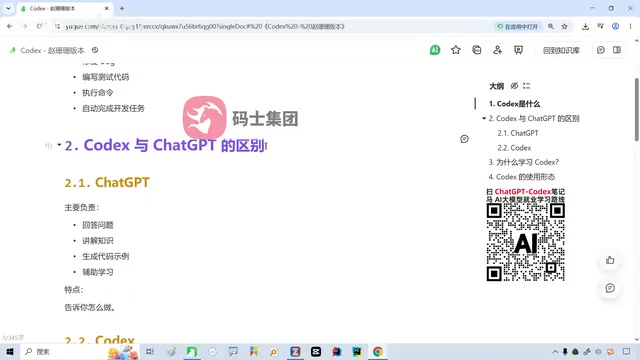
What Codex Is: An Agent That Goes from "Talking" to "Doing"
Codex is an AI coding agent launched by OpenAI. Unlike ordinary chat tools, the core of an agent lies in autonomy—it can read code, understand project structure, fix bugs, run tests, and execute commands and scripts. This means you no longer need to manually copy and paste generated code snippets; instead, you directly issue a task and Codex completes it autonomously within the development environment.
According to the Bilibili tutorial author, Codex is positioned as a tool that "does the work for developers," not a simple Q&A assistant. It relies on a large model under the hood (officially recommended to use the model used by ChatGPT), but its interaction style and capability boundaries are completely different.
Agent is a core concept in AI in recent years, referring to systems that can perceive the environment, make autonomous decisions, and take actions to achieve goals. Unlike traditional chatbots, agents not only generate text but can also call tools, execute operations, interact with the environment, and adjust behavior based on feedback. In programming scenarios, an agent can read and write files, run terminal commands, execute test suites, and even manage version control. Codex is a typical representative of this idea: it uses a large language model as its "brain" and translates intent into actual actions through tool-calling interfaces (such as the file system and command line). Understanding the difference between an agent and a chatbot is key to understanding Codex's capability boundaries—the former pursues task closure, while the latter focuses on information output.
The Core Difference Between Codex and ChatGPT: Teacher vs. Partner
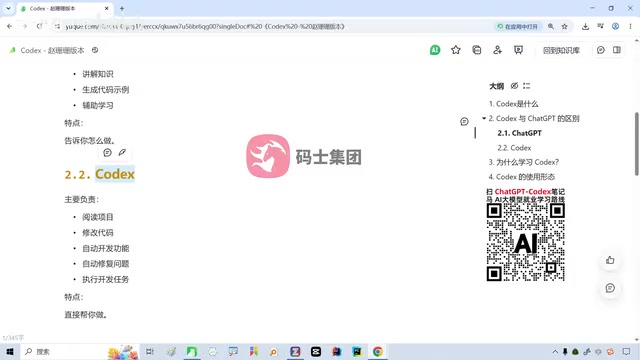
Many beginners wonder the first time they see Codex: "Isn't this just ChatGPT?" In fact, the two play completely different roles.
ChatGPT Is Like a Teacher: Responsible for Explaining
ChatGPT excels at answering technical questions, explaining principles, and generating code examples. For example, if you ask "How does Spring Boot implement a login feature?" it will explain the process in detail and provide code. But after generation, you need to copy and paste it into your development tools yourself and manually complete integration and debugging.
Codex Is Like a Partner: Responsible for Execution
Codex is like a programmer sitting next to you. You only need to say "Help me build the login feature," and it will autonomously read the project, modify code, generate new files, run tests, and debug errors until everything passes, then tell you "It's done." As the tutorial puts it: ChatGPT is responsible for talking, Codex is responsible for doing.
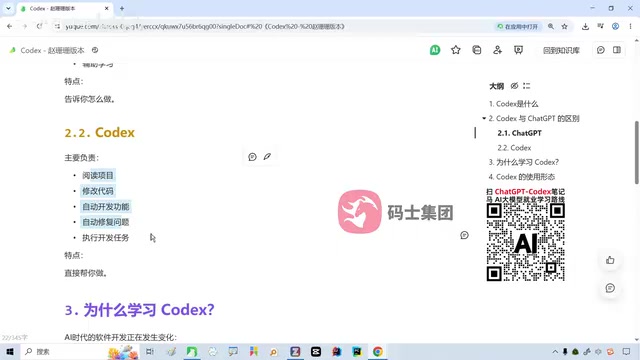
This difference determines the use cases: use ChatGPT for quick consultation, and Codex for complete task delivery.
API (Application Programming Interface) is a contract for interaction between different software systems. In AI coding tools, API usually refers to the way developers call cloud-based large model services through a key (API Key). As an agent, Codex's underlying reasoning capability depends on OpenAI's model API. Users need to configure an API key or log in to an account locally so that Codex can access the model and execute tasks. API calls are usually billed by usage (such as by token count), so understanding API configuration and cost management is necessary prior knowledge for actually using tools like Codex. In addition, the API also determines whether the tool can be integrated into existing development environments (such as VS Code or the terminal), affecting how smooth the workflow is.
Why Developers Need to Learn Codex
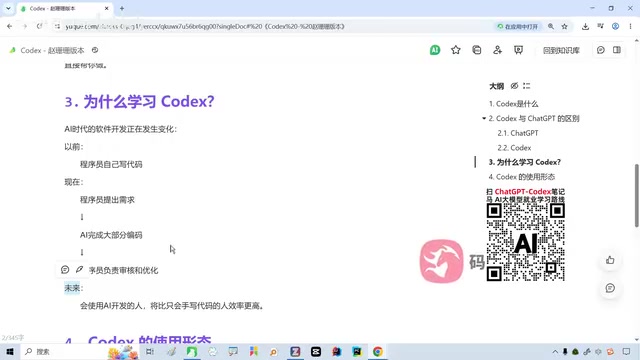
In the AI era, the development model is shifting from "writing code purely by hand" to "specifying requirements + reviewing and optimizing." Programmers no longer need to type code line by line; instead, they hand most coding work to AI agents and take responsibility for requirement definition, code review, and subsequent optimization.
The tutorial author points out that in the future, the most valuable people won't be the fastest coders, but those best at specifying requirements to AI. But this does not mean programmers will be replaced—if you know nothing about programming, you cannot review AI-generated code or optimize it. Therefore, learning Codex (or similar tools like Claude Code and Cursor) is key to improving efficiency and a necessary path to adapting to the new development model.
Getting Started Path and Practical Advice
The tutorial covers Codex's download, installation, registration, usage, and code examples. Although the original text does not detail the specific steps, from the characteristics of an agent it can be inferred: after installation, you need to configure the API or log in to an OpenAI account, then start Codex in the project directory and drive it with natural language instructions. In practice, it is recommended to start with simple tasks, such as "fix the syntax error in this file" or "add unit tests for this function," and gradually build trust in the agent's behavior.
Note that Codex's capabilities depend on the underlying model and project context. Clear and specific requirement descriptions can significantly improve task success rates. This is in line with the logic of "writing good comments" in traditional programming, except the target has changed from a person to AI.
Unit testing is automated testing in software development that verifies the smallest testable unit (usually a function or method). In the workflow of an AI coding agent, unit tests play the role of "acceptance criteria": after Codex modifies code, it can automatically run the test suite, judge whether the task is complete based on pass or fail results, and iterate fixes accordingly. Therefore, assigning tasks like "add unit tests for this function" to Codex not only improves code quality but also helps the agent establish a self-verification loop. Understanding the basic concepts of unit testing (such as assertions, test frameworks, and coverage) helps developers guide the agent more precisely and review whether its output is truly reliable.
Conclusion: The Value Boundaries of AI Coding Agents
Codex represents the direction of AI coding tools—from passive response to active execution. It will not replace programmers, but it will redefine how programmers work. The ability to collaborate with agents will become a core competitiveness for future developers.
One-line Summary
Codex is an AI agent that can autonomously execute programming tasks, forming a division of labor with ChatGPT: "doing" versus "talking."
Paragraph Summary
The article introduces OpenAI's AI coding agent Codex, emphasizing that its core lies in autonomy—it can read code, fix bugs, run tests, and execute commands, rather than simply chat and answer questions. By comparing it with ChatGPT, it points out that ChatGPT is like a teacher responsible for explaining and generating code snippets, while Codex is like a partner responsible for getting hands-on in a project to complete full tasks. The article also discusses the shift in development models in the AI era: programmers move from writing code by hand to specifying requirements and reviewing and optimizing, and those best at specifying requirements to AI are the most efficient. Finally, it offers getting-started advice, including configuring the API, starting with simple tasks, and describing requirements clearly, and points out that mastering agent collaboration is the core competitiveness of future developers.
Related articles

RAG Getting Started in Practice: From Principles to Building an Enterprise Knowledge Base
Bilibili RAG course highlights: from retrieval-augmented generation principles, document chunking and vectorization, to five accuracy factors and enterprise knowledge base boundaries, with fine-tuning vs RAG selection advice.

AI Model Selection Guide: DeepSeek vs. Qwen3 in Practice
How should AI developers choose models? Based on a Bilibili tutorial, this article breaks down the Function Calling differences between DeepSeek V3 and R1, Qwen3's programmatic thinking mode switching and agent capabilities, and outlines a multi-model learning path and practical selection logic.

Anchoring, Loss Aversion, and Nudges: 5 Psychological Tactics Retailers Use to Make You Spend
Behavioral economics reveals how retailers use anchoring, framing, loss aversion, and nudge theory to manipulate your spending decisions. This article breaks down 5 common psychological tactics and offers counterstrategies like slowing down decisions and setting your own anchors to see through the pricing design behind discounts.